


The Worst Time to Pause Agile Is During a Crisis
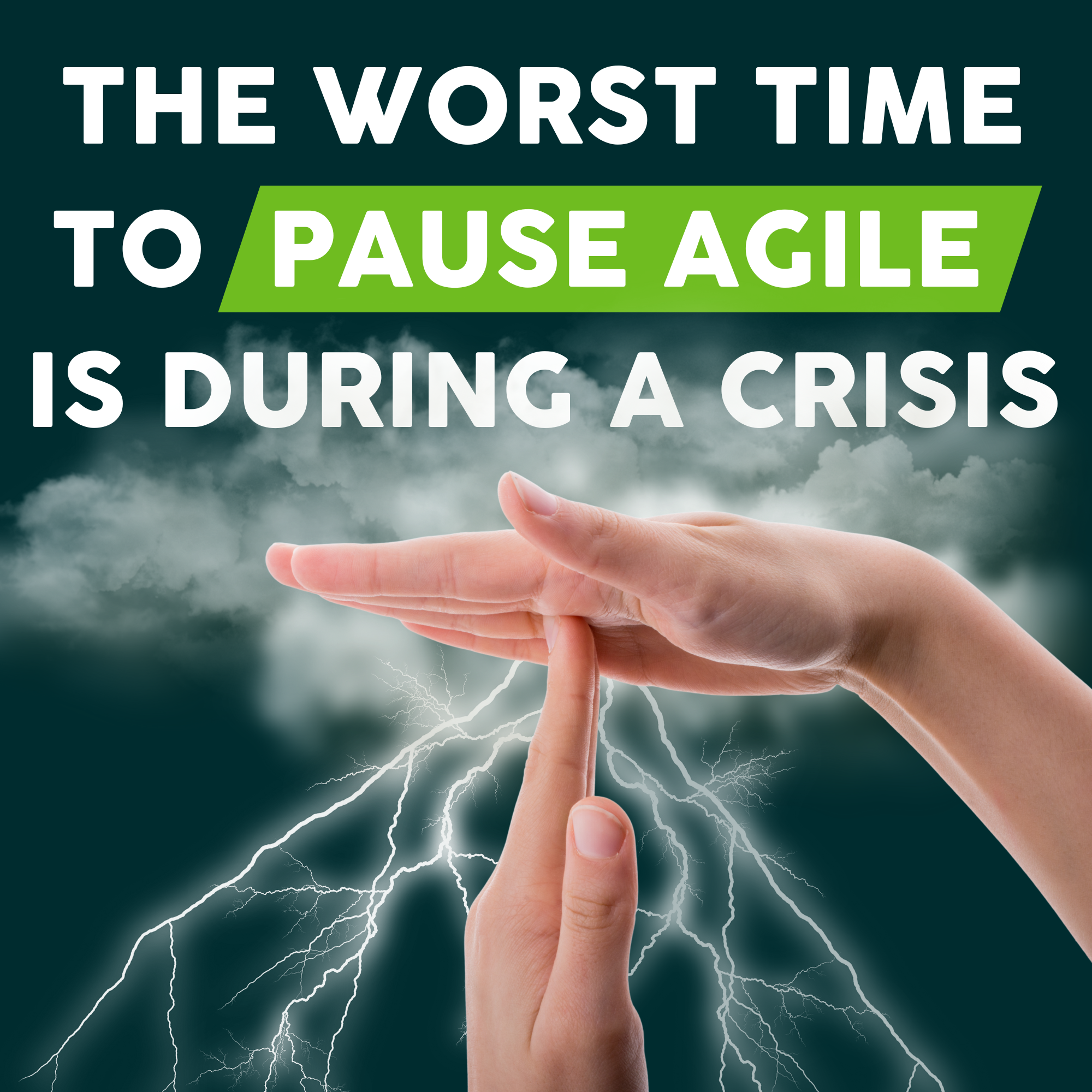
In this episode of The Agile Marketing Edge, Andrea tackles a critical issue: why pausing Agile during a crisis is a mistake.
Watch the Full EpisodeEpisode Transcript
All right, people, brace yourselves because this is a tough talk episode of The Agile Marketing Edge. I am not gonna pull any punches because this topic is serious. Here's the deal. This is a situation when far too many of our clients and prospective clients just walk away from Agile, even though it is the exact moment when they should be running right, toward it, and that is the moment when things blow up. There's a reorg or there's an acquisition, or the agency of record gets fired, or a new CMO comes in, or the product launch gets moved up by six weeks.
Whatever it is, insert your particular flavor of crisis here. It feels like there is no way you could do anything else right now, and so your Agile transformation gets paused, and the next thing you know, a year has passed and you are just as stressed, just as reactive, and just as behind as you were yesterday. And this is where the tough talk comes in.
When things blow up, that is the best time for agility. That is the best time to transform, and no, I am not joking. The rest of this episode is all about why. Welcome to The Agile Marketing Edge, the first podcast dedicated to turning Agile theory into real-world marketing breakthroughs. I'm Andrea Fryrear, CEO of Agile Sherpas, and your guide on this climb to smarter, faster, outcome-driven marketing. Every week, we unpack the what, who, and how behind Agile marketing, from building high-velocity workflows and slashing waste to measuring what really matters and scaling success across teams. You'll hear quick hit strategies you can deploy today, plus candid stories from marketers who have traded chaos for clarity and never looked back. Hit follow wherever you listen, and let's carve the next switchback together. Okay, you're still here, and I'm really glad you stuck around because this topic is super important, and honestly, it is why I stand at this microphone, like, every week, 'cause one of the reasons I started this podcast is to be able to say out loud the things that I am thinking all the time but I don't get the opportunity to say 'cause it turns out when you're the CEO of a consulting company, you hear about all the clients, the good, the bad, the amazing, the appalling. It nearly all finds its way to my ears or my inbox, so I see these patterns, but I don't really work directly with clients all that much, so I don't get an opportunity to point out the patterns very much, but now I have this microphone so I can point things out every single week, woo-hoo, and hopefully you find it helpful.
So, why should you stick with your plans to go Agile when things blow up? I'm gonna give you five reasons, each with a real story from a client or prospective client to try and illustrate my point.
So reason number one, you guys, Agile was made for uncertainty. Y'all, this is literally why we have Agile in the first place because the world started moving too fast for us to spend a huge amount of time planning and working things out before we release things to the world.
So you remember back in the olden days when software used to come on CDs, CD-ROMs, discs, used to get it in the mail or you used to have to go to the store and buy software? That's how we got it, and it used to take years and years for updates to be released and then you had to slide it into your computer and install updates. That's what used to happen. That's how it used to work, and this was pre-Agile, and so it would take years for things to come out and it would be things like Windows Vista, and it would come out and people, would hate it.
It would be not at all the features and functionality that people wanted because so much time would pass between people talking to end users and gathering their input and writing down requirements and then they would pass that off to a whole bunch of software developers who would then go and spend months and months or years and years implementing all of that input and all of those changes, and then long time later, it would get released, and in that amount of time, either huge amounts of misunderstanding would have crept into the work or people would have changed their minds or completely forgotten that that was the thing that they wanted in the first place, and so things would get released that were not the things that were wanted in the first place. So all this disconnect and dissatisfaction were showing up and it was this huge amount of waste, wasted money, wasted effort. Billions of dollars were wasted, just set on fire.... in the world of software development, and this is why Agile originally showed up in software development to fix these issues. And there are so many analogous situations that showed up in marketing as well, right? One of the most recent, uh, and more horrific instances is a couple of years ago, right? Peloton had that, uh, Christmas campaign where it was this huge video campaign, an ad buy and everything of the woman who got the Peloton bike from her husband for Christmas.
And the expression on the actress's face, right? People just roasted mercilessly because she was supposedly kind of self-documenting her fitness journey, and you know, "This is my first ride," and you know, it was like, her year of riding the Peloton. But she was already super thin, and so it was like, why is she on a fitness journey in the first place? And she had this kind of like, "I'm maybe being held against my will," kind of facial expression anyway, and just eviscerated on late night talk shows, and a huge amount of their market cap was erased, uh, when their stock price plummeted after the campaign was released.
So all of these, these kinds of huge investments without testing and learning and iterative releases, this is why Agile exists, right? And so if you are in the midst of a time of uncertainty, this is what Agile is for.
So the fact that something big and scary and unknown is happening is not an excuse to avoid adopting Agile. It is, in fact, the perfect time to do it. And so we've had clients who have chosen to pause or, uh, completely stop their Agile roll-out because there was an acquisition. Either they had been acquired or they were acquiring someone, and yes, that does introduce a lot of uncertainty. Nobody knows what the combined teams are gonna look like.
What is the tech stack gonna be like? Whose tools will be chosen? What are the new teams gonna be? Who's gonna stay and who's gonna go?
There is a lot of stuff that we don't know, but Agile is perfect for this. It is designed to help us understand what are the small steps that we can take to understand the emerging situation? How can we test and learn what the right things to do are? We can iterate. We can talk about what's working and what's not. So yeah, an acquisition is an unknown and scary situation, but that is perfect for Agile.
All right, reason number two, why Agile is a great option when things are blowing up, and that's because unusual situations give you permission to act in new ways. So maybe it's not uncertainty that you're facing, but maybe it's an unusual, kind of weird situation.
And that is a great time to launch new ways of working because the change is gonna give everybody the air cover that they might need to test out a new way of being. And this is really particularly true if you find yourself in a, an environment that has deep-seated cultural resistance, or you suspect there might be a lot of challenges, uh, to changing behaviors, or maybe you have a lot of psychological safety issues that you think might be present.
Having a situation that is really, really different is a great opportunity to give people a weird, new energy that can allow them to be weird compared to how they normally are.
So take advantage of it. Let them shake things up. This is a gift. It is not a, an excuse not to act.
And during COVID, I actually worked with a client for whom this would've been the perfect opportunity, the pandemic would've been the perfect opportunity to shake up how they usually did things. They were being asked to support the roll-out of the COVID vaccine, and they could have, and I think should have, used this as a time to set aside their usual ways of aligning themselves and structuring their teams, and kind of set aside their usual politicking. But unfortunately, they really brought all their normal baggage and behaviors with them, and there was a lot of urgency around what they were trying to do.
And instead of using that unique situation as a driver to change the way that they worked, they really kind of used it as an excuse to fall back into the way that they always did things, and to, mm, do what felt safe instead of leaning in to doing something in a new way. So use the new situation to do something new instead of using it as an excuse to cling to what you know.If you do that, then you can't expect a new outcome. So when things are new, use them as an opportunity to work in a new way, not as an excuse to go back to the things that you already know. All right. Reason number three why a time of change is the perfect time to embrace Agile marketing is the idea that you need to start as you mean to go on. And this phrase, this idea comes from the Kanban framework. It is a core concept of Kanban, because it is really hard to go back and undo something once it has been established. It is, in fact, much easier to just go ahead and start out doing things the way you intend to always do them. So if something happens to disrupt your Agile roll-out, and you think, "All right. We're just gonna stop, and we'll wait a little while and then go back and bring Agile in again later," don't stop.
Don't pause, don't think that you're gonna go and pick it up again later, because spoiler alert, you will not. I have been doing this for a decade now, and I can tell you that you won't.
Or if you are one of the rare, rare groups who does manage to come back and pick it up, you're gonna be nine months farther behind than you would be if you just did it now. And I'll give you an example from an actual client.
So they were making some good headway. They had some good momentum, and they had some excellent Agile practices up and running across multiple teams. They had done some of the really hard work of getting things started and taking the first few difficult steps, and honestly zero to one is some of the most difficult work. And they have done the zero to one work, but then they decided that they needed to fire their agency of record, and that's rough. Like that is a hard thing to do, and I completely get that. And so in the midst of all of that, they decided that while they were off-boarding their old agency of record, choosing a new one, and then on-boarding the new one, that they needed to stop all of the change efforts around ways of working. Frankly, I think that's a mistake. I think that they should have kept the changing ways of working in place so that when the new agency of record came on board, they could start as they mean to go on, and they would've had these established, well-oiled machine type ways of working up and running, already in place and beautifully established so the agency of record can just slot right in instead of now having multiple things that they're gonna have to try and figure out as they are on-boarding the new agency of record. I think it's a much easier thing to do to bring in a new agency of record into an established system instead of trying to change a lot of things in sequence now. So new agency of record, restart Agile ways of working, and now we're behind.
We're, we're a year later in our Agile change journey than we would've been if we would've just kept those wheels turning, and now we're gonna have to go back and do the zero to one work again.
We're going to have to do that really hard work again because we put it down. We put the Agile work down and lost all of that momentum. So better to keep it going than... and start as you mean to go on than to set it down and have to do all of that work again.
All right. Reason number four why you should keep going with your Agile implementation even in the midst of all kinds of crazy stuff is that keeping change chunked together will actually get it done faster. Now if you've been listening to the show for a few episodes, this is not a new concept for you because we have talked about this in previous shows. Batching change together can actually make the changes that you combine easier, and the caveat here' is that is if you have effective change management practices in place. So we're gonna say that again just to make sure that's hitting home. Batching multiple changes together can make both changes easier if you have effective change management practices in place. So let's think about how this might work. If you have a focused, well-managed, 12-month change effort with solid executive support, good internal comms compared with a two to three year consecutive...... set of changes, so we're doing two to three different change efforts, that's gonna feel very different than having a focused, one-year batched change. If you batch those things together with strong executive support and really good comms, then it's done, and the change is complete, and people can internalize it and keep going. People can settle down to just getting work done. They can drop into an easy gear and just execute. Otherwise, if you're in this consecutive change of two to three years, people feel like change is always happening. It's never over. And yes, there will always be something else happening. If it's not AI, it's a new piece of technology, or it's a strategic change, or it's a reorganization, and so yes, there will always be some kind of adjustment that people need to internalize. But if we're talking about a major, major change initiative, you do need to be leery of having them one right after the other, one after the other, after the other, after the other, because people will get burned out on them. And I can give you, again, an example here. So we have had clients who would, who have been a third to halfway through a major Agile, transformation effort, but then a reorganization gets announced that they, perhaps, have no control over.
It's a mandate from on, high, from the executive level. And so they, they pause or potentially cancel an Agile transformation while this reorg gets implemented and the trickle-down effects kind of work their way through the system. Well, what happens is, people think whatever the next change that gets announced is, they can just wait it out because something else will happen, something else will show up that will disrupt it or cause it to get canceled, and so they don't have to commit. They don't have to get on board. They just have to wait it out, and that is really gonna hurt y- all of your change management efforts. And so figuring out a way that even if another disruptive change gets imposed on you, like a reorg, how can you batch these?
How can you make them work together so that you can accomplish the goals of both simultaneously?
This is gonna require strong executive sponsorship. It's gonna require really effective change management and internal communications. Not saying this is easy, not saying this is an overnight kind of thing, but you have to think about what this, what kind of message this sends if you say, "All right, something disruptive and, and difficult happened, and so we are going to pause or cancel a major effort that we invested a lot of time and money and effort in." It tells people that nothing is certain, and you can probably just wait out something. Whatever it is, if you don't like it, just wait long enough and it'll go away. Whatever the next thing is there, someone is just gonna dig in their heels and wait for it to go away. It's not a good look. So commit if you're committed.
Hold the line because it... otherwise, you're gonna undermine your credibility for the next thing. All right. Fifth and final reason that you need to hang on even in times of craziness, commit to your Agile transformation and stick with it is very much related to maintaining your political capital is because if you step back and walk away from Agile, you are not gonna get buy-in again. And this is related to when you have a significant change at the senior leadership level. And I don't ever get to say this one out loud, so I'm really happy to have this kind of opportunity to talk about it because every time this happens, I think it, but I don't usually get to say it. But if you are ready to champion Agile, if you are ready to say, "We should do this. We should implement these ways of working because they're important, and they are going to help us be more effective as a marketing organization," but then as soon as a new executive comes in, you back off, I don't think this is a good look for you. I think that if you really think that this is critical, you hold your ground.
And I think this goes for any big effort that you were ready to put budget and energy behind. If you aren't willing to go to bat for it when a new senior leader comes in, I think that means you don't believe in it enough. And they're gonna see that, and they're never gonna reauthorize it. That line item is out of the budget forever. It's not coming back.
And they've got their own ideas. A new senior leader is gonna wanna come in and put their stamp on things, but they also want to have some degree of continuity. They want to be able to get the buy-in, and they want to be able to collaborate effectively with the people who are s-... still in the organization. And if you can make your case, and you should be able to make your case, for why Agile is important, then make your case. And you should be able to tie an Agile transformation to the ability for this new senior leader to make a quick impact. Because the antidote to having Agile be immediately cut as a large initiative when a new senior leader comes in, is that Agile, of course, should be tied to business outcomes. So for example, if a senior leader comes in and you're able to say something like, "If we cut down on the wasted effort in marketing, we could release 30% more campaigns, which would then release, which would then generate 30% more MQLs, which would correlate to about a million dollars in gross revenue."
Well then, of course, should we delay that million dollar gain for six to nine months while this new senior leader gets onboarded? No, of course not. Or should the Agile transformation that was going to be earmarked for this next quarter get completely cut and we should just walk away from that potential million dollars in additional gross revenue?
Nobody's gonna say that we don't want to do that. But if the only description of this effort is, "We would like to pilot Agile marketing and that project costs $50,000," of course it's the first thing on the chopping block. I'd be looking to cut that line item in my budget too. You have to be able to document and show the potential ROI for this kind of work.
And I'm an Agile consultant and I wouldn't want to invest $50,000 in this kind of work if you couldn't tell me the impact that you expect it to have. And, good news, if you are struggling with how you might quantify the value of implementing something like Agile marketing, I got numbers for you. We have, with clients, documented a million dollars in productivity savings in under three years. Not making these numbers up, a million dollars in productivity savings in under three years.
That is a real thing that you can have happen by using Agile marketing. We have had a 32% decrease in the planned costs of executing marketing work. If you're worried about keeping around your best people, we have had a 17% increase in year over year employee satisfaction scores. We've had a 35% increase in the annual number of projects completed. If you feel like your work is just sittin' around and nothing's getting done, 35% more projects getting completed every year. And in case you're wondering if this is worth it as an individual contributor, 94% of marketers who have worked in an Agile team do not ever want to work any other way.
And these are just a few stats from a few of our clients, and all specific to marketing. There are more holistic studies out there from McKinsey and BCG about the impacts of business agility more broadly if you want to branch out and look at things even more holistically. We've got case studies and we have got tons of data at agilesherpas.com if you need some more ammunition to document your case. The important thing to remember is that disruption should not be an excuse to delay or derail your adoption effort, especially if you can tie it to these kinds of business outcomes. If anything, times of disruption are the time to accelerate your adoption of Agile.
And of course, as always, in times of disruption or times of smooth sailing, the Agile Sherpas team is here to help anytime you are looking for a partner on your Agile marketing journey. Until next time, I'm your host, Andrea Fryrear. The struggle is real, but so is Agile marketing.
Enjoying The Agile Marketing Edge?
More From The Agile Marketing Edge
Episode Library →
The Agile Marketing Edge Podcast offers insights on how to make Agile actually WORK for marketing teams. Browse the entire episode library.
Episode 20: How Agile Saves Marketers from AI Chaos →
Learn why there is a critical need for rapid experimentation, prioritization, and adaptability in the face of AI's unpredictable evolution, and why traditional marketing approaches simply can't keep up with the rapid changes AI brings, leaving teams overwhelmed and ineffective.
