


The Collaboration Gap Killing Marketers
In this episode of The Agile Marketing Edge, Andrea dives into the collaboration challenges plaguing marketers, sparked by my critique of the new Manifesto for Enterprise Agility. While it presents agreeable values, it lacks the teeth needed to drive real change.
Watch the Full EpisodeEpisode Transcript
When is the last time that you read a document that you agreed with completely, like every single sentence, and yet you walked away feeling vaguely annoyed? That was my experience reading the new Manifesto for Enterprise Agility, which was recently published by PMI and the Agile Alliance. Now, it is a beautifully designed document, thoroughly researched. They surveyed seven hundred-plus C-suite leaders. They interviewed 30 executives. They examined forty-nine existing manifestos and frameworks. And it contains sentences like, "Guiding with purpose and adjusting along the way outweighs over-planning and the illusion of control," which is true, technically. But here's my problem, which I originally posted about on LinkedIn and will now be ranting about a whole lot more. A manifesto that generates zero pushback is not a manifesto. It's a poster with better typography.
The original Agile Manifesto worked because it named contested trade-offs, things that the people using Agile frameworks actually argued about. It had teeth, and I just feel like this one does not. So here's what I wanna spend today's episode on, because I think there's a more interesting question that is hiding under my original critique. If I say I want a manifesto with teeth, what does that really look like? In other words, what are the uncomfortable, specific, unwelcome things that Agile has to tell organizations about collaboration that they really need to hear in 2026?
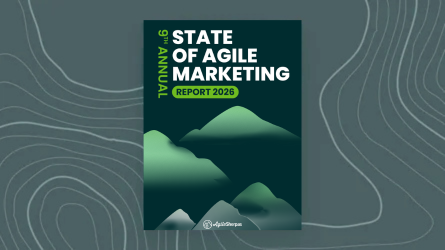
Today, that's what I wanna explore, not the values that everybody nods along with and then doesn't really change anything, but the data that makes people squirm in their chairs because they realize it's gonna force them to take a big old swing if they want a chance at a home run. Because, haha, coincidence, we now have that data. Our ninth annual State of Agile Marketing Report just dropped, and the collaboration section in particular is full — chock-full of — exactly the kind of specific, super uncomfortable findings that good discomfort-causing manifestos are made of.
All right. So let's get comfortable. I mean, haha, uncomfortable, people.
Welcome to the Agile Marketing Edge, the first podcast dedicated to turning Agile theory into real-world marketing breakthroughs. I'm Andrea Fryrear, CEO of Agile Sherpas and your guide on this climb to smarter, faster, outcome-driven marketing. Every week, we dig into the what, who, and how behind Agile marketing, from building high-velocity workflows and cutting waste to measuring what actually matters and scaling success across teams. Today, we are using our own research to do something the PMI manifesto didn't: name the specific hard trade-offs in how teams actually collaborate and what it costs when you get it wrong.
First, let me be fair to the PMI Agile Alliance document before I push back on it. The research behind it is legit. Two global C-suite surveys, thirty-plus executive interviews, a public feedback board. They synthesized forty-nine different enterprise agility frameworks. That is not nothing. And the four values that they land on — clear purpose through adaptive plans, shared enterprise outcomes over functional optimization, continuous reinvention over preservation, human centricity amidst change — these values, they're not wrong.
But here's the thing about values like these. Nobody is arguing for the opposite of those things. Nobody is out there saying, "Woo, departmental silos over enterprise outcomes," or strongly making the case for rigid efficiency over adaptability. So when you write a manifesto around things that are technically true but practically uncontested, all you've really done is document consensus, and consensus, in my experience, does not change behavior, and that's what we need is behavior change. And it certainly does not feel like a manifesto.
I mean, the document does have also nine principles, and to be fair, a few of them have a little bit of teeth, but the teeth they do have just aren't very sharp. Like the phrase, "Govern with clear guardrails, not gatekeepers." That's kind of specific, but most people would say they do that now. I'm pretty sure that all the people who would get labeled as gatekeepers by somebody else would adamantly deny that they themselves engage in gatekeeping behavior. So how are you gonna get them to not gatekeep if they don't think they do it right now?
And then we have the phrase, "Fund purpose and intent, not execution activity." It sort of feels like that names a real trade-off and might force a real change in behavior. But again, you can easily make the case that you're already doing this, no matter what your behavior is actually day to day right now. Because I can see and hear in my head the most change-averse executives that I have ever worked with, the ones who would rather be dragged by their toenails through a sticker patch than adopt Agile, those people would tell you with 100% belief that they are already doing this. And they would also say they are doing many of the other things in this manifesto. They would tell you those things with a straight face, and they would believe it. And it's because by the time you get to the end of this manifesto, the elaboration parts have really softened any of its edges.
And so by the time you're done reading, you've agreed with everything, and you feel good because, hey, look at that, you have already achieved enterprise agility. But then you also feel kind of bad because apparently you have achieved enterprise agility and things are still not working, so apparently Agile isn't the answer and doesn't help. And I feel like this is one of the reasons that people conclude that Agile is dead, or it doesn't work, or provides no ROI, or whatever other nonsense you may hear. And it's why documents like this tend to give me hives and make me all twitchy. Because it reinforces this belief that, oh, we're already doing all these things. We're already Agile, I guess. And so it's not working. It's not making things better, so it clearly isn't the answer.
And honestly, this is why we do our State of Agile Marketing report. We don't just say, "Hey, collaboration is important. You should do it." We really dig in and ask who is being successful at collaboration, who is not, and the important part, who thinks they're doing it well when they're probably not, and what does that look like? And this last part is where maybe it is a little bit uncomfortable. I think that is what a manifesto should do — point out the difference between good and bad, and how do you bridge that gap — and call people to action to jump over that gap if they really want to be able to say that they are being and doing Agile. They want the label, they've gotta do the things.
So here's the headline from the collaboration section of this year's report: "92% of marketers experience collaboration challenges." So basically everybody, every marketer everywhere experiences collaboration challenges. If you are hearing that and thinking, "Yep, sounds about right," let's all just sit with that for a second. Because we're not talking about a segment of struggling teams in B2B or B2C or in a particular industry or a particular function. We are talking about near-universal pain in our role. So basically, cross-functional collaboration in marketing is broken as a default, not as an exception. That's sad, but here's where it's gonna get interesting.
The top challenge faced by non-Agile marketers is slow approvals and bottlenecks. 46% of them named that as their top challenge. For Agile marketers, only 32% named slow approvals and bottlenecks as their top challenge. What that 14-point gap tells us is that this is a process problem. Slow approvals are fundamentally a structural friction issue. You do not have the right workflows, the right decision rights, the right visibility into where things are stuck, and Agile solves that, not perfectly, but measurably, demonstrably solves that.
But here's the thing about Agile marketers' top challenge, because it wasn't the same as non-Agile marketers. The top challenge that we heard from our Agile marketing respondents was capacity mismatches. 40% of Agile marketers said capacity mismatch was their top challenge, which means their team has solved the process problem. They are moving fast, iterating, delivering, and now their biggest obstacle is legal, IT, sales, product. The departments that they depend on and collaborate with are not keeping in sync with them. They are not built the same way.
So if it was me trying to write a manifesto with teeth, I would say this out loud in like bold type with lots of underlining and arrows pointing at it. Solving the process problem inside your team creates a new coordination problem with every team around you. If we're really talking about enterprise agility, like big, giant flashing lights around this, we cannot optimize at the team level — is a ridiculous thing to do. Agile adoption at the team level without any movement at the organizational level creates a capacity and speed mismatch that eventually just becomes demoralizing. Your team is ready. Nobody else is. That is not a motivation problem. It is a structural one.
And can we pause for a second and just be like, "It's 2026, y'all. How many years ago did the OG Manifesto come out?" Like a long time ago. We're talking in decades now, and this is still an issue. We still have capacity mismatches at the team level. The PMI manifesto, the new one, talks about shared enterprise outcomes over functional optimization. We need that, but we haven't even got team-level stuff right. We are still having team-to-team mismatch. We have to get this stuff right before we can even think about enterprise-level optimization. So if we want shared enterprise outcomes over functional optimization, that kind of great value, true value, there's a lot of work ahead.
And so what does this mean in practice? It means that a department's functional Agile transformation, whether it's marketing or somebody else's department, it's gonna fail. Agile is gonna fail at the department level. It's gonna fail to reach its potential until the departments that are around you, those that you collaborate with, change too. That is the uncomfortable version of that value that we see in the PMI manifesto, and our data backs that up. So for orgs who have left functions like marketing out of their Agile transformation, y'all are in for a world of hurt because you cannot go faster than your slowest component, and everybody's gonna get slowed down when you are leaving people out of the Agile transformation.
It's time to say the hard things out loud. The next quiet thing that we need to say out loud is that the perception gap is doing a lot of damage to teams. And this is a finding that I kept coming back to in the report because I feel like it was not obvious, but really, really important because here's how it goes. We asked marketers in our report, "How effectively does your team work with other departments?" Non-Agile marketers, 74% of them said very or mostly effective — so three-quarters. Agile marketers, 85% said very or mostly effectively. At first glance, an eleven-point gap, mm, maybe not that dramatic. You might read it as, you know, non-Agile teams, they're doing okay, and Agile teams are doing a bit better.
But here's why I think that reading is wrong and why other parts of the report say so explicitly. Non-Agile marketers are almost certainly overestimating how well they collaborate. And now, here in this report, we did not survey other departments. We didn't ask legal or product or sales what they actually think about working with their marketing teams, but I got strong reasons to believe that these self-assessments might be off. Now, here's the evidence. We asked a separate but related question: How reliable would other departments say marketing is when working toward shared goals? Agile marketers, 80% would be extremely or very reliable. Non-Agile marketers said others would say they are extremely or very reliable only 66% of the time. That's a fourteen-point gap in perceived reliability, and that's marketers estimating how others see them — not self-rating their own work. So when you ask marketers to take that outside view, the gap widens significantly.
Then we layer in other data points. Eighty-nine percent of Agile marketers say Agile helped them respond more quickly to requests from other departments. Eighty-three percent say Agile increased internal stakeholders' trust in their team's predictability. Those are outcomes generated by a specific set of Agile practices, things like visible workflows, regular delivery cadences, transparent prioritization. Non-Agile teams just don't have those structural trust builders. So they might think they're collaborating well, especially if they've never experienced Agile ways of working and they don't know what they're missing. They just don't have a better point of reference to realize how untrustworthy they actually are in the eyes of their partners. But their partners may tell a different story.
And when we work with private clients, we survey those partner stakeholders, and I can tell you, those stakeholders always tell a different story. Their survey results are wildly different when the marketers are not using Agile yet. This is a manifesto-worthy finding. Not "collaboration is important," but "your team may be significantly overestimating how collaborative you actually are, and there's no way to know without asking the people you're collaborating with or building systems that make the work visible enough so that trust builds on its own." A flat statement of shared outcomes over functional optimization doesn't tell you this. Data can.
Okay, now let's talk about what Agile actually does, and most of the time it is not what the pretty poster says. Here's another thing I think is worth naming directly. The reason that Agile marketers collaborate better is not that they just value collaboration more. It's not that they're nicer people or more intentional humans. It's just structural. Ninety-nine percent of Agile marketers say Agile improved their ability to collaborate with other departments in our survey this year. Ninety-nine percent. We surveyed four hundred and thirty marketers. Like that's nuts in terms of statistical significance. Eighty-nine percent said it improved the quality of their communication. These are not soft outcomes. They are downstream results of specific Agile practices. When you make work visible, when you hold regular reviews, when you clearly define what done looks like before you start the work, when you have a backlog that stakeholders can see and influence, trust is a byproduct of that system, not a value on the wall that you have to remember to act on.
This is the part of the conversation that fluffy manifestos consistently skip. They name the values, they describe the principles, but they don't explain the mechanism. "Move authority and decision-making to where value is created" is one of the PMI manifesto's nine principles, and it's right, but what does that look like on a marketing team specifically? It looks like a prioritization system where the team makes the call on what fits in the next sprint, not the CMO making ad hoc requests that override everything else. It looks like a capacity model that makes "we do not have room for that right now" a visible fact, not a feelings-based negotiation. It looks like retrospectives where the inevitable collaboration friction gets named and addressed on a regular cadence, not a quarterly all-hands where nobody says anything real. The mechanism matters. The values are an aspiration. Practices are how you get there.
Now, I do want to be honest about something as we near the end of this episode. I am probably harder on documents like this one than they deserve. I know why manifestos get written this way. You want broad endorsement. You want to speak to a broad swath of industries and organization types. You need the seven-hundred C-suite survey respondents to recognize themselves in the values. You cannot have the CEO of a big pharma company and the CEO of a fifty-person software startup reading the same document and feeling like it doesn't apply to either of them. So you abstract, you generalize, you write sentences that are technically true and technically very agreeable. I get it. I have written content for big audiences. Specificity is the enemy of scale, and scale is the goal.
But here is the tension. Specificity is also the only thing that actually changes what somebody does on Monday morning or in their next board meeting. Our collaboration data is very specific. It says non-Agile teams think they collaborate well, but they don't. It says solving your own team's process problems creates new coordination friction with everybody else. It says forty percent of Agile marketers are stuck, not because of their own practices, but because they're the speedboat in an armada that is still rowing. Those findings may not feel very inspiring sometimes, but they do feel true. And that's the difference between a document that gets passed around on LinkedIn and a document that I really hope gets used to make a difference.
Speaking of which, here's what you can do with this data. First, of course, if you have not read the collaboration section of our ninth Annual State of Agile Marketing Report, please go read it. It is free to download and easy to get. I don't want you to read it to validate what you're already doing. That is not the point. I want you to read it to benchmark honestly and think about that perception gap finding in particular. Do you actually know how the departments you work with experience your collaboration? If you don't, go find out. Ask a stakeholder this week. Reach out to me, and I will give you our stakeholder survey for free. You can send it to them and find out what they really think. It's probably worse than you think.
Second, identify which problem your team actually has. Is it a process problem? Slow approvals, unclear workflows, requests that disappear into black holes? Or is it the coordination problem where your own team is running well, but the organizations around you are not? These require very different interventions. Do not throw sprints at a capacity mismatch problem.
Third, and I'm sorry to say, this is the harder one. If you're not Agile yet or you're early in your adoption, you gotta ask yourself, "Does my team have any structural trust builders in place?" Visible work, regular delivery touch points, a backlog that stakeholders can actually see. You need these because "we value collaboration" is not a structural trust builder. Reliable delivery cadences are. So not a transformation — an experiment. Pick one of these three and do something about it this week.
Until next time, I am Andrea Fryrear, and remember, the struggle is real, but so is Agile marketing.
Enjoying The Agile Marketing Edge?
More From The Agile Marketing Edge
Episode Library →
The Agile Marketing Edge Podcast offers insights on how to make Agile actually WORK for marketing teams. Browse the entire episode library.
Episode 29: How Marketing Teams Get 3X Better AI Results →
Explore how marketing teams can achieve three times better AI results. The secret isn't in having the biggest budgets or the most advanced tech stacks; it's about readiness and structure.
