


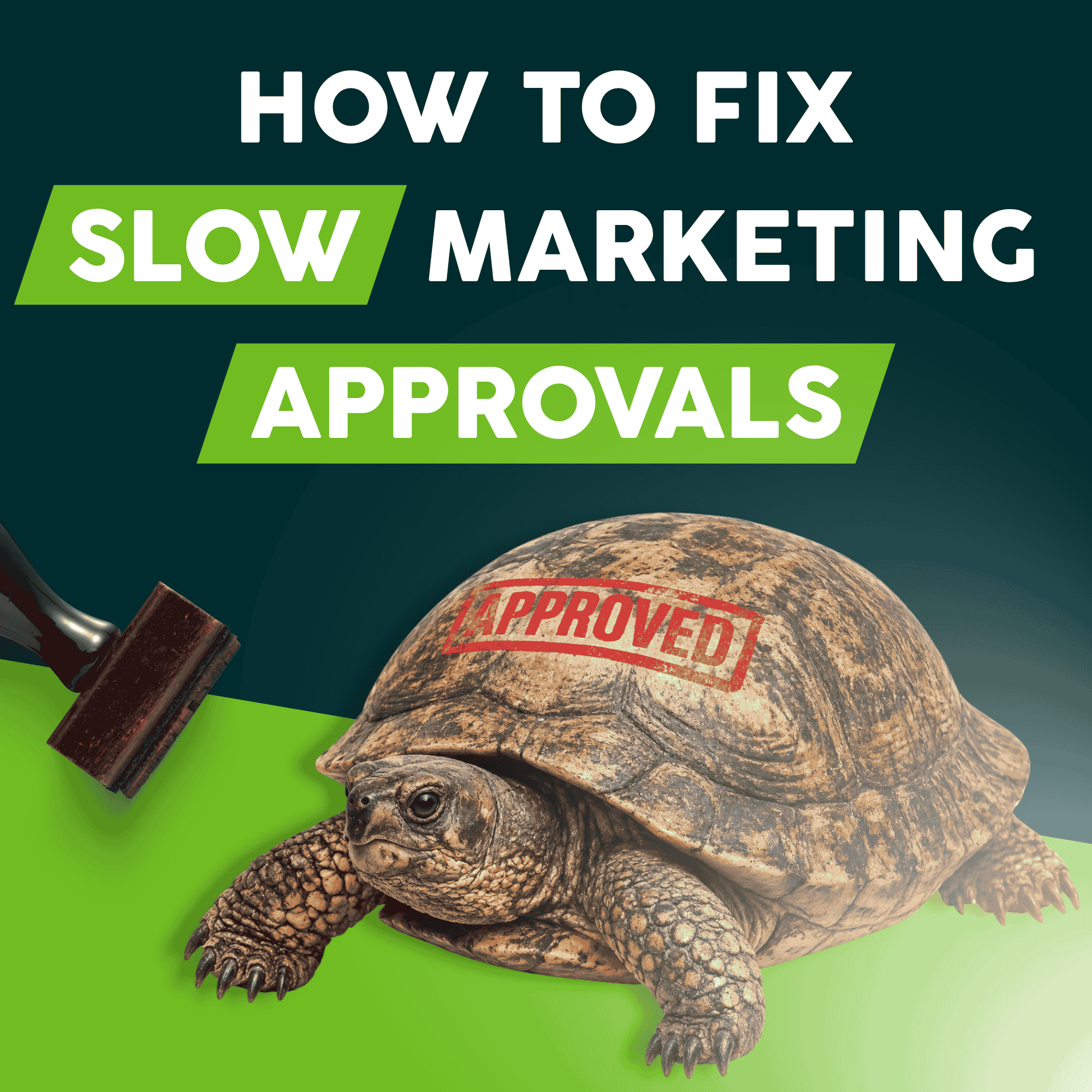
How to Fix Slow Marketing Approvals
In this episode of The Agile Marketing Edge, we focus on the pervasive issue of slow marketing approvals and their hidden costs. Drawing insights from our latest State of Agile Marketing Report, Andrea reveals how approval bottlenecks are the top collaboration challenge for non-Agile teams and still a significant hurdle for Agile ones.
Watch the Full EpisodeEpisode Transcript
Here's a scenario that might feel familiar. Your team has done the work. The brief was solid. The asset is good. Honestly, it's better than good, and now it's just sitting. It' is sitting. in someone's inbox, and it has been there for three days, waiting. It's waiting. for a sign-off that may or may not arrive before the campaign window closes entirely.
And while it's sitting there, your team is now context switching to something else, but half their attention is still sitting over there, on the thing that is in inbox limbo.
Momentum is gone. The energy is gone, and if the window closes before you get that sign-off, you're gonna spend another two days re-briefing for a slot that might not be as good anyway.
Sadly, this is probably not a one-off. It's just Tuesday. According to our ninth annual State of Agile Marketing Report, slow approvals and bottlenecks are the number one. collaboration challenge for non-agile marketing teams.
Not misaligned priorities, not tool incompatibility, approvals. Almost half, 46%, of non-agile marketers named it as their top friction point.
But here is the sad truth that we're gonna dig into today. This is not just a non-agile problem. Agile teams do better on this metric, but better still leaves room for real damage, and more importantly, most teams are treating approvals like they're some kind of quality control mechanism when they're actually something else entirely.
So today, we're gonna talk about what approval culture is really about, why it is costing marketing leaders way. more than you realize, and what it' actually takes to redesign it. This is not an episode about how to get sign-offs faster.
It's an episode about questioning whether your current approval architecture is solving the problem that you think it's solving. Welcome to the Agile Marketing Edge, the first podcast dedicated to turning Agile theory into real-world marketing breakthroughs.
I'm Andrea Fryrear, CEO of Agile Sherpas and your guide on this climb to smarter, faster, outcome-driven marketing. Every week, we dig into the what, who, and how behind Agile marketing, from building high-velocity workflows and cutting waste to measuring what actually matters and scaling success across teams. So lace up those virtual hiking boots, limit your WIP, and hit subscribe wherever you listen 'cause it's Time to Climb.
The data from this year's State of Agile Marketing Report, paints a clear picture of what's holding marketing teams. back from true collaboration, and slow approvals. are sitting at the top of that list. Today, I wanna go beyond the data point. and into the organizational psychology behind why approvals become bottlenecks in the first place. Because until you understand the root cause, any fix you try is just gonna be a band-aid.
But let's start with the numbers because I wanna be precise about what our data actually shows and what it really doesn't.
So 76% of Agile marketers say their teams can make decisions and move work forward without unnecessary approvals.
For non-agile marketers, that number drops to 66%. On the surface, sounds like a solid Agile win, and it is. But let me flip this around for a second because that means 24% of Agile marketers, nearly one in four, are still getting stuck in unnecessary approval cycles.
Even on teams that have committed to Agile ways of working, a meaningful chunk of people are still experiencing this friction. And lest we' forget, Agile marketing teams only made up 25% of our respondents this year, so the vast majority of marketers out there are trapped in approval hell. So whether you are on an Agile team and listening to this or you're on a non-Agile team, this is your problem.
So the question really is whether your organization has done the really hard work of designing how decisions are getting made.
Agile practices can create the conditions for that redesign to happen. They're not gonna do the redesign for you, and that distinction's really important. So you can run sprints, have retrospectives, and have this beautifully prioritized backlog and still have a VP who needs to personally approve every piece of coffee.
Copy. Also maybe coffee, but the copy is really what the problem. is. If you've still got a VP who needs to look at everything before it goes out, you've got an approval problem. The Agile practice then exists in tension with the approval culture, and over time, guess who wins?
Culture every time. I've seen it happen way too many times to even count it. And ultimately, this is a how plus who problem within the Agile marketing operating system. The how, your process, and the who, specifically your organizational decision-making structure, end up misaligned.
And sadly, you're not gonna be able to fix it by only optimizing one half of that equation, so we gotta talk about both today.And next, we've gotta have a little bit of a contrarian take for you to think about because most of our approval processes are not actually there to improve quality. They' are there to distribute anxiety.
When a leader insists that everything has to go through them for sign-off, the stated reason is usually quality control, brand consistency, risk mitigation.
Those are legit concerns, but if you trace most approval requirements back to their origin, what you're gonna find is somebody got embarrassed once.
Something went wrong. A complaint landed hard, and the response was to add a gate.
But the gate does not solve the underlying problem. It just means that the next time something goes wrong, the person at the top of the approval chain can say, "I reviewed it." So the anxiety has been redistributed from the doer to the approver.
The quality problem, whatever it ultimately was, usually has not been addressed at a structural level.
And this is where Daniel Kahneman's work on fast and slow thinking gets genuinely useful for marketing ops people, not as like an abstract psychology lesson, but really as a diagnostic tool. So if you're not familiar, Kahneman's research distinguishes between two modes of thinking. System one is fast and intuitive and pattern driven. System two is slow and deliberate and analytical.
Most creative and strategic decisions in marketing need us to use system two kinds of engagement for real thought and real evaluation. But in the approval review moment, a lot of the times we' are rushed because our poor approver has 17 other things open. The brief wasn't read in advance or maybe it doesn't exist at all, and so they end up using a system one response.
It's a gut check. It's a glance. You get a, "This looks pretty much fine. Hey, maybe change the headline," that kind of feedback. This is not real quality control. That is the performance of quality control. It still consumes up real time and it still creates real bottlenecks while doing very, very little of what we actually put it there to do. The teams that have genuinely solved this, and let's remember that Agile teams are more likely to be in that category, have done so by shifting their accountability structure.
So instead of a gate at the very, very end for appearance's sake, they build clarity at the beginning of the process. They have standards that are established before the work starts.
Reviewers are involved during the process. They're not standing there waiting at the finish line. And the definition of ready, ready to publish, ready to ship, is agreed on in advance.
So the person signing off is confirming the completion of a pre-agreed upon checklist. They're not making a judgment call in the three minutes before they have to rush off to their next meeting.
And this last part is really important because a judgment call under some kind of crazy time pressure constraint is almost always gonna be a system one decision. A structured checklist review can be a strategic system two way of thinking even when it's happening quickly because the slow thinking already happened upstream.
And I wanna take a minute to make the cost of this as concrete as possible because I think a lot of marketing leaders are dramatically underestimating the cost that this is really taking from their teams.
And now the visible cost of a slow approval is pretty obvious, right? We have a delayed campaign. We have a missed publication window. We have an asset that's sat in somebody's inbox or in a queue for a really long time. But that's actually the smallest part of the real cost.
The much bigger parts are usually totally invisible. So first we have the cognitive switching cost. So when your team submits something for review, they're not just gonna sit around and do nothing until they get the feedback. They have to move on to their next piece of work while they're waiting.
And while they're doing that, they are not fully onto the next thing. Part of their attention remains on the work item in limbo.
You can't do anything about that. It's just how human attention works. And the longer the approval cycle and the more things that are stuck there, the more of their attention that is fragmented and the less that's available for whatever's in front of them right now. That leads you to more errorsLess creativity and a whole host of downstream problems that become very, very expensive. Second, we have a momentum cost.
Creative work has a rhythm, and when a piece of work goes cold because it's been sitting in approval for a week, a month, heaven help us, a quarter, relaunching it after you get the slew of nopes back is a lot more costly than it looks. And it's not just revision time, it's the time it takes to re-engage and recommit and fall back in love with that brief.
You have to re-understand the context. You have to realign your collaborators and the team. And teams and leaders undercount the cost of this consistently. And again, you're gonna end up with a quality cost here that is hard to measure, but significant.
Third, and I think this is the one that's probably getting ignored the most, there is trust erosion. Every time a super capable marketer submits a piece of work and waits a week for feedback that amounts to nothing more than, "Hey, maybe change this button color," something happens to their relationship with that work.
You can feel it. They start to disengage.
They stop bringing their best judgment because their best judgment keeps getting overridden for arbitrary reasons. And over time, you have hollowed out the exact thing you were supposed to be protecting as their leader, the quality and creativity of their work. And then we have the more tangible piece, which is the market timing cost.
That 10% window that was open when you submitted the campaign has shifted or maybe completely closed by the time you got approval.
Trend moments pass, competitive space gets filled in. That copy that was perfectly pitched to last week's news cycle is now totally stale and needs to be rewritten. None of these costs are probably gonna show up on your budget lines, but all of them are real. So as we start moving toward what the heck to do about this, I wanna bring in a framework from outside marketing that you might have heard of, 'cause I think it's really super relevant here. Uh, it's Amazon's disagree and commit principle. So the basic idea is that you don't have to reach full and complete consensus before you move forward.
People can voice disagreement and then still commit to the agreed upon direction that a team or leader decides to take.
This is explicitly designed to prevent the kind of endless review and revision cycles that bog things down. Not because agreement doesn't matter, but because waiting for complete and total consensus on every single decision or every single piece of marketing collateral is how organizations and marketing teams grind to a halt.
So in marketing terms, we can think of disagree and commit as things like the copy director has reviewed the email.
Maybe they have a note about the subject line. They log that note, and yet they are committed to moving forward with the current version because the campaign needs to launch today. The note is getting captured.
It's gonna inform future subject line creation, but it is not gating the current asset. And now I wanna be direct about what this requires because this framework is really easy to misuse. Disagree and commit does not mean shut up and comply. Not the same.
It requires two things that many marketing organizations simply don't have yet. So if you don't have these, you gotta build them first before you get to deploy disagree and commit. You can probably guess what the first one is. It's psychological safety, which is the ability to voice disagreement without negative consequence. No one's gonna disagree and commit if they think they're going to get punished for speaking up with an unpopular opinion. So if the people downstream in your opinion chain feel like logging dissent is gonna get them marked as difficult, they're not gonna log that dissent. They're just gonna quietly resent what's going on, mentally disengage, and then your whole model is gonna break.
So psychologically, psychological safety first, disagree and commit second. And the second thing you need, which correct- connects directly back to the state of Agile marketing data, requires that the people making your decisions , this sounds straightforward, but trust me, it gets overlooked a lot. The people making decisions have to actually have been empowered to make them. So the 24% of Agile marketers who are still stuck in unnecessary approvals, most of them aren't stuck because they don't know about the concept of disagree and commit.
They're stuck because their decision-making authority has not been clearly established. Nobody has told them, "Here's what you get to decide unilaterally without asking anybody."And here is what you need to check with someone about, and here is what requires explicit sign-off.
And when you sit in that kind of ambiguity, everything ends up defaulting to ask somebody above you. And typically, that ambiguity is not accidental. It goes back to that anxiety infrastructure that we were talking about. If nobody is sure who gets to decide, then everybody is gonna route everything up. The person at the top gets to feel like they're in control, which is kinda nice, even though they've got a giant pile of work at their door. So if you wanna be able to effectively deploy the disagree and commit practice, psychological safety and clear decision-making authority have to be in place first.
Now, none of this is fixable with a piece of paper. You cannot issue a policy memo or roll out a new project management tool and wash your hands of this. I need to be clear about that because that's usually how people think they fix this. They say, "Hey, let's just add a 48-hour SLA to our approvals," or, "Let's route everything through our shiny new project management tool and that will fix it." Look, the tool is not gonna solve your trust and authority problem.
It's just giving the bottleneck a new address. Real redesign of this problem, which is a process and a people problem, remember, so we are working across two-thirds of your operating system, so you've got a lot of work to do to really deal with this. So three things you gotta do.
First, explicit decision rights audit. For every type of work that your team produces, campaign copy, design assets, media buys, press releases, social content, whatever your mix is, you gotta map who can make decisions at what stage of production.
This is not a philosophical conversation. It is a literal document that you must build. Here's the work type. Here's the stages it goes through. Here's the authority level required for each of those. The map needs to be shared, agreed on, and shocker, actually used. If you've done sprint planning or backlog refinement, you know what it feels like to get explicit about scope and ownership.
That same discipline applied to decision rights is what's gonna help you break down the ambiguity that is feeding approval anxiety.
Second thing you gotta do is front-load your standards. If your reviewers are making judgment calls at the end of the process, it's because the standards weren't explicit at the beginning.
What are the brand guardrails? What are the legal must-haves? What is the definition of quality for this type of work?
These are not questions that should be answered for the first time when a finished piece hits someone's inbox. They should be settled as part of the brief and not re-litigated while the work is in progress.
Third, and this one is a little uncomfortable when it comes time to deal with it, you're gonna have to address the leaders who are using approvals as control rather than a means to achieving quality.
As we have said, this is a people problem just as much as it is a process problem. If you've got a leader who insists on personally reviewing things that they don't even have subject matter expertise on, or who is using the approval step to re-litigate decisions they might not like, you've got an organizational dynamics issue, and no process redesign is gonna fully solve it. You gotta name this, and it's gonna require somebody with significant organizational standing, oftentimes a CMO or maybe an Agile champion, to say this directly.
"This is the cost, and we're either choosing to pay it or we're not." So this third step is gonna be the messy one, but you're gonna have to deal with it if you want to fix this problem.
So practical close time. Here's your three-step start for the week. One, pull your last three campaign launches and map them. Where were your delays? At which stage?
Whose review were you waiting on, and for how long? If at all possible, don't estimate. Actually trace it. The data's gonna show you where the bottleneck lives, and we all know how important it is to know exactly where your bottleneck is. It's probably a lot more concentrated than you think.
Two, do a decision rights audit just on one work type. Pick the category that seems to be creating the most friction. Maybe it's emails, paid assets, wherever that is for you. Map out who currently touches it for sign-off at each stage. Then ask whose sign-offs are adding quality and which are just adding anxiety. You don't have to solve it right now. We're just gonna name it for this step.
And three, if you have an Agile team, run a retro specifically about approvals. Ask your team, "Where are we still getting held up by approvals that we feel are unnecessary? What's the pattern? What authority do we not have that we probably should?" The 76% of Agile marketers who say they can move work forward without unnecessary approvals, they did not get there by accident. They got there because somebody asked these questions and acted on the answers.
As always, if any of those steps feel way too hard and overwhelming, and you have no idea how to do them, you don't have to do them by yourself.
That is why me and the team at Agile Sherpas exist. You can reach us at agilesherpas.com/contact, and we will be by your side to get those hard steps taken. Until next time, I'm Andrea Fryrear, and remember, the struggle is real, but so is Agile marketing.
Enjoying The Agile Marketing Edge?
More From The Agile Marketing Edge
Episode Library →
The Agile Marketing Edge Podcast offers insights on how to make Agile actually WORK for marketing teams. Browse the entire episode library.
Episode 32: Why Marketing Teams Get Customer Focus Wrong →
Tune in to learn practical steps for embedding customer insights into your marketing operations and transforming them from aspiration to infrastructure.
