



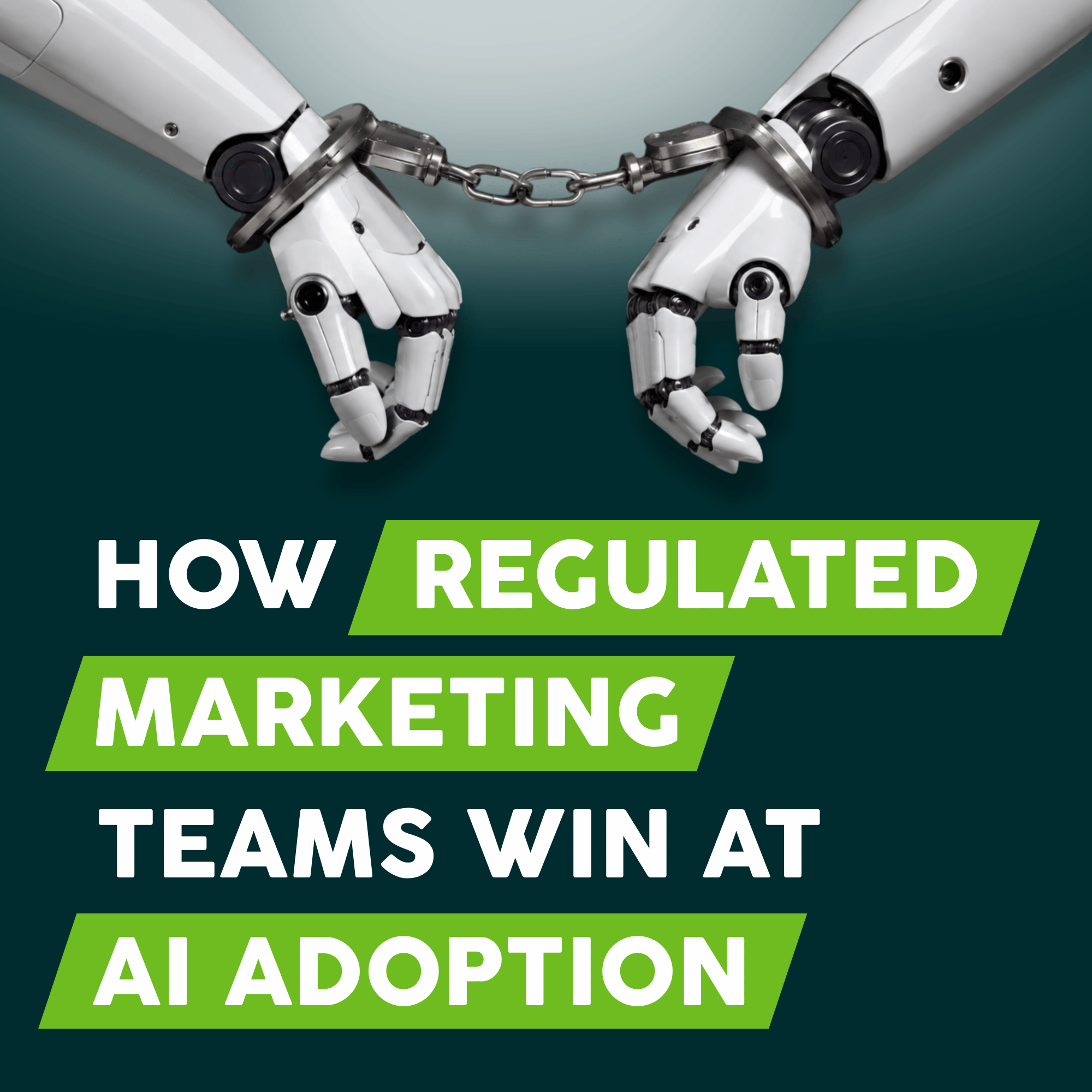
How Regulated Marketing Teams Win at AI Adoption
In this episode of The Agile Marketing Edge, we dive into the unique challenges faced by credit union marketing teams in the age of AI. As marketers juggle roles from brand management to social media, they must also navigate the complexities of compliance and community trust with limited resources.
Watch the Full EpisodeEpisode Transcript
Quick gut check if you run marketing at a credit union: are you also the brand team, the social media manager, the person fielding the board's questions about AI, and somehow still expected to out-market banks with 50 times your budget? If that's you, stay right here.
Credit union marketers are carrying one of the toughest mandates in the industry today — grow the institution and protect the community trust it was built on, with a fraction of the headcount, a regulator looking over your shoulder the whole time, and now AI raising the bar on speed and personalization without lowering the bar on compliance.
Today we're talking about why Agile marketing isn't a nice-to-have for teams like this. It's becoming the thing that makes the math work. My guest spent 15 years inside the credit union industry, most recently as Chief Marketing Officer of CUES, and now helps credit unions build brands that actually move. We're getting into why credit union marketing is a harder job than people give it credit for, why Agile is landing differently now than it did five years ago in this space, and how to adopt AI without moving recklessly. Let's get into it.
---
Welcome to The Agile Marketing Edge, the first podcast dedicated to turning Agile theory into real-world marketing breakthroughs. I'm Monica Georgieff, sitting in for Andrea Fryrear today, and I care just as much as she does about helping you build faster, smarter, outcome-driven marketing. Every week we dig into the what, who, and how behind Agile marketing — from building high-velocity workflows and cutting waste, to measuring what actually matters and scaling success across teams.
Today, we're taking that lens into an industry that doesn't get enough airtime in Agile marketing circles, if you ask me: credit unions. It's a sector built on lean teams, high trust, and heavy regulation, which makes it a real stress test for whether Agile marketing holds up outside the tech company playbook it came from.
To pressure test that, I brought in someone who's lived it from the inside. Tony Hill spent 30 years building brands and marketing strategies, including 15 years inside the credit union industry — most recently as Senior Vice President and Chief Marketing Officer at CUES, where he helped shape the strategic direction of an organization dedicated to developing current and future credit union leaders. Today he runs T Hill Marketing and Strategy, helping credit unions and the companies that serve them build brands that people really trust.
---
**Monica:** Tony, welcome to The Agile Marketing Edge. Before we get into all the topics we've got on deck today, can you tell listeners a little bit more about yourself and the work that you're doing right now?
**Tony:** Thank you, Monica. This is a great opportunity and I appreciate you asking me to participate. I've spent a career — almost 30 years — in marketing, branding, and sales engagement. Most recently I spent the last 15 years or so inside the credit union industry, working for multiple organizations that provide services to credit unions, as well as most recently as Chief Marketing Officer of an association for credit union professionals that provides leadership development solutions. And now I'm trying to hang my own hat and do my own thing as a marketing consultant. Having had some experience working with Agile marketing and working specifically with AgileSherpas, I'm just happy to be here and hopefully impart a little bit of knowledge.
**Monica:** Amazing. Let's ground this for listeners a little bit more, because we invited you in part because of this incredible experience you've had in the credit union world. I actually come from a European country where credit unions aren't really a thing, so I'd love to hear your take on what a credit union actually is and how your career put you inside that industry from a very interesting angle.
**Tony:** A credit union is a member-owned financial cooperative. It provides and offers all of the same services as a bank, but the difference is that rather than having shareholders, a credit union has members. The members are the owners of the organization — they can vote, and they have a voice in how the business is run. And because a credit union is a not-for-profit organization, they return their profits back to the members in the form of lower fees, lower rates on loans, and higher rates on deposits. At the end of the day, all of the profits get returned back to the members, versus at a bank where the profits get returned back to shareholders.
**Monica:** I like that. And that distinction — member-owned versus shareholder-first — is going to matter for everything we talk about today, because the incentive structure underneath the marketing is just different for credit unions than it is for banks and many other types of organizations. This makes me want to ask, though: what does that structure actually do to how credit unions run day to day? Specifically, what process challenges might you have encountered seeing credit union leaders run into?
**Tony:** Credit unions are generally — and I won't just say "generally," they truly are — smaller than banks. They run the gamut from really small to actually very large, but even the largest credit union is still small compared to the larger banks. So by design and by mission, they run lean. They have smaller staffs and much smaller budgets. As a result, in many cases people are wearing multiple hats. At a small credit union, for example, it's not unheard of to have the CEO also managing the lending operation, also possibly managing marketing, and also managing another part of the organization.
They run lean because they want to keep costs low so they can ultimately be of benefit to their members. And as a result, the challenge isn't so much about process — it's about sequencing, prioritization, and what to work on next. There are so many things they have to do and offer that staying focused on the highest-value opportunity is really where the challenge comes in. They're mandated with regulations, with building community trust, and with running a successful organization. So what you find is really smart, purpose-driven people who are just under-resourced.
**Monica:** Right, and that's familiar. What you're describing around bandwidth and competing priorities is very real across a lot of different types of marketing organizations. But the interesting part is that they're actually quite lean — so it's not that the process is poor, it's that there are a lot of competing priorities and a lack of bandwidth that makes it difficult to achieve everything you're setting out to do with the resources you have.
I want to sit with that a little, because it's the exact diagnosis we make with marketing teams way outside the credit union world too. It's rare that people don't know how to prioritize — it's just that there are a lot of legitimate priorities that could be picked up, and they're landing on too few people at the same time. So you have a smaller team focused on a number of important things at once.
Since marketing is the function that holds that bandwidth problem while also being the face of the member relationship you described, how does marketing's role at a credit union differ from this function's role at a bank?
**Tony:** At a bank, marketing is responsible for selling products to customers, acquiring new customers, and cross-selling and upselling additional products. At a credit union, those things aren't unimportant — but they're done differently. It's all about driving growth through educating members on the value the credit union can bring. Historically, in fact, marketing wasn't even called marketing at credit unions — it was called member education, because ultimately they didn't want to sell to their members. They wanted to educate them on how these products and services can improve their lives, their finances, their financial well-being.
That terminology has started to change, but the idea of offering products and services that benefit the members versus selling them to make a profit is still present. So the messaging isn't just "buy a product" — it's "this is your institution, this is your organization. Let us support you. How can we help you grow and achieve your financial goals?" The goals are generally the same; it's how they approach it that's different.
**Monica:** That's interesting, because I've done a lot of coaching work in the pharmaceutical space, and marketing isn't really called marketing there either. You're not selling — you have a commercial operation, a customer experience operation. The word "marketing" sounds very salesy, almost like it doesn't have the customer's best interest at heart. I'm not sure why it's become a bit of a loaded term in some of these settings, because it's supposed to be mutually beneficial.
You're positioning this as a harder job with fewer resources — but not necessarily a smaller job. And that's the reframe a lot of credit union marketers need permission to say out loud, especially to their leadership. We've worked with a number of credit unions where I felt this was very true for the people operating inside the teams, but it was never said outright — that we actually have a lot of ground to cover and we're working with limited resources.
So when that bandwidth problem lands inside marketing specifically, what does it look like day to day? What trade-offs are credit union marketers having to make that are causing pain?
**Tony:** I'll be honest — I think all marketing organizations face similar challenges. Credit unions have the acute challenge of being smaller, with slightly fewer resources, and they have the mandate of integrating with their local community that a lot of other organizations don't have. You often see credit unions very tightly connected to the communities they serve — offering financial education, financial wellness, welcoming people into the branch to help them build their credit, and doing things that promote themselves locally. That community focus is probably a big extra that a lot of other organizations don't have.
But generally, if you look at marketing, there's a commonality: competing priorities, limited bandwidth, shifting goalposts, unclear direction. All of those play into the challenges that marketing teams face, because marketing has gotten so complicated over the years — with new technology, new data platforms, analytics, and now AI. There are all these digital operations that the marketing team is also responsible for managing, in addition to generating growth through promoting and selling products and services. The scope has expanded, the complexity has expanded, and that's where I think Agile comes into play and can help with a lot of that.
**Monica:** You make a great point. If you close your eyes and think about everything you just said — the competing priorities, the shifting goalposts, the last-minute drills — that could be any marketing team in any industry. But in the credit union world, the dichotomy you described is particularly sharp: you've got your community and your physical branches, which still really matter on the local level, but then you've also got all these digital platforms and channels to maintain and compete in. Have you seen that map of all the marketing tools available out there?
**Tony:** Oh yes. Initially it was small, and now you can't even read it anymore.
**Monica:** You have to zoom in. It's really expanded, and the complexity there has expanded with it. I think that's why it's so important to have this conversation right now, because if the symptoms that credit union marketers are experiencing are universal to other marketers — who are also dealing with this huge landscape of digital tools, and for whom local community or physical presence might still matter too — there might be a fix that can help all sorts of marketers.
Which brings me to a timing question I want to explore. We've noticed that more credit unions are coming to AgileSherpas for support in rolling out Agile processes over the last few years. Yes, they're dealing with all the new digital tools. Yes, they're balancing competing priorities. But why do you think they're reaching for Agile now, versus a few years ago? This complexity has been building over time, but Agile wasn't really on their radar before. Now they're lining up for this new way of working and investing real resources in this direction. What changed?
**Tony:** Technology has grown so quickly and expanded so fast that five years ago, yes, marketers were still busy, still dealing with a lot of platforms, but that curve has been exponential. And you've also got younger members in the market — Gen Z is now of age and needing financial services, and their needs are different from traditional segments. They've grown up on digital tools, fintech, and digital apps, and ways to move money immediately. So credit unions have to accommodate for that, as well as for their older demographics who still want to come into the branch, still want to talk to a teller, still want to meet with a person. They've got the full spectrum of age demographics to deal with.
So you've got shifting member demographics, increasing technological complexity, shifting regulations, and growth expectations that still have to be met. Agile is a way to organize, process, and synchronize what you're doing from a marketing perspective in order to accommodate all of those things. Marketing has gotten more complex, the demographics are shifting, and there's more technology at play that marketers have to figure out.
**Monica:** It's almost like the cup has just overflowed. It's been building over time, but it's gotten impossible to participate in all of these conversations at the same time without a new way of working. And Agile has become the best-in-class way of working for marketing over the last decade, so it's really no surprise that they're turning to this method over others.
**Tony:** And I'm glad to hear that credit unions are reaching out and interested in Agile. I think it's a fantastic methodology and it's great to see them moving towards adopting it.
**Monica:** That tracks with what we're seeing in our own research too. In the most recent State of Agile Marketing Report — which we've been doing for nine years now, making it a really interesting study of the evolution of Agile and marketing — we saw that 37% of marketing teams named stretching their budget by doing more with less as a priority for 2026. No surprise to anyone, I'm sure. And yet only about a quarter of marketers say they're actually working in an Agile way right now if you draw that line. So that's probably the gap we're seeing between the need and getting there.
Let's get a little more concrete about where Agile shows up for credit unions specifically. You spoke about their dual identity — the local and relational on one side, and digital experience and competition with banks on the other. Big banks can lean on their scale to do both at the same time successfully. A credit union doesn't have that scale. How do they actually pull it off?
**Tony:** There's a bit of a dual situation happening. Credit unions are challenged by certain things because they're smaller and don't have the scale or national reach that banks do. But that's also a good thing — it's part of their value proposition. Being smaller, more responsive, more member-focused, more member-facing is where they find their opportunity to build and grow their market and be that true supporter for their members.
For example, I live in Florida, and we're no stranger to storms and hurricanes. During the last big hurricane that hit, power was out for many days, trees and power lines down everywhere, everyone scrambling for cash. I was no stranger to that myself. And driving around, the credit union up the street from me was open the day after the hurricane. Every other business was closed, every other bank was closed. The credit union was open for business, because they knew the community needed them. This industry is full of stories like that — credit union leaders going out of their way to help in times of need, in natural disasters. To the point of a credit union CEO getting on a jet ski with a bag of cash to go open brand-new accounts and make loans on the spot for people who needed that support. There are dozens of stories like that across this industry.
So that local-minded focus is what sets a credit union apart — that's their value proposition. Now, with all that said, they still need to compete with the big banks. They still need to have the technology to meet the needs of younger members, and the personalized service to meet the needs of their older and middle demographics. And Agile can help them do that, because it replaces big, slow, monolithic initiatives with short, time-boxed sprints that allow them to test, iterate, and roll something out quickly. They may not have the scale, but they can use Agile to take advantage of speed and getting things to market quickly.
**Monica:** I can't imagine any bank CEO getting on a jet ski and delivering directly to the public the way you described. That's an incredible story I'll continue to share after our podcast is over. It's also a great example of being agile in the true sense — things are going on around you, but you're adaptive to that environment and still delivering value despite everything.
There's one more topic I want to touch on since it's hard to ignore in a conversation like this, where we're talking about marketing becoming more complex, the speed at which everything is moving, and the expectations that come with it. That's AI. Credit unions, just like any other business, are under pressure to adopt AI — but they're also regulated institutions that really can't afford to get this wrong. Can you talk about that tension, and whether it's yet another thing they have to add to their list of priorities?
**Tony:** It is. A lot of credit unions are trying to figure out how to move into AI in a responsible way that keeps them in line with regulations, meets member needs, and creates efficiency in the business. The benefit I think credit unions have in this space, though, is that they've always had to manage innovation alongside their fiduciary duties to their members — even before AI. Because they are financial institutions, they do have to follow certain regulations and communicate the right information in the right ways to stay in compliance. So they already have that backbone.
Agile can help them as it relates to AI, because they can roll things out in a shorter, smaller way. They can make short bets that are tested and iterated upon, and they can grow that before committing to some big, irreversible bet that may or may not work. There are real opportunities to leverage what they already know how to do, as it relates to AI. The challenge is not being paralyzed by the technology. Some institutions will move too fast and get themselves in trouble. Others will move too slowly, not adopt it at all, miss the benefits, and get overtaken by someone else. The right balance is not moving too quickly and not moving too slowly — iterating carefully and responsibly.
**Monica:** I like that. "Iterating carefully" is definitely a quotable line. It's the responsible path, not the slow one — because if you go too fast, it can blow up in your face. I think that's the whole AI conversation right now in one sentence, at least what I'm hearing.
It also echoes something we talk about a lot on this podcast: the parallel between how Agile got adopted and misapplied over the last two decades, resulting in Agile theater in a lot of areas — and now seeing the same dynamic play out with AI adoption, just on a much faster clock. It's not going to take two decades to look back and say whether the pace was right, sustainable, or not.
I'd love for you to go into a little more detail about governance specifically, because that's usually the thing organizations don't talk about until it's too late. How are credit unions governing the rollout of AI? Are they behind, ahead of the curve? And does being small actually help them here?
**Tony:** My observation is that credit unions are generally not going to be early adopters, but they will follow. Some will follow quickly, others more slowly — so there is a range in how they're going to adopt AI and what they're doing with it. But the ones rolling it out responsibly are going to be the successful ones.
In some ways they're actually ahead of the curve as it relates to AI governance, because they're already required to do certain things in certain ways. They have a governance infrastructure in place, and some maturity around how to handle things that need to be compliant or regulated. If they're able to tap into that regulatory maturity as they roll out AI, they can put the proper guardrails around it to ensure they're doing it responsibly — and that way it doesn't have to be a drag, it can be a benefit. We can all see the opportunity AI presents, but you do have to use it responsibly and carefully, with the proper guardrails. It's a shiny new toy that nobody has really taught us how to use. But credit unions, because they have that compliance mindset around how to communicate certain things, if they apply that skill set to AI, they'll be able to roll it out effectively.
**Monica:** It's incredible to hear from you on this topic, because in the position you were in until recently, you were able to see inside and talk to a lot of credit union leaders. You've got perspective across more than one type of organization — you weren't limited to just one credit union's experience. And that's something AgileSherpas coaches share with you too: we're able to see inside a lot of organizations, spot the patterns and anti-patterns, and speak to those. So I'm very grateful for that take, especially on AI since it's so pertinent.
Since we're coming up on time, I want to put one more question in front of you — and I'll put you on the spot a little. It's an objection we hear constantly. A marketing director comes to you and says, "Agile is for tech companies, not for organizations that have a board and regulators." What would you say to that person?
**Tony:** I think that's an interesting perspective, but frankly, Agile is for everyone. It's for every marketing team — credit union marketing teams and other organizations alike. In all of my experience in marketing and in talking with other marketing leaders, both within this industry and outside it, we've all faced the same challenges: competing priorities, shifting goalposts, last-minute requests, unclear direction.
And there's a common thing I've heard — I don't know if I should say this or not, but — everyone thinks they're a marketer. Because everyone is exposed to so much marketing in their day-to-day lives, business and personal, they see it, they see the ads, the emails, the communications. So everyone thinks they know and understand marketing. But what they see and understand are tactics, not the strategy behind it. And this is where Agile can help — it can help you organize and structure the processes that make you more effective. It can help put time-boxed sprints in the right place so you can focus on the high-value work. And it does a great job — depending on how your organization is structured — of improving stakeholder relations through better communication, better feedback, and better collaboration.
Agile is not just for tech companies. I know that's how it started, and that's probably where that perception comes from. But the marketing iteration of Agile is for every marketing organization, in my opinion.
**Monica:** I'm biased, but I agree with you there. I've heard this objection a lot and have had to defend it in a similar way. There's a lot to gain.
Okay, before we wrap — here's what I want everyone who's listening to actually do with what we've talked about, especially if you're running a marketing function at a credit union or honestly any lean, regulated team.
Tony, you said Agile is for everyone. A lot of marketing teams are experiencing similar issues, and credit unions might already be lean in a lot of ways, but competing priorities are exponentially growing. So the first thing you can do is probably name your actual constraint out loud — and it's probably not going to be something like "we need better marketing." It should be something more specific, like: "We have three people covering growth, compliance, and community relations at the same time." You can't fix a problem you haven't named precisely. So start with what is the problem we want to fix, how will an Agile process support it, and how would AI support it as well if you're already in implementation mode.
Two: pick one thing — one digital improvement, one AI use case — and scope it as a short, reversible experiment rather than diving headfirst into a transformation, because that's so daunting to people. If you can ship a process improvement with AI or with Agile in weeks and not quarters, it's going to be to everyone's benefit.
Three: before you scale anything with AI — and I think there's a tendency to say "okay, this sort of works, let's emphasize it, create a thousand blog posts and articles because we can now" — before you do that, ask which existing governance processes you can plug into instead of building a new one from scratch. Your lending compliance process, your data privacy reviews, your marketing claim sign-off — that muscle probably already exists, so use it.
And four: the next time someone tells you Agile is for tech companies, you've got Tony's answer. Don't argue the theory. Point to your own team's competing priorities and shifting goalposts and ask them what they'd call the fix for that, if not this. Maybe there are other ideas out there — you should be happy to collect them. But these are proven ways to fix a lot of the typical issues that pop up when you're dealing with a regulated environment, limited resources, and competing priorities.
Tony, any final words for someone who's listening and nodding along but still feels a little stuck on next steps?
**Tony:** I'm a firm believer in Agile marketing. I think it's a great methodology. I know it can feel daunting when you look at it holistically, but my feedback would be just to start small. You don't have to incorporate everything at once. You can implement some very small things, see how it goes, collect the learnings, and expand from there. That's kind of the Agile mindset in a nutshell — small iteration. So even as you're implementing it, you can do it in a small way and continue to iterate and let it grow until it becomes a bigger part of your organization. It's a fantastic tool, and I'd encourage everyone to take advantage of it.
**Monica:** Tony, thank you so much for joining in and for your perspective. I'm so grateful you were able to come on the podcast. Where should people go to find you and the work that you're doing?
**Tony:** I'm just getting started, so there isn't a lot of public information out there just yet — but you can find me on LinkedIn under Tony Hill, and you can look out for my organization, T Hill Marketing and Strategy. You can also email me directly at thill@thillmarketing.com.
**Monica:** Awesome. Thanks so much again, Tony. Until next time, I'm Monica Georgieff, filling in for Andrea Fryrear as host. And remember: the struggle is real, but so is Agile marketing.
Enjoying The Agile Marketing Edge?
More From The Agile Marketing Edge
Episode Library →
The Agile Marketing Edge Podcast offers insights on how to make Agile actually WORK for marketing teams. Browse the entire episode library.
Episode 40: The Missing Piece Inside HubSpot's Loop Marketing Model →
In this episode of The Agile Marketing Edge, Andrea Fryrear puts Loop Marketing side by side with the Agile Marketing Operating System and finds some striking similarities.
But she also identifies three places where Loop can slow down if the operating system underneath it isn’t designed to keep pace.
