


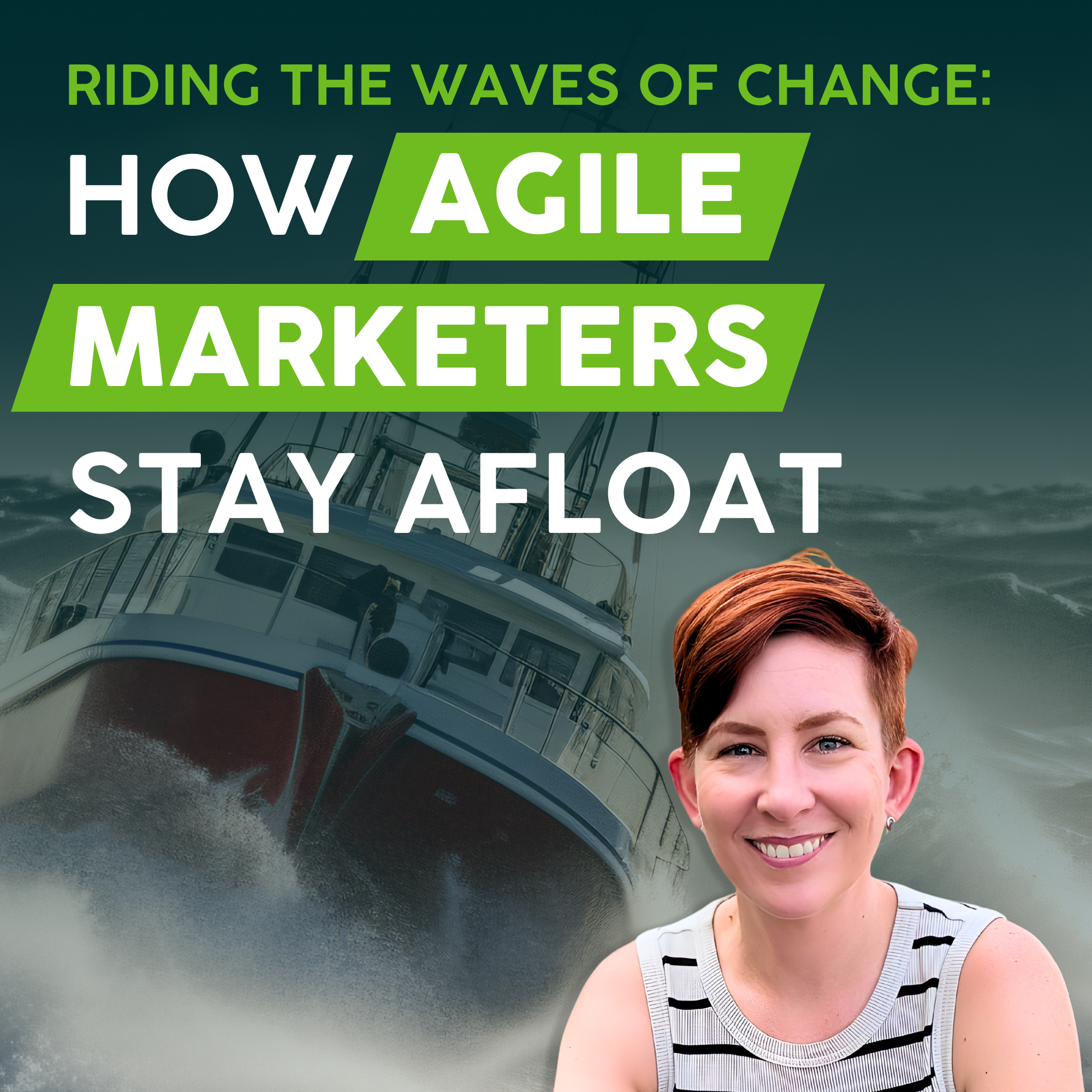
Riding the Waves of Change: How Agile Marketers Stay Afloat
Explore how Agile marketers can adapt and thrive amidst uncertainty, sharing insights from a recent leadership panel on AI and its implications for our work.
Watch the Full EpisodeEpisode Transcript
Welcome, my fellow marketers, to the era of continuous change. What you know today will be obsolete by next year, and a channel that doesn't yet exist will soon be your main source of leads. This might make you want to leap out of bed every morning to learn something new, or it might make you wanna hide under the covers and pretend to be a cave person. But either way, it's not going away. So in this episode, we're talking about how to ride the waves of change.
So, it's smooth sailing, not a scary tsunami. Let's go. Welcome to The Agile Marketing Edge, the first podcast dedicated to turning Agile theory into real-world marketing breakthroughs. Every week, we unpack the how behind Agile, from building high-velocity workflows and slashing waste to measuring what really matters and scaling success across teams. You'll hear quick-hitting strategies you can deploy today plus candid stories from marketers who have traded chaos for clarity and never looked back. So lace up those virtual hiking boots, limit your WIP, and let's start ascending. This is your weekly shot of practical, no-fluff Agile insight so you can deliver more value with less busy work and love your marketing again.
Earlier this week, I was on a leadership panel with other CEOs of professional services businesses. We meet monthly to talk about how we're using AI and what the risks are and where it's helping us and our clients and so forth and so on. And this month, we had a lawyer visit us who's specializing in AI law and copyright, and holy wow. I mean, I know that AI is changing everything and it's turned the world upside down and all of that, but this was the first time that somebody really made me stop and think about the implications for the stuff that we are making, and the example that really blew my mind was the copyright laws about what we make with AI.
So under the laws right now, if you're holding a camera and you push the button to take a picture, you created the photo. You can own the copyright to the photo that you took with this machine, the camera. But if you sit down and spend hours working on a prompt and refining the prompt and going back and forth with AI to get something out of the machine, you don't own that thing that came out of the machine, even though it took you a lot longer than pushing a button on a camera.
Like what, what does that mean? The other thing that, that came up was if you're using AI to help you write a book, for example, you should document every word that AI helped you with, every single word, just to be safe, in case. What, what even is the world right now? Like, on the one hand, we're moving so fast. Everything's going so fast. On the other hand, we're supposed to be documenting every word that AI helped us write compared to what we might have pulled out of our puny human brains, and this is the world, marketers, where we are trying to convince people to do stuff.
Click that ad, open that email, sign up for our event, book a demo. All the craziness going on in the world, but we have still got KPIs to hit, and it's not gonna slow down, and it's not gonna get simpler.
Things just do not move in that direction. It's just like the ocean. The waves are just gonna keep on crashing. They're not gonna stop. They're really just gonna get bigger and more aggressive. We can build walls or we can try to build dams or whatever, but eventually, the waves are gonna get too high and too mean and change is gonna catch up to us and break them down.
It is far, far better to spend our time and energy building a boat that will allow us to ride these waves and maybe even get to the point where we enjoy the waves, and that's gonna mean building change readiness. Maybe, dare I say it, an eagerness, a welcoming of change into our organizational DNA. And to do this, we're cutting across two of the three pillars of Agile marketing in this episode because we're talking about mindset and culture, as well as processes. So that's what and how.
What, because process is where this pillar intersects with how. We'll post the link to the picture if you're listening and not watching so you can refresh yourself on what the Agile marketing diagram looks like. Let's start with the mindset part because first we have to get our mind right, and then we can get our systems and processes right.
So mindset is our collection of attitudes, beliefs, assumptions that shape how we as individuals and our teams as a group of individuals interpret situations, how we make decisions, and how we respond to challenges and opportunities. You can think of it kind of like your mental operating system that's going on behind the scenes of every single action that you and your teams take, especially when there's something gnarly going on like ambiguity or disruption or transformation or crazy AI things.And I like this particular definition of mindset because it's pretty tangible and easy to understand and, and you can connect it to reality. Because in general, I've always kind of found this Agile emphasis on mindset to be kind of squishy and sort of a cop-out. Uh, "We always have to change our mindset" and "We can't do anything until we s- we fix the mindset." I, I kind of have an allergic reaction to that. However, you do need to work on that because if you are fixed and rigid, you can't be open to change. So, you can work on things in parallel, and we're gonna talk about how we can kind of parallel process these things today, but you'll see as we get into some of these examples, you can't have an old school mindset and expect to be change-ready. So, let's get into some more detailed and specific examples across three dimensions, and I think you'll see what I mean by how important the mindset piece is, even if it is kinda squishy. We're not gonna use it as a cop-out.
We're gonna use it as a way to make all of the other tactical, measurable things that we're doing work even harder and be more impactful. Okay, so there are three dimensions of mindset. First, we have cognitive beliefs. What do we believe about change, failure, success, and about our own personal and team capabilities? Do we believe that change is threatening or energizing? Is it coming for my job? Should I resist it actively?
Or is this an amazing new thing that I should be jazzed about and I should embrace and try to be on the forefront of a change?
This is what we believe in our mind about change. Similarly, do we see failure as a learning opportunity, ultimately a good thing that should be studied and better understood, not shied away from? Or do we see it as a reputational risk that we should pretend never happened and should certainly not talk about in public? Right? So, you can see how these different cognitive beliefs about change, failure, success, capabilities are gonna inform the way that we show up in a meeting, in our interactions with other people, in our eagerness to adopt new tools and new ways of working, right? You probably have heard these referred to as a fixed versus a growth mindset, right? So a fixed mindset is stuck. "This won't work because it's never been done before," versus, "We've never tried that. We have a chance to be first." Right? So, fixed versus growth are two different versions of cognitive belief. Second piece here is your emotional posture.
So how do we feel about uncertainty or feedback or risk? Do we take an anxious and defensive posture, right? Kinda closed off, trying to protect ourselves? Or are we curious and open and experimental and maybe even optimistic? And it turns out that our emotional posture can affect our resilience. If we have a positive, open, optimistic emotional posture, we can be more responsive without kind of flailing. We can pivot without panic. But if we were on the defensive, we're more brittle, we're more rigid, right?
We can't bob and weave in that smooth, fluid way that boxers have. We're gonna get stuck and we're gonna get broken if we are too closed off. So we need that open and optimistic emotional posture. Third here, we have our behavioral orientation, and that is what we do when change shows up. Do we resist it actively? I know we've all worked with people like this who are digging in their heels, doing everything they can to not change. Are we trying to maybe put it off for as long as we can?
Just maybe pretend it's not gonna happen, ignore it, hope it goes away? Or are we leaning in, right? Asking questions, looking for ways to be a co-creator of these new paths when change is coming our way. Ultimately, it is our mindset that drives our behavior, and this is important because the things we do is the work that is going to be done or not done. And ultimately, this is a podcast about Agile marketing, which is work. And so what you think influences what you do, which is how you work, so it's all connected. And what we do over time, all of our choices and how we think about things and how we act solidifies and becomes our culture.
Cause culture is not... I'm sure you've heard this. It's not a poster on a wall. It's not the values that your CEO talks about at the all-hands or that one summit that you have every time, every March once a year, right?Culture is actually what you do and how people think. It's the unspoken beliefs that underpin actions.
And so if we wanna change culture, if we want a culture that embraces change, then we need a mindset that is open and receptive to change as a positive concept, not something to be feared and avoided. So if you're wondering where you and your team might fall on this spectrum, I suggest starting with this question:
What story is your team telling itself about change, and what story are you telling yourself about change? Think about that.
Write it down, think it through, and really think critically about whether it's the story you would like to be telling yourself or the story you want your team to be telling itself about change. Cause if it's negative or even on the fence, it's gonna be hard to be excited and embrace change over the long term.
All right. Once we are getting our heads right and seeing change as an opportunity, not a threat, it is time to harness the power of change by starting to embrace and embed change-ready processes.
So, five ways that we're gonna do this, five change-ready processes. And now, I wanna emphasize very carefully here that, yes, you're gonna hear a lot of Agile stuff here. This is an Agile marketing podcast, so you shouldn't be surprised by this. But these are Agile not for the sake of being Agile. These are Agile practices because they bring with them the ability to embrace and adapt all the time, continually, forever. 'Cause the point is not to be able to do AI right now, because AI is the thing that is making everybody crazy and it's the change that we are having to manage right now. We want a system that will allow us to adapt forever. 'Cause AI today is gonna be something else tomorrow, so we need a system that will allow us to be change-ready all the time. So that's what we're aiming for with these five systems and processes that we're gonna talk about. Okay. So the first is about your planning cycles, and they have to be faster. You've gotta shift and get your planning metabolism sped up.
I realize that some of you listening to this are not in control of the planning cycle. It's gonna happen when it's gonna happen and you are at its mercy. But even if you are still, um... I feel for you if you're still at the mercy of annual planning goals. But even if you're still tied to those things, you can start to break them down into smaller, more bite-sized pieces so that even just you can execute on your pieces of them faster. If you are able to take your pieces and break them down, if you're in control of your own planning and you can speed up its metabolism, by all means do that as soon as humanly possible. So this is where we need to just get things done and then be able to move on if the things you were assigned are not good. But if you can, change your planning cycles. Quarterly is good. Quarterly, in my opinion, is the absolute longest time horizon we should be planning right now.
Planning for 12 months is just not smart right now. Thinking that you know what's gonna be happening in 12 months, no one knows what's gonna be happening in 12 months. Why waste time planning for it? Three months is just about right, and it's always been just about right. As humans, we are bad at predicting the future, and so it's a waste of time to plan too far in advance. So quarterly is good.
Monthly is better. Biweekly sprints is the best. Ideally, you do the quarterly plan and then your biweekly sprints allow you to adjust and adapt almost in real time as you're going through the quarter, so that if it turns out you were wrong, you're gonna learn that really quickly. You don't have to wait till you get all the way to the end of the quarter, 90 days, to find out that you got something wrong. So in the midst of all of this, right, as the sprints are going along, we rely on Agile touchpoints to help us create rhythm within whatever the time boxes that our plan exists, and reduce chaos. Right? So we want these Agile ceremonies to help us create rhythm and reduce chaos. So we want ceremonies like daily stand-ups, which are gonna create alignment amongst team members on a daily or three times a week, however often you have them, basis. Sprint planning, right? So where we get together at the start of every two-week sprint. That's gonna create focus around the most important work that's coming up. We have retrospectives where we get really focused on improvement of our processes for the next upcoming sprint, and then reviews or demos so that we can show and tell what we've done and increase transparency across the organization.So, all of these things come into play to allow us to move faster without succumbing to that feeling of frenetic chaos that we can sometimes have creep in when we're moving too fast. Because in these kinds of situations, when we have this lightweight process around us, structure doesn't slow us down, it gives us traction so we can speed up.
So, the second process, and you can see that it's really tightly connected to the first one, is that you need a constant feedback loop, and that's from customers on the outside of your organization and stakeholders on the inside. So, we have the demos or the reviews, which is critical, right? And so we need to invite stakeholders to those so they can see what's happening, what we've already done or what's in progress, so that we can get their input before things are done. So, back to the shorter planning cycles.
We don't wanna do a quarter's worth of work and show at the end, only to find out that it was not what was wanted and start over. These short cycles allow us to do a little work, test, learn, iterate. Same thing, we need very trustworthy data that's connected to performance in the outside world so that we can understand what's happening with our campaigns that are out and live.
And I have to emphasize, don't get stressed about bad, quote-unquote, "data." This is great. Bad data means we are avoiding a catastrophe. We learned really fast that this creative or this channel or this messaging, whatever it was, was not great. We learned it quickly, and we can move on and iterate towards something better. So, back to the whole mindset around failure, don't shy away from the bad data. Learn to celebrate it as a larger mistake avoided. And so, get as close to real-time as you can. That's the benefit of having a faster metabolism around your marketing. You don't have to wait until the campaign is over to learn something 'cause at that point, you've already lost. We can learn something sooner and then we don't have to wait.
All right, the third process that we need to put in place to make sure we are embracing change once we have our mindset right is rolling prioritization. So, we're doing this planning at a more frequent cadence, but it's still not set it and forget it. We need to be looking at our priorities on a regular basis, and these can be more micro-priorities as represented in the backlog, where we're looking at more of the tactical task level of what the team is doing. That is gonna shift, right? Depending on data, depending on performance, depending on organizational shifts. All of the backlog's composition is gonna be in flux. And don't be afraid to, to kill your darlings, right? You might have a pet project in the backlog that you really thought was gonna just crush it, and maybe it doesn't, and that's okay. Don't be afraid to pull it. Don't be afraid to kick it out, and again, celebrate that you learned and that you are able to walk away before a ton of resources was invested. Walk away when there was just a few.
So, looking at the backlog is critical. This should happen before your sprint if you're doing biweekly sprints. You should be looking at the backlog very, very critically before each sprint and deciding, is it in the right order? Is the right work in here? Does some need to come in? Does some need to come out? Make sure that that's reflective of the current reality and use it as a real-time reflection of what's most important. Don't set it and forget it. This is a living, breathing organism.
We have a whole episode about backlogs if you need a refresher. All right, fourth change-ready process that we need to put in place is cross-functional collaboration. Now, this one's gonna be a little harder, but you're gonna need to break down silos because the handoffs and the miscommunications amongst teams is one of the biggest sources of delay and waste in modern knowledge work, especially in marketing.
If we can get rid of silos, then we can shorten the path from idea to execution. That means we get to market faster. That means we get value faster, ROI faster, customer value faster, all things that we desperately need in a world moving as fast as this one is.
And that means we need to co-create with sales, product, customer experience, legal early and often.
So again, if we have this increased metabolism where we're doing biweekly sprints, for example, we can invite them to our planning sessions. If we are doing demos every couple of weeks, we invite them to join and give feedback. This is how we make sure that we are communicating often, doing the work that's actually wanted, and...If you listened to the previous episode, we are making sure that we are having our eyes open for opportunities for reuse or collaboration or cross-pollination amongst different groups' work that would not be identifiable if this was all happening in a vacuum or in silos where people didn't talk to each other. So I hope you're starting to see that in the Agile marketing operating system, all of these Venn diagram pieces overlap a lot for a reason. A lot of stuff about people here, a lot of stuff about process, a lot of stuff about mindset. It's all connected, and this is why we need to work on all of the components and not just do Agile things.
Okay, fifth and final change-ready process that we need to implement is the definition of done. Now this one might seem kinda small compared to the previous one, which was break down silos, that one sounds big and kind of scary. Definition of done sounds kind of small. It sounds small but it is hard to get this right because the first time you try it, you will understand what I mean, because you're gonna have to get everyone who's involved in a particular project to agree on what done means before the work starts.
It's really magical because this provides so much clarity and it actually reduces the amount of micromanagement that you're gonna need. It makes feedback more constructive, it speeds up the approval process, but you're gonna realize how far apart some people are on their definition of what done actually means. But if you take an extra 30 minutes on the front end to debate this and come to an agreement, which you should document, write it down, make sure it's agreed upon, if you take the time to do that, you will streamline so much work downstream, it will be amazing.
And if you do that for everything you will take so much waste out of your system, y- you will not believe. So this one's a little, it sounds little, and compared to some of the others it is, but it is a big unlock if you can get it right. So if you wanna start, one, getting your mindset right, very important. While you're doing that, you can also begin to audit your current processes to see where you need to be more change ready. So a good way to start this is to ask yourself, "What's slow? Where are we slow? And what's siloed? Where do we feel like there's a lot of handoffs?" And really, also, what's working? Where are things flowing nicely? Where should we not interfere and not mess around with things? Your best bet is to start by changing the rhythm and the rest can follow. If you're not really sure how to go about this or that whole process feels overwhelming, I highly recommend our free Agile Marketing Assessment. It's gonna give you a tangible, numerical score across all of the nine dimensions of Agile marketing that span the what, the why, and the how. So you're gonna get scores for teams, process, data, practices, mindset, customer centricity, people, leadership, and planning, so you can focus your efforts where it matters most.
We will share the link in the show notes and of course at AgileSherpas.com. Thank you as always for being here. Until next time, please remember, the struggle is real but so is Agile marketing.
Enjoying The Agile Marketing Edge?
More From The Agile Marketing Edge
Episode Library →
The Agile Marketing Edge Podcast offers insights on how to make Agile actually WORK for marketing teams. Browse the entire episode library.
Episode 8: AI Won’t Save You If Your Process Is Broken →
Delve into the five focusing steps of the Theory of Constraints and learn how to harness AI effectively.
