



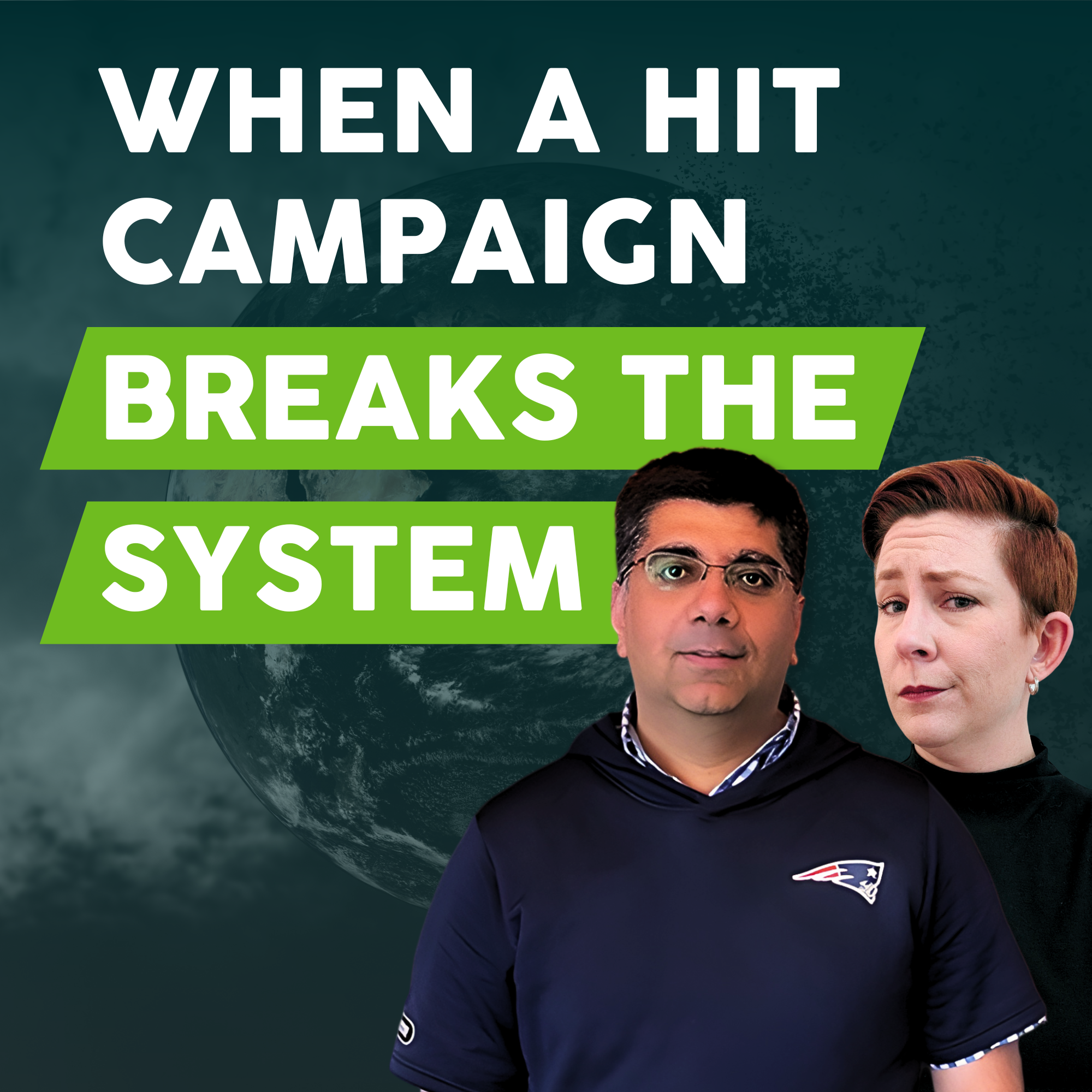
When a Hit Campaign Breaks the System
In this episode of The Agile Marketing Edge, Andrea sits down with Kamal Hans, a seasoned Agile coach, to explore the unexpected challenges of a wildly successful marketing campaign.
Watch the Full EpisodeEpisode Transcript
What if your next marketing campaign was so successful that you sold millions and millions of units, but then you found out your production facility could not fulfill the orders? That is what happened to today's guest back when he was coaching an Agile marketing team at Vistaprint.
And it taught him some tough lessons about when and how to look beyond what his team was doing and to examine where there might be dependencies across the larger system. Kamal Hans has spent over 20 years supporting Agile teams and transformations at organizations of all sizes, and he's also heavily involved with the Boston chapter of the American Marketing Association.
So, like everybody and everything on The Agile Marketing Edge, Kamal is going to help us explore what happens when agility and marketing collide — in this case, for what seems like a great outcome, only to find out that it was something else.
So let's get to it.
Welcome to The Agile Marketing Edge, the first podcast dedicated to turning Agile theory into real-world marketing breakthroughs. I'm Andrea Fryrear, CEO of AgileSherpas and your guide on this climb to smarter, faster, outcome-driven marketing. Every week, we unpack the what, who, and how behind Agile marketing — from building high-velocity workflows and slashing waste to measuring what really matters and scaling success across teams. You'll hear quick-hit strategies you can deploy today, plus candid stories from marketers who have traded chaos for clarity and never looked back. Hit follow wherever you listen, and let's carve the next switchback together.
Andrea: Kamal, thank you so much for being here today. Can you please introduce yourself to the audience and maybe tell them just a bit about your background and how you found your way into Agile marketing?
Kamal: Definitely, Andrea, and thank you for having me on your podcast. A little bit about me: my passion is to connect people with each other and with their purpose. That's what I believe in, and that's what I believe creates the conditions for people to do much bigger things in their life. And that is what Agile is — if you see it simply, it's about delivering value together, sustainably. That's my definition of Agile in one line.
But how did I get there? I started my career as a telecom engineer, and soon I got involved in customer-facing roles — like systems engineering, where I was working with customers, understanding their pain points, and then crafting the technical requirements for my technical teams. That's how I got into really understanding customer-centric marketing, which in simple words is about understanding the pain points of your customers.
My organization was going through an Agile transformation, and that was a good overlap with marketing, which is all about understanding your customers while also asking how you can execute in a way that is iterative and built on faster feedback loops. That's how I got into the Agile marketing space, where I've been working with organizations like Vistaprint and the American Marketing Association, and at the same time with many product organizations.
Right now I work as an Enterprise Agile Coach for USAA, where my primary role is to improve product operations enterprise-wide, end-to-end — applying all the learnings I've gained over the last 20 years.
Andrea: I love that. Okay, so we're going to be able to look at the big picture across the system and across the enterprise, but first we need to go back in time a little bit and talk about this one instance that we're going to use as our jumping-off point. We talked about this when we were preparing for the episode — you had this moment that was seemingly a great marketing triumph. Maybe set the stage for us. Tell us about the team, what you were trying to do, and how things got to that point.
Kamal: Yeah, that was a little while back. I was coaching a transformation at an organization named Vistaprint. So, what was the situation? Our ideation team came up with an amazing idea to produce photo mugs for the holiday season. Right now it's very common, but believe me, back then no other company was producing that kind of mug. It was a genius move — people would have their photos on mugs for the holidays.
So we worked hard, launched the campaign, did the TV commercial and everything around it, and it was a huge success. We sold over half a million mugs within a week. And we were like, "Let's open the champagne. Let's party. We are a major success."
But then reality hit. We started getting calls from our production factories saying there was no way they could produce that many mugs within that timeframe — they didn't have the capacity. So now we were faced with a choice: do we leave customers with unfulfilled orders, or do we escalate? We raised our concerns to the CEO level and took guidance from there. One key learning from that moment was: the customer comes first. If we promised to deliver the orders, we were going to deliver them — no matter what.
So we had to figure out what third-party vendors we could use to produce those mugs. But that created additional cost. Technically, we were fulfilling each order at a $5 loss in margin. Ultimately, yes, it was a big success — even if financially we didn't hit our margins. Operationally, we delivered every single mug, we protected the brand, and we earned our customers' trust, plus the wow factor of bringing something entirely new to market and delivering over half a million mugs within a month.
Andrea: Right. So many lessons there — about customer centricity, but also about internal issues you just didn't anticipate. A lot to unpack with the benefit of hindsight. So let's dig in. You've got some distance now and you've come a long way since then. What do you think listeners here — most of whom are Agile marketers — can learn about balancing the success of the brand or organization as a whole with the success of an individual team? How do we walk that line between optimizing for ourselves as an Agile team versus looking at the bigger picture?
Kamal: Great question. The first thing I'd do is ground us in one definition of marketing — or of a product — which is: solving customers' problems profitably. If you think from that perspective, yes, we are solving problems, but if it's not profitable, we may not be able to keep doing it for the long term. Profitability isn't the goal itself — it's the fuel to fulfill our mission. So we have to understand how to achieve all the factors in that definition, end to end.
That means thinking from a systems perspective: how do we map the full journey, from the moment an idea is triggered to collecting money from our customers so we can fuel the next idea or the next problem we want to solve? That's the biggest learning — you need to connect all the dots in that definition. Don't just focus on speed and output. Think from output to outcomes: how do we launch a campaign and truly be successful — not just in sales, but in actually delivering those mugs to customers and creating that wow factor?
Andrea: Right. And I think there's an extrapolation here, too — even within a large marketing function, we can't just optimize for social or email or one part of the buyer's journey. We really have to think holistically end to end.
Kamal: Absolutely. That's the magic of systems thinking. The problems we work on are not simple problems with a direct cause and effect. Everything is connected, and if you optimize just a small portion of the system without understanding how the whole thing works, you may not get the impact you're looking for.
Andrea: Right — it's not a simple "change this one thing and it only affects one thing downstream." There's a ripple effect across the whole system. So, if you could go back in time and whisper in your own ear during those sprint plannings leading up to the launch, what would you do differently? Is there a scoping change, an MVP approach — how would you handle it?
Kamal: That's a great question. We actually did a retrospective after all of this — and we still called it a success, not a failure. Many things came up, but as I've evolved in my career and coached more marketing and product organizations, the main thing I would have done differently is this:
First, plan for big success. We never anticipated selling that many mugs. We thought maybe 50,000 or 100,000. But anything can happen — especially today, when things can go viral very quickly. We later applied that same lesson to fidget spinners, when they were getting popular, and we could respond quickly. Speed matters, but never assume you won't have massive success. Plan for it.
Second, during planning, think through the end-to-end constraints. I talked earlier about moving from output to outcome. Our goal was to launch a campaign and sell mugs — that was our stated goal, and I think that was the wrong framing. That's an output, not an outcome. The outcome is: our customers have those mugs in their hands so they can gift them to their loved ones. If we had framed it that way, we would have asked very different questions during planning and thought through the whole system, not just our part of it.
Andrea: And thinking end to end might have required the marketing team to almost throttle themselves — to turn off the campaign at some point, take a hit on their own numbers, and say, "We're going to sell less so we can help our colleagues on the production side." How do you coach teams toward that kind of thinking, especially in cultures where competition between teams is the norm and people are laser-focused on hitting their own KPIs?
Kamal: There are two aspects to it. One is the human and business side — people need to actually talk to each other. But there's also a technical side. Is the production line connected to the front-end store? Could we have built a constraint that said, "Our production line can make 1,000 mugs a day, so we will only sell 1,000 mugs a day"? In our scenario, those two systems were not connected. That's systems thinking not just from a people perspective, but from a technology perspective — how are your technical components connected, and how is information being shared so that people can use that data across the whole system?
On the competition side, I like to use a soccer analogy. You have offensive and defensive players. If you're an offensive player and the ball is near your goal, do you say, "That's not my job — I only play offense"? No. You defend, because you're all connected by one shared goal: to win the game. No one is only an offensive player or only a defensive player when the situation demands otherwise. That's the spirit of a cross-functional team — yes, you're an expert in one thing, but you can do multiple things when needed.
So when I see a culture of competition, my diagnosis is usually the same: the teams are not aligned on purpose. They're going in different directions. That's where I run what I call a purpose workshop — where we take the organization's purpose, connect it to the team's purpose, and then connect it to each person's individual purpose. When all three are aligned, that's where the magic happens.
Andrea: Do you see purpose and outcome as the same thing, or are they adjacent?
Kamal: Purpose is bigger than outcome. You'll achieve an outcome within a certain timeframe and then move to the next one. Purpose is the larger reason why — it's the north star. Outcomes are the slices of that purpose that you're working to fulfill.
Let me give you an example with LEGO. LEGO's purpose is to create learning and entertainment opportunities for kids through play. Their outcome is that when a child is having fun playing with their LEGO set, that experience is being created. To achieve that outcome, they produce specific products — Star Wars sets, Minecraft sets, Roblox sets. Those are the outputs, the deliverables. The outcome — kids having fun — leads to impact: children tell their parents to buy more sets, revenue goes up, and LEGO can invest in more innovative ideas. So it all flows: purpose → outcomes → outputs → impact.
In our Vistaprint case: launching a campaign was an output. Delivering a photo mug so that someone could gift it to a loved one — that was the outcome.
Andrea: I love that distinction. And thinking about the individual level — autonomy, mastery, purpose — I often hear from marketers, especially in B2B, that they've come to feel disconnected from the organization's purpose. With long buying cycles and sales owning the customer relationship, marketers end up as order takers: make the landing page, write the email, just do the thing. How does this more interconnected, systems-level view help address that feeling of disconnection?
Kamal: In the B2B space, it's often a journey from order taker to value flow designer. When you first join a team, the purpose and goals may already be established — and you may not yet have full visibility into them. Or the team has been there a while, but leadership has shifted strategy, and that change wasn't communicated down. Now there's a conflict between the old purpose people are working toward and the new purpose leadership has in mind — and people feel it as being treated like order takers.
My coaching is this: it's okay to start as an order taker. You earn trust first. You do the work, and then from that foundation you move toward being a trusted advisor. But even as an order taker, you can ask questions. "I can craft this email campaign — can we connect the dots on how it fits into the larger strategy? Is this for customer acquisition? Retention? A fire drill?" Ask where it fits in the bigger picture.
And if you're a junior marketer saying, "I don't have the power to change anything, but I see these problems" — that's actually your role. Your leaders may not be seeing what you're seeing. Show them the mirror. At the same time, stay curious: they may see opportunities you don't yet see. That collaborative exchange, bridging what leadership sees from above and what you see on the ground, is where the real insight lives.
Andrea: And so much of what you're saying depends on there being an environment where it's safe to ask questions, to point out what isn't working, to say "I don't understand the connection." We have a whole episode on psychological safety and radical candor — we'll link to it in the show notes — because those things don't just show up automatically. You have to cultivate them. And ultimately, all of it is interconnected.
Kamal: That's exactly why we talk about the system.
Andrea: Kamal, thank you so much for being here and helping us see how even a great campaign can disrupt a system, and why we have to look beyond what we're doing as a team. Such a valuable conversation, and it was so fun to hear about your journey — from team-level coaching all the way to looking at the enterprise. I'm sure we have much more to explore together, so maybe there's a future episode where we go even bigger. Thank you again for your time.
Kamal: Thanks for having me. I had so much fun.
Andrea: And if you've been listening and wondering where in your system the issues might lie, we have a Marketing Agility Assessment that can help you figure some of that out. We'll put the link in the show notes, and of course you can always find it at agilesherpas.com.
Until next time, I'm your host, Andrea Fryrear. Remember: the struggle is real, but so is Agile marketing. Thanks for listening.
Enjoying The Agile Marketing Edge?
More From The Agile Marketing Edge
Episode Library →
The Agile Marketing Edge Podcast offers insights on how to make Agile actually WORK for marketing teams. Browse the entire episode library.
Episode 17: Scaling Agile Marketing the Smart Way →
Too much rigidity stifles creativity, while too much flexibility leads to chaos. Explore the delicate balance between flexibility and rigor in scaling Agile marketing practices.
