


The Four False Senses Running Your Marketing Team
In this episode of The Agile Marketing Edge, AgileSherpas Chief Value Officer Ross Libby breaks down four dangerous “false senses” that can make marketing teams believe they’re in better shape than they really are: security, stability, scalability, and sustainability.
Watch the Full EpisodeEpisode Transcript
How are you doing today? And don't say fine — even though I have to admit to giving that exact response without a second thought when I'm asked the same question.
Well, I'm here to tell you — and me — today that fine is not okay. Because fine is usually a facade. Fine is the mask we hide behind so as not to bother others with what's going on. Fine is doing a lot of heavy lifting that it can't support.
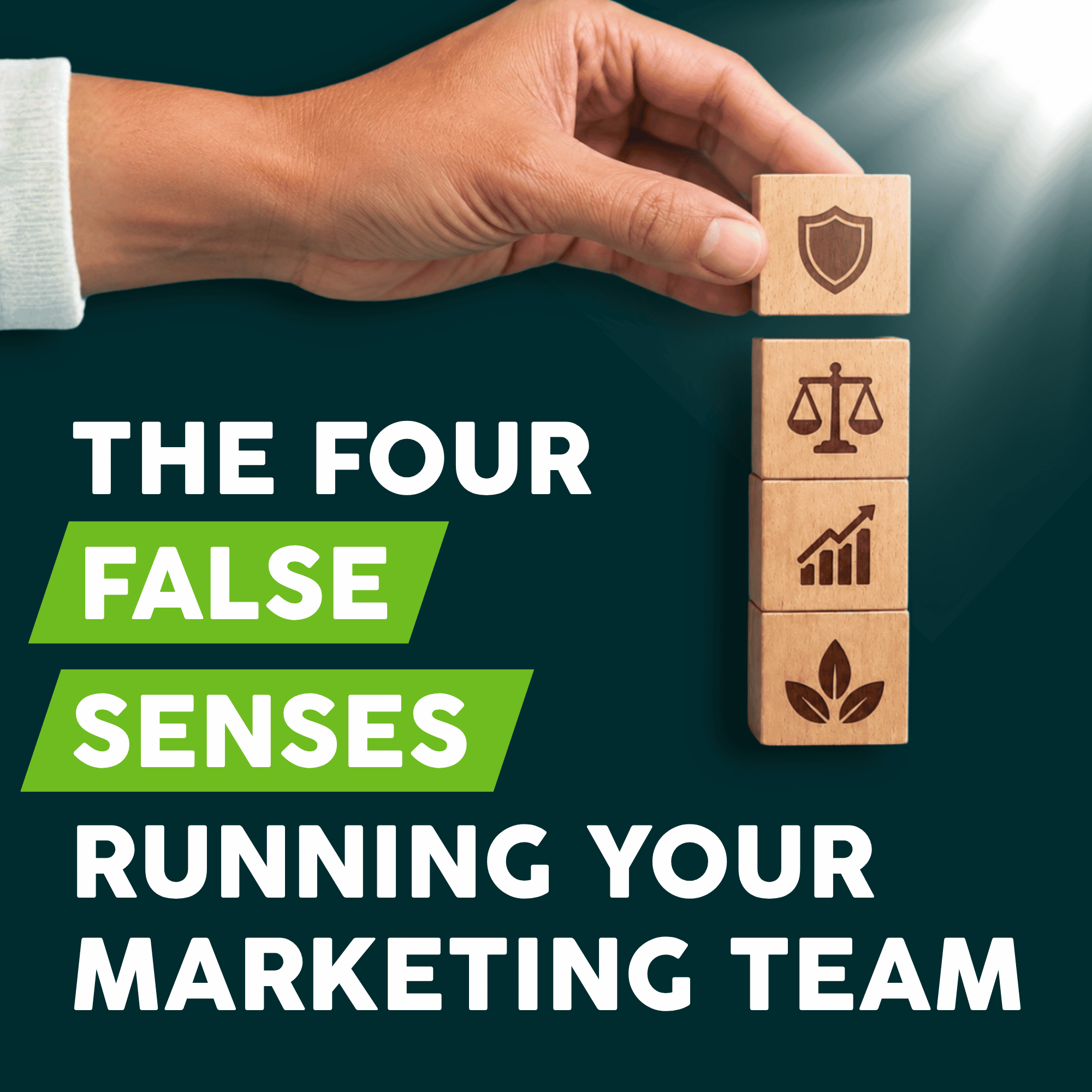
There's a pattern here which I've seen across my work experiences for decades now, and I've just recently been able to put a name against it — or rather, an anti-pattern. I call it the false senses of. We've all heard of a false sense of security. Well, to that I've added a false sense of stability, a false sense of scalability, and a false sense of sustainability. And while they're four separate false senses, they really all point back to one thing: we keep mistaking the absence of visible problems for the presence of a real foundation. Those aren't the same thing. They just tend to look identical right up until they're not.
And here's something that should make you worry even more. AI doesn't create these gaps — or fix them, for that matter. It is really good at finding the ones you already have and then hitting the gas.
So today I want to walk through all four false senses and connect them to the parts of your operating system where they're actually living. And more importantly, tell you what real ones look like instead of the fake. Some of this is going to come straight from the data in this year's State of Agile Marketing Report. Some of it is going to come from stuff I personally got wrong. So let's get into it.
---
Welcome to The Agile Marketing Edge, the first podcast dedicated to turning Agile theory into real-world marketing breakthroughs. I'm Ross Libby, Chief Value Officer at AgileSherpas, and this week I'm your guide on this climb to smarter, faster, outcome-driven marketing. Every week we dig into the what, who, and how behind Agile marketing — from building high-velocity workflows and cutting waste, to measuring what actually matters and scaling success across teams.
Today's episode is a little more personal than usual. It's built off a series I wrote myself, which means some of the client patterns — well, they're really just my patterns.
---
Let's start with the one most familiar and easiest to relate to: the false sense of security.
A false sense of security doesn't require anyone to lie to you. That's what makes it dangerous. No one's hiding anything. Everyone generally believes things are fine. The belief itself is the problem.
As mentioned in the opening, a false sense of security is a concept and a feeling almost all of us know. Like most things, the opposite can be true — and in this case, just as harmful. This opposite became part of a discussion in the comments of a recent post I did on the false sense of security. Chris Niesen, a connection of mine and my former manager from my Target days, shared something he'd been sensing on the other end of this recently: the idea of imposter syndrome.
At first, it felt almost like a disconnect from the line of reasoning I was laying out. But then I paused and thought about it a bit more, and I realized — no disconnect, no disassociation. Rather, he was describing the other end of the same false senses spectrum. Too much confidence and you stop questioning anything. Too little and you stop leading at all. Both of those are a who problem — who your people trust, who's actually steering, who's allowed to say "I don't know" or "it's not fine."
The fix isn't finding the exact middle point and parking there forever. It's what I call humble confidence: humble enough to keep learning, confident enough to keep leading. And this isn't a personality trait you either have or don't — it's a discipline that comes with practice, and it has to be built through actual honest feedback, not vibes.
Here's what the data backs up, in a bit of an unexpected way. In this year's State of Agile Marketing Report, when we asked marketers what's actually holding back their AI use, non-Agile marketers' top barrier was accuracy and quality. They're still deciding: can I trust the tool? Agile marketers had mostly moved past that. Their top barrier was a lack of clear guidelines. They're not asking "does this work?" — they're asking "how do we govern this responsibly?" That's the difference between a false and a real sense of security. One group has a trust problem; the other solved the trust and is now working on the harder piece of building guardrails around it.
So what do we do with this? For starters, stop treating confidence as something you either have or you don't. Treat it as a system output. If your team's confidence is high but untested, that's not security — you have exposure there. If your team's confidence is shaky but they're asking "how do we do this responsibly," that's further along than it may feel, and way more than a vibe.
---
If security is about who you trust, stability is about how you're actually working day to day. And this one wears maybe the best disguise, because it dresses up as professionalism.
Have you heard of watermelon status? Here's the description: someone keeps reporting a project is green — on track, no issues — when underneath it's red, slipping behind. Green on the outside because that's what people, especially leadership, want to hear. Red on the inside because the truth stopped feeling safe to say out loud somewhere along the way. Green surface, red middle — like a watermelon.
Watermelon status isn't a dishonesty problem. It tends to be a cultural problem. It means somewhere upstream, bad news got treated as a personal failure instead of information to learn from. And when that happens, even once, people learn fast: smooth beats real.
I'm not the only one seeing this pattern. Amber Winn, who I shared a webinar stage with back in July, posted about a very similar dynamic recently. She pointed to Patrick Lencioni's five dysfunctions of a team — specifically fear of conflict, which shows up as artificial harmony. Everyone agrees, everyone nods, and the hard conversations get skipped, only to land on the team as confusion later. Sound familiar? It's watermelon status with maybe some manners.
Her point wasn't to eliminate conflict — it was that healthy conflict is the behavior we actually want. The goal isn't consensus; it's clarity, even when getting there is uncomfortable. She borrowed a line from Brené Brown to make the point: clear is kind. Unclear — like presenting a green status when it's actually red — is the unkind version, even when it feels more polite in the moment.
Here's the contrast to key in on. Real stability shows up as measurable trust, not a quiet room. In this year's report, 89% of Agile marketers said Agile improved the quality of communication with other departments. 99% said it improved their actual ability to collaborate. That's not an absence of tension — that's the capacity to surface it and work through it without the wheels coming off. Real stability is loud enough to hear the problems. False stability is just well-behaved when authority figures are around.
So if your standups are suspiciously smooth, that's not a compliment to your team. It's a diagnostic to interpret.
The actionable move here is small, but it works. This week, ask a direct report or a partner some version of this: "What's the thing you're not telling me because it feels like bad news?" And then — this matters more than the question itself — don't freak out. Real stability stays calm and collected when instability surfaces.
---
The next false sense is one I almost hesitate to put out here, because it's the one that points back to me as the problem in a scenario I laid out. That's the false sense of scalability.
Revenue is climbing, headcount and customer activity all point up and to the right, and the logic feels airtight: if we're operating this way today and it got us here, more of it will get us more. So we hired. We invested in more tech. We did everything that seemed to be working. We skipped the harder question — not "are we growing?" but "what does our operating model actually require to get to the next order of magnitude? Would this hold up through an economic turn? Are our people and processes built for the next order of magnitude, or just for the moment we happen to be in?"
We never stop to ask because things are going well. And when things go well, it's exactly the conditions where nobody stops to think about what could go wrong. That's a what problem — strategy, planning, prioritization, the stuff that determines what work gets chosen before you even get to who does it or how. Growth numbers get used as validation for the strategy instead of as a stress test of it. And those are very different things.
AI adds its own version of this same trap. You run a pilot — it kind of works, or it works. Good. But building the process, the guardrails, the capability for that AI pilot to work at scale is a completely different thing. And it's the thing that's getting skipped. AI can get you to the wrong place just as fast as the right one. If you want to land in the right place repeatedly — which is itself a moving target — you need a system underneath it, not just a tool on top of it. Otherwise, you're not scaling. You're just accelerating in whatever direction you're already pointed, including if that ends up being the wrong one.
So here's the action. Before your next growth conversation — whether it's headcount, a new tool, or a new market — ask the question I skipped: not "can we handle more?" but "what does the next order of magnitude require, and do we have it yet?" If you can honestly answer it, great. But the honest answer is probably no. And that's not a reason to stop growing — it's a reason to build the operating model before you scale it, not try to retrofit it after.
---
One more, and this last one hits a bit close to home as well. It's where the comments on one of my posts actually captured my false sense of scalability more personally — what it looked and felt like from the inside.
I shared being part of a center of excellence: all the right intentions, good people, real spirit. But our focus was distributed, and each one of us ended up on an island — heads down, absorbing our own piece of the work, quietly assuming that's just what being a good teammate looked like. We're all fine. We weren't.
What surfaced it was a retro during a team offsite. Each of us mapped out the work we'd been carrying over the previous several months under the guise of everything being fine. Then we charted our emotions on the same timeline, side by side. What came out clearly showed it was not fine. Every single one of us hit our lowest point during the exact stretches we were grinding it out alone. And every one of us felt like we were letting the others down by doing it — even though doing it alone was the very thing we thought made us a good teammate.
That's what happens here: the who and the how colliding. You can have the right people — the who — and reasonable-looking practices — the how — and still burn out. Because sustainability doesn't live in either one alone. It lives in whether they reinforce each other. A team of great people with no shared practices to say "I'm underwater" will burn out exactly as fast as a mediocre team. Maybe even faster, because they're grinding longer before showing or asking for what the reality is.
The data backs this up in a way that matters more than nice sentiment. In this year's State of Agile Marketing Report, 87% of Agile marketers said Agile improved their productivity — while 77% of them also said they felt less stressed because of it. That's not something that's supposed to go hand in hand. More productivity usually means more stress, right? Not the case here. And this isn't "wow, they figured it out." There's a system behind it.
AI makes this slow burn a little tricky too. It absorbs tasks and speeds up delivery, making a team feel more capable — and then all of a sudden they're met with the reality that the pace that was unsustainable before still is. It's not magically fixed. It may just get delayed a bit more.
Sustainability doesn't mean everything's fine. It means your team has a working, practiced way to say it's not fine — before the offsite retro moment has to drag it out. If your team's only mechanism for surfacing burnout is a retro every six months or so, that's not sustainability. You're just delaying detonation with maybe some good lighting.
---
So there they are — the four false senses, one root cause: people and process get starved of attention while data and tech get more of the investment. Data and tech are more visible and tangible. People and process are hidden behind a mask of "it's fine." AI isn't to blame for that imbalance — it was there before. However, it makes its consequences show up faster, louder, and there's still no easy button as an escape.
So here's what to actually do with this, in order.
**First:** Pick one false sense from today that hits closest to home right now. Not all four — one. Is it security, stability, scalability, or sustainability?
**Next:** Find the specific mechanism — not a vague feeling or a vibe. Don't write something like "we might have a stability problem." Write down the actual watermelon status, the actual silence, the actual thing that's being treated as fine that isn't.
**Then:** Build one small, real mechanism to surface it. This week, not next — and especially not next quarter. One direct conversation in a one-on-one. One retro exercise like the one that broke things open for my team. One honest look at whether your growth plan matches your actual operating model.
**And lastly:** Treat this as a practice, not a project. Moving from a false sense to a real one isn't something you fix once and move on from. It's ongoing maintenance on the parts of the system nobody puts on the dashboard.
If you want a structured way to keep building that muscle alongside this podcast, it's exactly what we built The Ropes for. It's our online learning platform — free, self-paced. And if you refer a colleague or someone from your network, you'll get additional access to certified trainings and actual coaching from our Sherpas team. It's built precisely for this ongoing, real practice — not a one-time false sense of a fix.
Real security, real stability, real scalability, and real sustainability. None of them are a feeling. They're all something you build on purpose, and before you need them.
So remember: if you don't want your ways of working stuck in a false sense of dazed and confused, it takes more than a vibe. It takes an operating system to get your people, process, data, and tech feeling alright, alright, alright.
---
Until next time, I'm Ross Libby. And remember: the struggle is real, but so is Agile marketing.
Enjoying The Agile Marketing Edge?
More From The Agile Marketing Edge
Episode Library →
The Agile Marketing Edge Podcast offers insights on how to make Agile actually WORK for marketing teams. Browse the entire episode library.
Episode 39: How Regulated Marketing Teams Win at AI Adoption →
Discover how credit unions can leverage agility to compete effectively against larger banks and meet the diverse needs of their members. Tune in to learn how to turn Agile theory into real-world marketing breakthroughs.
