



Key Takeaways
- Organizational agility empowers businesses to adapt quickly, make smarter decisions, and continuously deliver value in fast-changing markets.
- Recognizing the signs of low agility like long delivery cycles, unclear priorities, and high turnover helps leaders address root causes early.
- Agile organizations focus on collaboration, transparency, and customer value instead of rigid plans and isolated teams.
- Leadership buy-in and a culture of learning are critical enablers of true agility.
- Modern tools, data-driven decision-making, and AI-powered insights can accelerate the path to organizational agility.
- Marketing teams are often the best place to start building organizational agility, testing iterative, customer-centered practices that can later scale company-wide.
- Avoiding common pitfalls like overreliance on tools or trying to scale too fast ensures agility becomes sustainable, not superficial.
- Every step toward agility compounds over time, turning reactive organizations into resilient, high-performing ones ready for 2026 and beyond.
Mike Tyson famously said, "Everybody has a plan until they get punched in the mouth." The sentiment holds true, even when the punch is metaphorical, because it's easy to be distracted by immediate problems.
When it comes to processes and the way teams get things done, we might say that," Everybody wants agility until they get punched in the mouth."
Maybe leaders know they should be upskilling employees to build more effective cross-functional teams.
Maybe it's clear an enterprise project management tools needs to standardize how the entire organization gets things done.
Maybe executives can see new competitors entering the market and know they need to be more closely aligned to their customers to stay relevant.
The problem with all of these needs (and dozens more long-term investments like them), is they can always be put off or de-scoped. In the face of a crisis, plans for organization-wide change are often the first to be postponed.
But investing time wisely now will deliver exponential returns as Agile ways of working permeate the enterprise. In other words, stay true to your quest for organizational agility, even if you get punched in the metaphorical mouth. Here's how to manage that focus, and why you'll be glad you did.
What is organizational agility?
An organization has agility when it is able to easily adapt to change, quickly provide value to internal and external customers, and consistently search for ways to improve processes. The cumulative result is an organization that’s able to constantly adapt itself in order to maintain a competitive advantage.
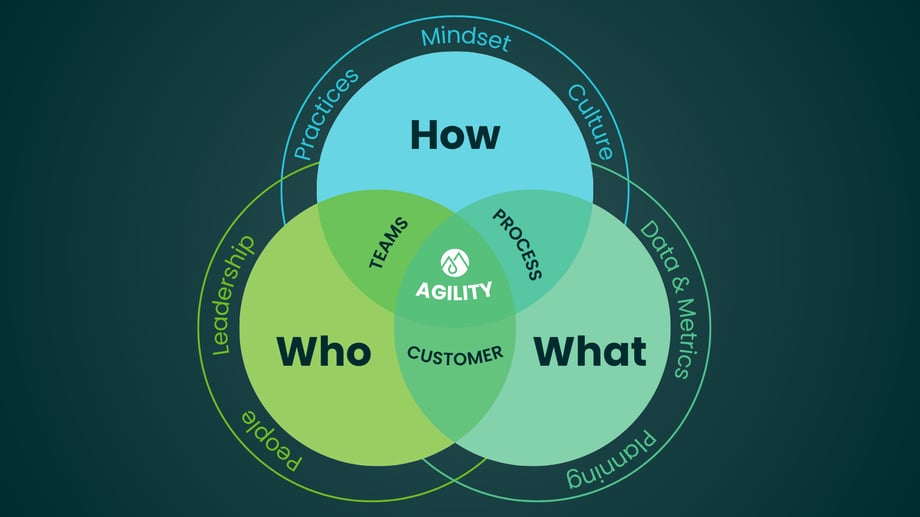
In other words, Agile organizations are able to quickly reconfigure themselves to meet evolving situations and customer needs. This allows them to eliminate waste, make consistent improvements to how they work, and ultimately better serve their customers.
However, that does not mean these organizations lack structure or planning.
Far from it.
Organizational agility is built on a stable foundation of Agile processes, which allow for all of those adjustments to be done in a way that doesn’t sacrifice organizational cohesion or stability.
Think of it like a car. Your car should be able to turn, stop quickly, go in reverse, etc., but its ability to move in these various ways doesn’t mean it’s unstable.
Rather, the driver and vehicle together have certain procedures that let them know when to move in a specific way and how to execute that movement.
In a similar way, when an Agile organization makes an internal change or improvement, the entire process is done via a set of Agile principles. This way, everyone involved understands why and how the change is being made, so it’s far less disruptive than ad hoc changes done without any kind of structure behind them.
(To get a better idea of how this works in practice, read more on how Agile marketing leaders handle crisis.)
Now that you have a basic sense of what organizational agility looks like, how do you know when you should be implementing it in your organization?
1. You rarely meet with customers to decide on new priorities
Does your organization get instructions from a customer and then simply go off and follow them for weeks or months at a time with little to no feedback?
Have you ever found yourself suddenly discovering that your customers’ priorities have changed long after you should have?
These are some signs that you need organizational agility.
Operating under priorities that either have changed or should change leads to enormous wasted resources. That’s not even getting into how team members feel after learning their hard work isn’t useful anymore because priorities have changed. Worst of all, it means it’s far less likely you’ll have a satisfied customer after all of your hard work is completed.
But how do we allow this to happen?
Ultimately, it’s far too easy to simply operate on autopilot and not seek input on new priorities. That’s true for both businesses and their customers.
Thus, one of the benefits of implementing organizational agility is that it encourages both you and your customers to ask yourselves whether priorities have or should change more frequently.
So ask yourself whether you would benefit from more frequent customer meetings to sync on priorities. Whether you end up implementing full-fledged organizational agility or not, this is a key area where most organizations can improve.
2. The time between committing to work and completing it is too long
This second criterion is deeply linked with the first, because the two often go hand-in-hand.
Organizations that take a long time to complete work and deliver end-customer value are probably less likely to check in on priorities in the meantime as well. That’s why these issues can so easily compound with each other. So, as a result, that value arrives late and no longer meets the customer’s priorities.
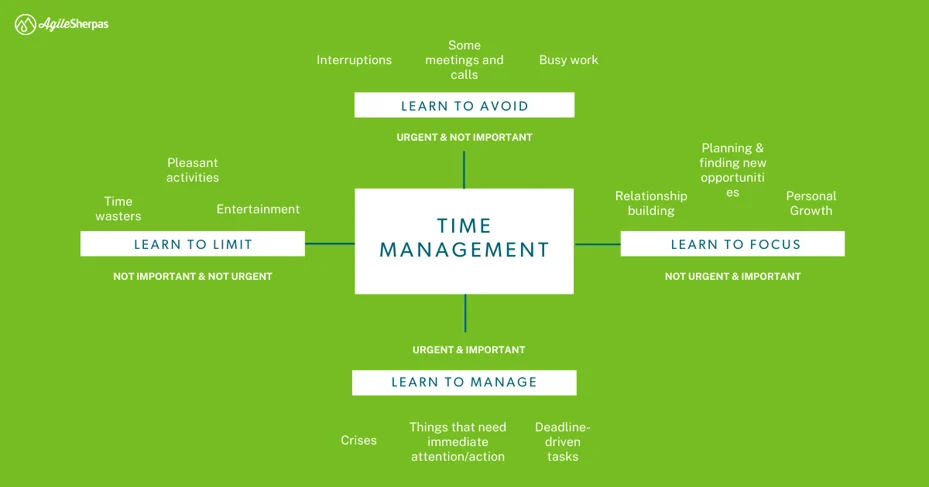
This points to the need to break work up into smaller pieces that can be delivered more frequently. This allows for more frequent feedback and shorter development cycles.
But even if this is a standalone issue, shortening the time between committing to work and completing it is a clear win for any organization. Productivity increases, employees get that great sense of accomplishment more frequently, and clients get more overall value from you.
So ask yourself whether:
- you’ve upset clients with how long it takes for you to complete a project;
- by the time you’ve completed a project the priorities have frequently changed;
- your teams aren’t living up to their full productive potential.
All of these should be red flags that your organization could benefit substantially from using Agile principles to obtain organizational agility.

3. You’re not turning completed work into real value for your customers frequently enough
It’s a situation that’s all too familiar for most organizations.
You finally “complete” some work, but your definition of completion is not the same as the client's or customer's definition, so the work gets stuck in a kind of purgatory.
For example, you create a new strategy for a stakeholder. But once it’s completed, you simply email it to them and it never really gets looked at. As absurd as it sounds, these small handoff issues happen all the time in knowledge work. This is, in part, because that work suddenly becomes “someone else’s problem” to everyone.
In fact, as much as half of information or knowledge gets lost with each handoff, so it's easy to see how this is a common point of failure in all kinds of organizations.
That’s why simply blaming the last person who worked on that strategy isn’t the solution. Most likely they were told to email it when it was done, so under the criteria they were given, the work was complete.
That’s why getting at this issue requires changing the way you approach your work on a systemic level, not just telling one person to do a single task differently.
So ask yourself whether your completed work is really translating into value for your customers, and whether that’s happening often enough. If you see some room for improvement, organizational agility might be what you need.
Before you keep reading, The Ropes gives you 100+ hours of FREE Agile marketing courses, exclusive resources, and certification & coaching giveaways — completely free.

4. Lack of visibility is leading to duplicate and incomplete work
Issues like running into roadblocks when you don’t know who to ask for help, not being sure what the next step should be, or just feeling lost on your team are so common we forget how damaging they can be. These problems can easily stop work in its tracks and make team members feel helpless.

That’s why a lack of visibility is one of the most important problems managers face today.
One McKinsey study found the average worker spent 20% of their time simply gathering information. That’s not even touching on the added costs of not having that information on hand at the right time.
Of course, a lack of visibility also leads to new team members having a far more difficult time onboarding, which brings us to the final sign your business needs organizational agility.
5. Your turnover is too high
All 4 signs mentioned so far contribute to a poor work culture. Each one of them is compounded when you consider the psychological effects they have. Team members just don’t feel good when they’re working under systems that so clearly inhibit them.
Spending months working on a project only to learn that it no longer meets the client’s needs is deeply dispiriting.
Knowing that your projects are going to be delivered late and that they may not even end up being used by the client is dispiriting. Feeling stuck because you don’t have the information you need is dispiriting.
That’s why seeing a bad culture develop is a clear symptom that you may need to try implementing organizational agility. You need a system in place that promotes openness, accountability, and transparency. While organizational cultures are complex, those elements are excellent building blocks to start with.

6. Your leaders struggle to make fast, informed decisions
Even the most experienced executives can get stuck in analysis paralysis when the market moves faster than internal decision-making structures. If your leadership meetings often end with “let’s revisit this next quarter,” that’s a clear signal your organization lacks agility.
Organizational agility empowers leaders with real-time visibility into data and outcomes, enabling faster, evidence-based decisions. It shifts leadership from a command-and-control model to one built on trust and empowerment, allowing teams to act quickly within clear strategic boundaries.
When leaders spend less time approving and more time aligning, your organization becomes capable of responding to change at the speed your customers expect.
7. Your teams are overloaded with projects but short on impact
Does your organization seem to be “busy” all the time without moving the needle? That’s a symptom of work-in-progress overload, a classic sign that your system isn’t truly Agile.
High-performing, Agile organizations limit the number of active projects so teams can focus, finish, and deliver value more consistently. They prioritize outcomes over output, ensuring that energy goes toward what actually matters to customers and the business.
If your team is juggling too many initiatives, constantly shifting priorities, or frequently missing deadlines, it’s time to reassess how work gets prioritized. True organizational agility isn’t about doing more. It's about doing what matters most, faster.

8. Your organization resists change instead of learning from it
Change is uncomfortable, but in today’s business environment, it’s unavoidable. If new tools, processes, or market shifts consistently cause confusion or pushback, that’s a strong indicator your organization lacks the adaptive muscle that agility builds.
Agile organizations treat change as a learning opportunity, not a disruption. They test, adjust, and iterate continuously, creating a culture that views change as normal and beneficial. This resilience is particularly vital in marketing, where technologies, channels, and customer expectations evolve faster than ever.
If resistance to change feels like the default mode, your business may benefit from building a stronger culture of continuous learning and experimentation, which are key components of organizational agility.
9. You collect data but rarely use it to guide decisions
Many organizations have plenty of data but lack the processes and habits to turn that information into actionable insights. Teams produce reports, dashboards, and performance metrics, but strategic decisions are still based on intuition or outdated assumptions.
Organizational agility requires more than access to data. It requires a rhythm of data-driven reflection and adjustment. Agile organizations use short feedback loops to interpret results and pivot quickly, ensuring every new initiative builds on real evidence.
If your organization is “data-rich but insight-poor,” building agility can help you close that gap. The goal is not to have more data. It's to have faster, smarter reactions to what your data reveals.

10. You’re missing opportunities because teams don’t experiment enough
In many organizations, the fear of failure stifles innovation. Teams stick to “safe” ideas because experimentation feels risky or time-consuming. But in the modern marketplace, playing it safe is often the biggest risk of all.
Organizational agility fosters a culture where small, fast experiments are encouraged — not punished. By testing ideas early and learning quickly, marketing and product teams can identify what resonates before committing major resources. This approach transforms uncertainty into opportunity.
If you can’t recall the last time your team ran a small test to validate an idea, that’s a sure sign your organization needs to embed experimentation into its DNA. Agility makes it safe, and smart to fail fast and learn faster.
If several of these signs feel familiar, your business is not alone. Many organizations start recognizing the need for agility only after experiencing stalled growth, frustrated teams, or missed opportunities. The good news is that organizational agility isn’t an abstract concept. It's a practical, learnable capability that any company can develop over time.
To help you take the next step, here are answers to some of the most common questions marketing and business leaders ask when considering how to make their organizations more Agile.
FAQ About Organizational Agility
1. What exactly is organizational agility?
Organizational agility is an organization’s ability to adapt quickly to change, make informed decisions, and deliver value continuously. It combines flexible structures, empowered teams, and data-driven learning loops that enable a company to respond rapidly to new market realities.
2. How is organizational agility different from Agile marketing?
Agile marketing focuses on improving how marketing teams plan, execute, and measure campaigns. Organizational agility expands this mindset across the entire enterprise, aligning leadership, operations, and culture around adaptability and continuous improvement.
3. Can small or mid-sized businesses benefit from organizational agility?
Absolutely. In fact, smaller organizations often see results faster because they can adapt without the layers of bureaucracy that slow large enterprises down. Agility helps smaller teams compete with larger players by increasing speed, innovation, and customer responsiveness.
4. What are the main enablers of organizational agility?
Key enablers include leadership commitment, a culture of psychological safety, cross-functional collaboration, and smart use of technology. Agility thrives when decision-making is decentralized and teams are trusted to take initiative.
5. How can marketing leaders contribute to greater organizational agility?
Marketing leaders play a central role by fostering transparency, customer focus, and rapid learning cycles. They can pilot Agile practices within their departments like shorter planning horizons, frequent feedback sessions, and experimentation, and then share those learnings across the company.
6. How do you measure organizational agility?
Common metrics include cycle time (speed of delivery), adaptability (number of pivots or course corrections), customer satisfaction, employee engagement, and innovation rate. The goal is not perfection but progress — consistent evidence that the organization learns and adapts faster over time.
7. What’s the biggest obstacle to achieving agility?
The most common barrier is cultural resistance. Even the best frameworks fail without leadership support and a willingness to challenge old habits. Building organizational agility requires patience, transparency, and a shift from control to trust.
8. How does technology support organizational agility?
Modern collaboration tools, automation, and AI-driven insights make it easier to share information, streamline workflows, and respond quickly to market data. However, technology is an enabler. True agility depends on people using it to make smarter, faster decisions.
9. How long does it take to build organizational agility?
The timeline depends on scope and readiness. Some teams see improvement within months, while full-scale agility across a large enterprise can take several years. What matters most is consistent, incremental progress. Agility grows sprint by sprint.
10. Is organizational agility just a trend, or is it the future of business?
It’s absolutely the future. As markets, technologies, and customer expectations evolve faster than ever, organizations that can learn, adapt, and act quickly will define the next decade of success. Agility isn’t a buzzword. It's the operating system of modern business.
If these answers have sparked ideas for how agility could improve your organization, you’re already moving in the right direction. Let’s explore what’s next.
What Should Your Next Steps Be?
If by now it seems clear that your organization could benefit from implementing organizational agility, there’s some good news.
You have plenty of options for how to get started on that path. One excellent way to start the process is by beginning with Agile marketing.
Why marketing?
Frankly, implementing Agile in an entire organization all at once can be quite tricky. Often, a good approach is to start with a single team. It’s easier to implement on a smaller scale via Agile transformation first, and once that team is running more smoothly, it’s far easier to convince more teams to change how they work.
Few things are more convincing than seeing for yourself just how much better things can be.
Of course, this article is just a basic introduction, so if you feel like you need to learn more before trying Agile out, you can start small with one of our many Agile marketing courses below.
But in any case, your Agile journey starts with understanding the problems that are holding your organization back, so you’ve already completed one of the first and most important steps.
Now it’s time to take the next one!
Don't stop here. The Ropes unlocks 100+ hours of free Agile marketing courses, resources, and more — one free registration away.
Improve your Marketing Ops every week
Subscribe to our blog to get insights sent directly to your inbox.

.png?width=450&height=250&name=Marketing%20The%20Gateway%20for%20Agility%20in%20the%20Business%20(3).png)