


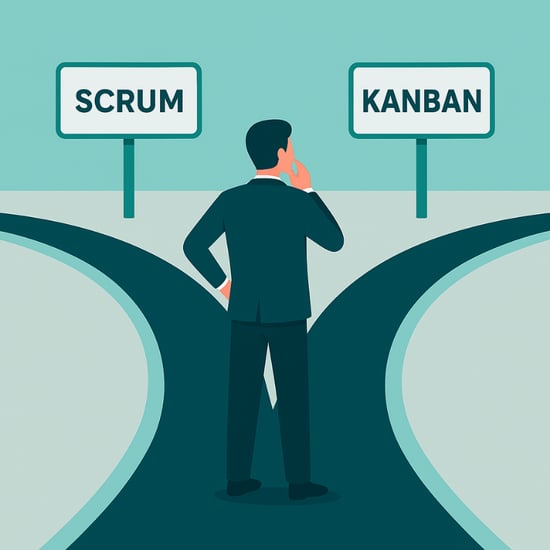
If you’ve been around Agile marketing for any amount of time, you’ve probably heard the “sprints vs. Kanban” debate.
But why do we have to choose? In reality, all frameworks have a place, you just need to understand where they shine, where they struggle, and how to pick the right Agile path for your team without getting dragged into an internet turf war.
If you’re looking for clear guidance, real stories, and simple next steps, you’re in the right place.
What Sprints Do Well (and When They Don’t)
Let’s start with the classic Agile path. After you learn the word Agile, you learn the word sprint. In Scrum, sprints are time-boxed windows, usually two to four weeks, during which a team commits to a clearly defined amount of work. That commitment matters; it’s the heartbeat of the sprint.
Why marketers love sprints:
- Focus. You lock in a scope, shut the door on interruptions, and get work over the line.
- Cadence. Sprint planning → doing → review → retro. The rhythm builds habits.
- Learning loops. Every sprint becomes a chance to test, learn, and improve.
A perfect use case of this Agile path is a website relaunch. It’s big, cross-functional, and high stakes. A marketing team can use sprints to ship a page, get real-time analytics and feedback, and fold those insights into the next sprint. I’ve seen this used in real life, and conversions climbed because learning was built into the work.
But here’s the hard truth: sprints aren’t a universal solvent.
When work demands same-day responsiveness, a two-to-four-week promise can become a prison.
Creative teams servicing many internal clients. PR and comms reacting to breaking news. Shared services drowning in daily requests.
If you can’t realistically say, “This is all we’ll do for the next two weeks,” sprint commitments turn into broken promises and frustrated stakeholders.
If that’s your reality, it’s not that you’re “doing sprints wrong.” It’s that sprints may not be the right how for your what and who.
Sprint smell test
- Do you have major work that benefits from chunking and iteration? (Think: launches, campaigns, new journeys.)
- Can you protect the team from mid-sprint scope changes most of the time?
- Can you put work in front of customers or internal stakeholders every 2–4 weeks and learn from it?
Three yeses? Sprints will likely serve you well. If you felt queasy on questions two or three, keep reading.
Kanban 101: Flow, WIP Limits, and Finishing
Kanban often gets treated like Scrum’s scrappy cousin, but that’s not fair. This Agile path predates Scrum and is laser-focused on flow: moving work smoothly from “started” to “done” with as little waste as possible.
At its core, Kanban asks teams to:
- Visualize the workflow. Make your process visible on a board (physical or digital).
- Limit work in progress (WIP). Put a hard ceiling on how many items can be in each “in-progress” column.
- Manage flow. Use data from the board to identify bottlenecks, unblock, and finish.
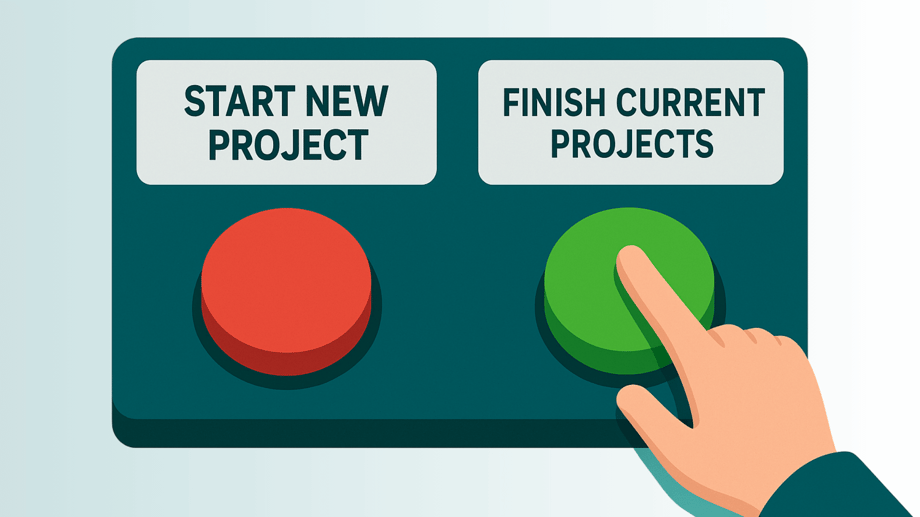
The WIP limit is the beating heart of a good Kanban implementation. It’s not a suggestion; it’s a guardrail that forces prioritization and prevents the all-too-familiar marketer’s trap: 50 things started, nothing finished.
Here’s how Monica Georgieff, Agile marketing coach and Kanban guru, puts it, and I couldn’t agree more: with WIP limits, you protect attention like the scarce resource it is. When the team hits its WIP limit – say 10 items across five people – you stop starting. You swarm to finish. Only then do you pull in something new.
This is why Kanban shines in service-oriented or reactive environments. If a stakeholder shows up with a hot request and you have capacity under the WIP limit, you can respond now, not two weeks from now.
If you’re at the limit, you negotiate a trade: “We can pull this in today, but we need to pause or finish Item X first. Which outcome is more important?”
That’s adult, transparent capacity management. It builds trust fast.
Let’s talk about the productivity killer we all underestimate: context switching.
When you hop from ad copy to webinar deck to budget forecast to stakeholder Slack, you don’t just lose seconds repositioning windows. Your brain loses minutes – sometimes more – reloading the “state” for each task. Multiply that by a whole team, and your throughput tanks.
WIP limits are your context-switching antidote.
A simple script when someone asks you to “just start this today”:
“We’re at our WIP limit right now, so we have two options:
- We finish one of the items in progress by EOD and then pull yours in, or
- We swap your request in and pause Item Y. Which trade-off do you prefer?”
Notice what’s happening there. You’re not saying “no.” You’re making work visible and asking the stakeholder to help prioritize. That’s Agile marketing maturity in one sentence.
Personal Kanban works, too. Even if your team hasn’t adopted an Agile path yet, a personal board with WIP limits will change your week. I’ve used one for years. Family projects, big life events – even my husband and I plan with it. One of our Sherpas managed her entire wedding this way. The principle is the same: visualize, limit, finish.
Before you keep reading, The Ropes gives you 100+ hours of FREE Agile marketing courses, exclusive resources, and certification & coaching giveaways — completely free.

When to Mix: Scrumban and Switching Modes On Purpose
Do you have to tattoo “Team Scrum” or “Team Kanban” on your arm? Absolutely not.
Marketers can – and should – be pragmatic. Many high-performing teams run Scrumban, a hybrid Agile path that borrows the best of both:
- Keep Scrum’s cadence (planning, review, retro) to build learning loops.
- Use Kanban’s WIP limits and flow metrics to manage work in real time.
- Allow just-in-time prioritization between ceremonies when the world changes.
I’ve also seen teams switch modes based on the work:
- Kanban mode for continuous, reactive streams (social, PR monitoring, internal service tickets).
- Sprint mode for big, complex pushes (new product launch, site rebuild, campaign arcs).
You don’t have to choose an Agile path once and for all. You have to choose on purpose.
The What, Who, and How: A Simple Decision Lens
Around here we talk a lot about the What, Who, and How of Agile marketing:
- What outcomes matter most right now? (Pipeline? Awareness? Journey conversion?)
- Who is doing the work, and what are their dynamics? (A shared creative pool? A cross-functional squad?)
- How will we manage and improve the work? (Sprints, Kanban, or a hybrid?)
Scrum and Kanban mostly live in the How, but they should always be informed by your What and Who. If you need rapid response, channel stewardship, and continuous delivery, your How leans Kanban. If you need structure to push a large initiative over the line, your How leans toward sprints. If you need both (most teams do), you design a system that flexes.
That’s being Agile—not memorizing a book.
Real-World Patterns You Can Steal
Here are five patterns I see working across marketing teams:
1. Sprint the big rocks, Kanban the rest.
Maintain a Kanban board for BAU (business-as-usual) work with WIP limits. When a strategic initiative hits, form a temporary sprint team with a tight, 2-week cadence to drive it to done.
2. Team-level WIP, plus role-level WIP.
Cap “In Progress” at the team level and add role-based caps where you tend to bottleneck (e.g., design or dev). This surfaces constraints early and encourages swarming.
3. Daily flow check.
Replace status updates with a 10-minute standup focused on unblocking flow: “What’s nearest to done?” “Where’s the bottleneck?” “Who needs help finishing today?”
4. Trade-off templates for stakeholders.
Pre-write two or three “capacity trade-off” scripts (like the one above) so anyone can negotiate intake respectfully and consistently.
5. Monthly retro on the system, not just the work.
Whether you sprint or Kanban, step back and ask: Did we ship? Did we learn? What slowed flow? What will we try next month?
Signs You Picked the Right (or Wrong) Agile Path
You’re on the right Agile path if:
- Cycle time (start → done) is trending down.
- Work-in-progress stays within limits 80–90% of the time.
- Stakeholders can see trade-offs and help prioritize.
- You ship small increments frequently and learn.
Time to adjust if:
- You consistently blow sprint commitments or keep changing them mid-sprint.
- Your Kanban board looks like Times Square and nothing moves.
- Work “parks” in review or design for days at a time.
- Urgent requests always bulldoze planned work, and nobody can explain why.
None of these are personal failures. They’re signals about your system. Tune the system, don’t blame the people.
Try This Next Week
If you want traction fast, here’s a one-week experiment:
- Visualize everything. Get your team’s real workflow on a single board. No secret lists.
- Set two WIP limits. One at the “Doing” column, one at your usual bottleneck.
- Establish a trade-off rule. If WIP is full, nothing new starts without a swap.
- Run a 15-minute Friday retro. What improved flow? What didn’t? What will we try next?
If you’re more sprint-curious, flip it:
- Pick a 2-week sprint around one meaningful outcome.
- Create a Definition of Done you can actually meet.
- Protect the commitment.
- Review the outcome and ship something, even if it’s a small slice.
Either way, you’ll learn more in two weeks of practice than in two months of reading.
Before moving on, why don't you take a second to get our Choosing an Agile Trailhead Guide?

Topics discussed

Improve your Marketing Ops every week
Subscribe to our blog to get insights sent directly to your inbox.