


Key Takeaways
- Agile marketing needs an “operating system,” not just frameworks. Scrum/Kanban are tools; sustained agility requires an ecosystem that connects people, processes, and culture into a cohesive model.
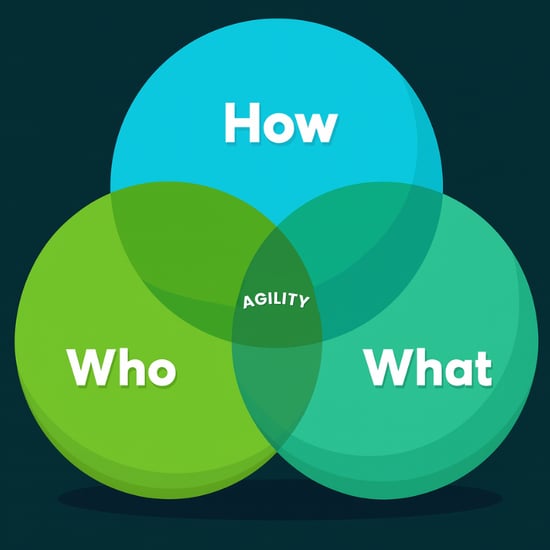
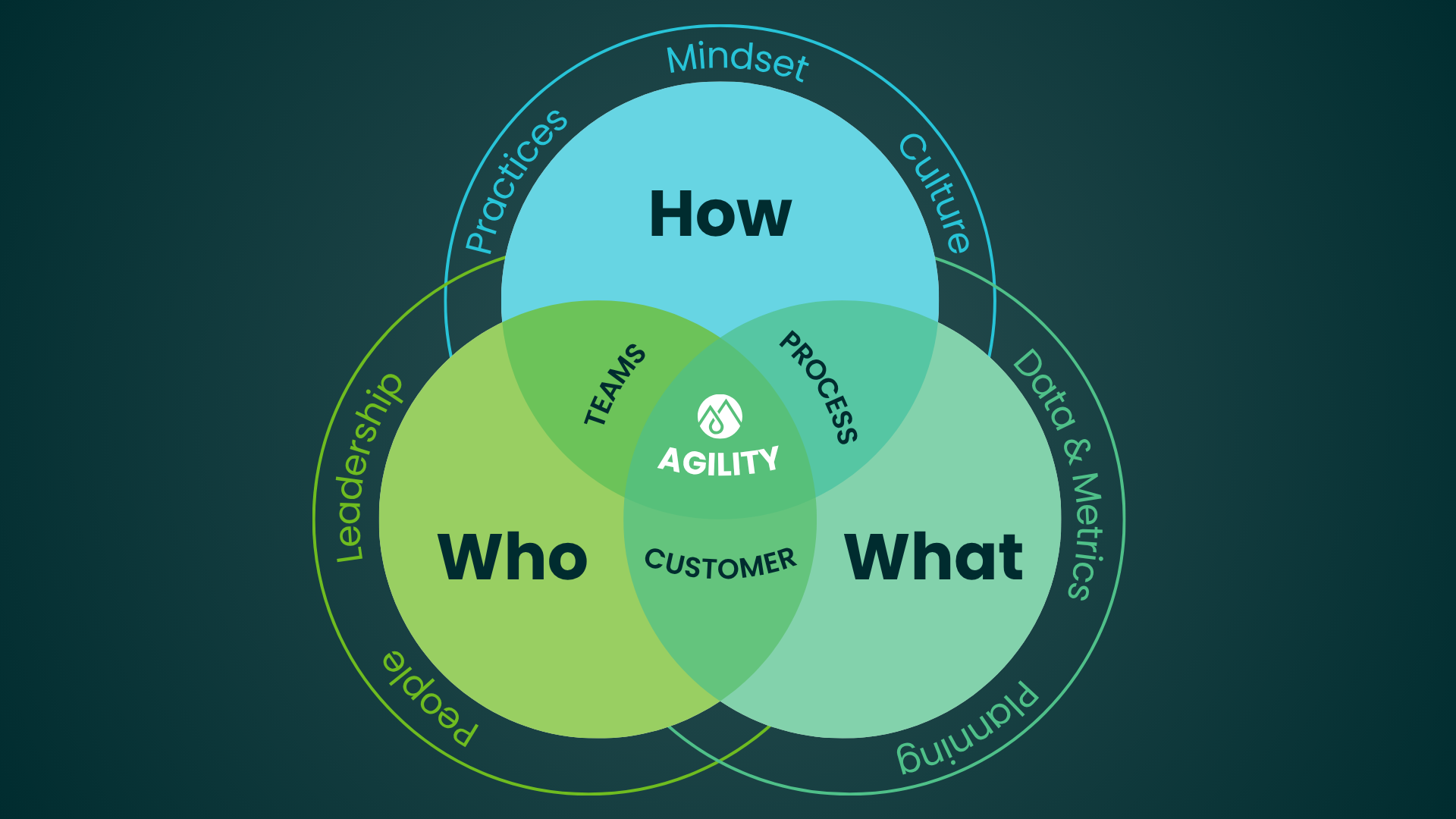
- The Agile Marketing Operating System (OS) aligns three layers: Who, What, and How. It clarifies how Teams (Who), Processes & work (What), and Mindset & culture (How) converge around agility and customer focus.
- Customer value is the center of true agility. Agile maturity is measured by continuous answers to: Are we delivering value? To whom? How do we know?—supported by fast feedback loops.
- High performance comes from integration, not isolated improvements. Breakthroughs happen where leadership, data, and culture reinforce each other—making agility intentional and scalable.
- The “Who” is cross-functional, outcome-oriented teams with evolved leadership. Teams are structured around delivering customer value (not channels/functions), reducing silos and handoffs; leaders enable, coach, and remove obstacles rather than direct tasks.
- Trust and psychological safety are prerequisites for agility. Without empowerment, alignment on purpose, and safety to experiment (and fail), Agile practices become fragile or performative.
- The “What” is evidence-based marketing with metrics that matter. Agile replaces intuition-heavy decision making with measurable value delivery, cycle time, predictability, and customer outcomes—shifting away from vanity metrics.
- Data strengthens creativity by making experimentation safer. Transparent measurement gives teams freedom to test boldly, learn quickly, and iterate with confidence.
- Planning shifts from fixed roadmaps to iterative experimentation. Teams plan small, learn fast, adjust often—treating campaigns and initiatives as micro-experiments tied to strategy.
- The “How” is mindset + culture that makes agility sustainable. The shift is from control → collaboration, certainty → curiosity, outputs → outcomes, supported by transparency, feedback, and incremental progress.
- Continuous improvement is built on a PDCA rhythm. Plan–Do–Check–Act becomes a self-sustaining loop where small tests generate insights that fuel innovation and customer value.
- Building your OS is ongoing, like software updates. Start by empowering the right teams/leaders (Who), defining success metrics and experimentation (What), and reinforcing culture and learning (How)—then keep evolving as conditions change.
Why Marketing Needs an Operating System for Agility
Agile marketing has evolved far beyond a set of rituals, frameworks, or buzzwords. As marketing organizations mature in their agility, many leaders are realizing that true transformation isn’t just about adopting Scrum or Kanban. It’s about building an ecosystem that sustains high performance across people, processes, and purpose.
The Agile Marketing Operating System (OS) brings that ecosystem to life.
It visualizes how Who, What, and How converge around a shared center of agility and customer focus. Much like an operating system in technology, it defines the underlying principles and interactions that enable everything else to function smoothly, adapt quickly, and continuously improve.
In a fast-changing marketing landscape – where customer expectations evolve overnight and technology redefines what’s possible – an operating system for agility provides structure in uncertainty. It becomes the invisible infrastructure that connects the creative, analytical, and strategic muscles of the marketing organization.
Without it, even the most talented teams struggle to maintain momentum or measure impact consistently.
The Agile Marketing OS gives marketers a shared language for agility. It turns what can feel like an abstract concept – “being Agile” – into something tangible, scalable, and measurable.
(If you’re curious about the concepts behind all of this, you can learn more about the foundational principles that shape this approach in the Agile Marketing Credo.)
The Core: Agility Anchored in Customer Value
At the center of the Agile Marketing OS sits agility itself, and you’ll notice it’s surrounded by three equally critical elements: Teams (Who), Processes (What), and Mindset & Culture (How).
Together, they ensure that marketing doesn’t just move faster, but becomes smarter, more responsive, and deeply customer-centric.
Agility here means more than just speed or efficiency. It’s a dynamic equilibrium between adaptability, alignment, and accountability.
Agile marketers continuously ask: Are we delivering value? To whom? And how do we know? The answers to those questions form the feedback loops that keep the OS running.
When customer value becomes the true north, agility transforms from a set of routines into an organizational instinct. Every retrospective, planning session, and campaign review becomes an opportunity to refine how marketing creates impact.
For a deeper exploration of customer-centered agility, check out this article: Customer-Centric Planning in Agile Marketing.

The "Who": Empowered Teams and Evolved Leadership
Every Agile transformation begins with people. In the Agile Marketing OS, the Who represents the teams and leaders driving the work.
High-performing Agile teams are cross-functional and outcome-oriented. Rather than being organized by channel or function, they’re structured around delivering customer value. Experts from different disciplines collaborate toward shared goals, eliminating silos and handoffs that slow delivery.
However, empowering teams requires a fundamental rethinking of leadership.
Adaptive leadership in Agile marketing is less about directing and more about enabling. Leaders cultivate psychological safety, empower decision-making, and act as coaches who remove obstacles instead of assigning tasks.
As teams mature, leaders evolve from managers of people to stewards of systems – ensuring the operating environment supports continuous learning and improvement.
Strong leadership also requires humility. Agile leaders listen more than they dictate, prioritize progress over perfection, and embrace experimentation – even when it leads to failure. Their success is measured not by control, but by how effectively they can let go and allow their teams to thrive.
This is where people leadership becomes a key component of agility.
Without trust, empowerment, and alignment on purpose, even the best frameworks will falter.
Explore what this leadership evolution looks like in practice in The Agile Leader’s Guide to Marketing Transformation.
The "What": Data, Metrics, and Evidence-Based Decision Making
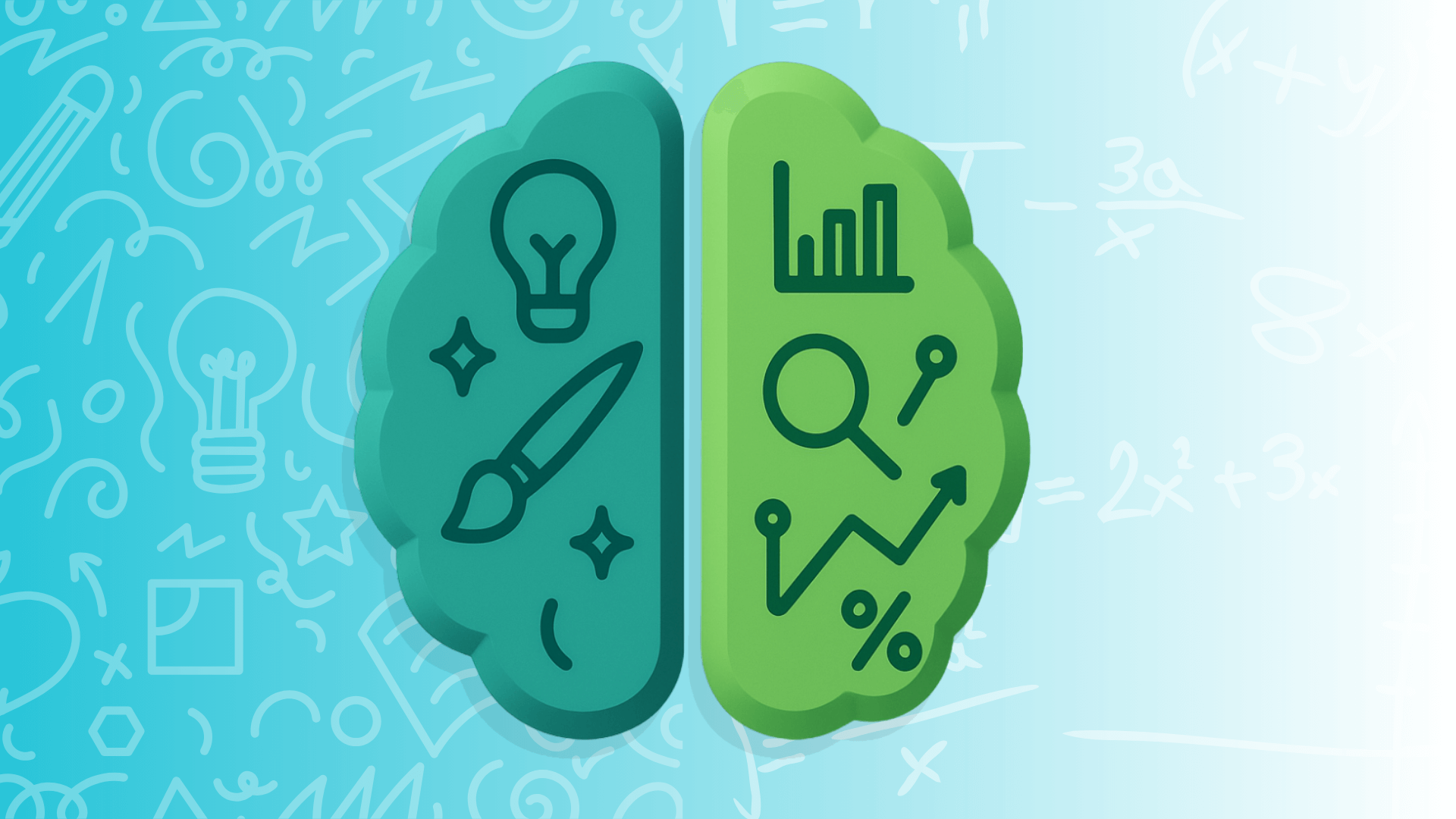
In traditional marketing, success often hinges on intuition or subjective evaluation. Agile marketing replaces that with empirical validation. The What in the OS focuses on the tangible aspects of agility: the work itself, the metrics that guide it, and the processes that govern it.
Data-driven teams measure what matters, such as value delivery, cycle time, predictability, and customer outcomes. They make decisions grounded in evidence, not assumptions. This shift transforms how marketing defines success.
Instead of vanity metrics, Agile marketers prioritize learning, adaptability, and flow.
This emphasis on evidence doesn’t stifle creativity – it enhances it.
With reliable data and transparent processes, marketers gain the freedom to experiment boldly. When every initiative is measurable, teams can iterate with confidence, learning what resonates with customers and refining what doesn’t.
Planning also evolves in the Agile OS. Fixed, long-term roadmaps give way to iterative experimentation. Teams plan small, learn fast, and adjust often.
Every campaign, content piece, or initiative becomes a micro-experiment contributing to broader strategic goals. The result is a marketing function that’s not only faster, but wiser with every iteration.
To learn more about how Agile metrics empower performance, explore Agile Marketing Measurement: Metrics That Matter.
Before you keep reading, The Ropes gives you 100+ hours of FREE Agile marketing courses, exclusive resources, and certification & coaching giveaways — completely free.


The "How": Mindset, Culture, and Continuous Improvement
The final pillar, How, represents the mindset and culture that make agility sustainable. Without a supportive culture, processes and tools become hollow rituals.
Agile marketing demands a mindset shift: from control to collaboration, from certainty to curiosity, from output to outcomes.
Teams practicing Agile ways of working embrace transparency, feedback, and incremental progress. They view change not as a disruption, but as an invitation to improve.
The Agile Marketing OS positions culture as both the soil and sunlight for agility; it nourishes growth while ensuring alignment. A healthy culture encourages constructive dissent, shared learning, and resilience in the face of setbacks.
This mindset is reinforced by a culture of experimentation. Agile teams operate within a virtuous cycle of plan, do, check, act (PDCA). Small tests lead to insights, insights fuel innovation, and innovation drives customer value. Over time, this rhythm becomes self-sustaining, embedding learning into the DNA of the organization.
When culture and mindset are aligned, teams stop seeing Agile practices as “extra work” and start seeing them as how work gets done best.
For further exploration of cultivating a strong Agile culture, read How to Build a Culture of Continuous Improvement in Marketing.
The Intersection: Where High Performance Lives
When Who, What, and How intersect, marketing teams unlock the essence of true agility. The Agile Marketing OS isn’t about isolated improvements in planning or teamwork. It’s about integration – connecting leadership, data, and culture into a unified operating model.
At this intersection lies a new kind of marketing organization: one that is adaptable, transparent, and relentlessly focused on delivering customer value. This is where agility transforms from a methodology into a mindset for performance.
These intersections are where breakthroughs happen; where data informs culture, where leadership amplifies process, and where teams connect strategy to execution in real time.
The Agile OS ensures these intersections are not accidental but intentional.
Moving Beyond Frameworks
While frameworks like Scrum and Kanban remain essential tools, the Agile Marketing OS reminds us that they are just that – tools.
Real agility is holistic. It emerges when teams understand why they work the way they do and have the structure to evolve continuously.
This model provides a roadmap for organizations ready to move from doing Agile to being Agile.
By embedding agility across the Who, What, and How, marketing becomes a strategic growth driver rather than a reactive service provider.
To understand this distinction more deeply, explore From Doing Agile to Being Agile: A Marketer’s Journey.
Before moving on to learn how to build your own Agile Marketing Operating System, why don't you take a second to get our Agile Marketing Transformation Checklist?
Building Your Own Agile Marketing OS
Every marketing organization is unique, but the fundamentals of agility are universal. To begin building your own Agile Marketing Operating System:
1. Start with the Who
Empower teams and leaders who are ready to own outcomes, not just deliver outputs. Evaluate where silos still exist and design structures that promote collaboration around customer journeys.
2. Define the What
Clarify your metrics for success and ground every initiative in data and experimentation. Introduce lightweight measurement frameworks that evolve as your teams mature.
3. Shape the How
Cultivate an Agile mindset through culture, transparency, and continuous learning. Reinforce Agile behaviors through rituals, storytelling, and shared accountability.
Implementing this OS isn’t a one-time project; it’s an ongoing process of evolution. Just as technology operating systems receive updates, so too must marketing’s OS adapt to new challenges, customer needs, and business realities.
The most successful Agile marketers treat their operating system as a living framework: flexible enough to evolve, yet consistent enough to sustain long-term alignment.
To start building or refining your own OS, explore the Agile Marketing Fundamentals Course for a guided approach.
Final Thoughts
The Agile Marketing Operating System isn’t a theoretical model; it’s a reflection of how the most successful marketing organizations operate today. By understanding and optimizing the interconnected layers of people, process, and culture, marketers can design for resilience, responsiveness, and long-term growth.
For organizations ready to go beyond the surface of agility, the OS provides a compass and a common language. It transforms agility from a buzzword into a measurable, strategic capability.
In a world where change is constant, agility isn’t optional. It’s the foundation for everything that comes next.
And with a shared operating system to guide them, marketing teams can finally move from chasing change to leading it.
Before leaving, don't forget to get your copy of the Agile Marketing Transformation Checklist.

Improve your Marketing Ops every week
Subscribe to our blog to get insights sent directly to your inbox.