




Key Takeaways
- Modern marketing needs smaller, faster, more connected teams—aka “two pizza teams.”
- Over-specialization in marketing has created complexity, silos, and slower execution.
- “Collaboration drag” is killing productivity, leading to burnout, turnover, and missed revenue goals.
- Communication complexity grows exponentially as team size increases, slowing everything down.
- Research shows smaller teams deliver work significantly faster than larger groups.
- The optimal team size is around five people—beyond that, effectiveness drops sharply.
- Pairing small teams with Agile practices (sprints, Kanban, retros) dramatically boosts speed and clarity.
- You can start small: carve out one project for a five-person team to run end-to-end.
- A “team of teams” model maintains alignment without bloated meetings.
- Small teams aren’t under-resourced—they’re more focused, more agile, and ultimately more effective.
When Jeff Bezos coined the phrase “two pizza team,” he probably wasn’t thinking about marketing. But his simple rule – that a team should be small enough to be fed by two pizzas – perfectly captures something marketers desperately need right now: small, fast, connected teams that actually get stuff done.
At its core, the two pizza team idea is about speed and simplicity. Small teams move quickly; they make decisions without endless meetings. They deliver real outcomes instead of updates about outcomes.
Bezos saw that the bigger a team gets, the slower it moves. And in today’s marketing world, where “do more with less” has become the mantra, that insight feels more relevant than ever.
Why Marketing Needs Its Own Two Pizza Moment
Let’s be honest: modern marketing isn’t exactly built for small teams. Over the years, we’ve specialized ourselves into oblivion.
Content has a team. Social has a team. MarTech has a team. Comms has a team (that sometimes doesn’t even think it’s part of marketing).
Each of those teams has its own priorities, tools, and metrics. And somewhere along the way, we lost sight of how to move together.
So now, when leaders ask us to be more efficient – stretch the budget, hit the same goals with fewer people, “just get AI to do it” – we can’t because we’re stuck in a system that was designed to reward complexity.
That’s where the two pizza mindset comes in.
It’s not about cutting teams for the sake of it; it’s about rediscovering the power of focus and connection.
Because when we simplify, we reclaim the speed and creativity that marketing used to have before it became a tangled web of approvals, dependencies, and misaligned priorities.

The Enemy of Speed: Collaboration Drag
One of my favorite new phrases comes from Gartner: collaboration drag.
You can almost feel it when you say it – like a weight pulling your work down.
Collaboration drag happens when too many people, processes, or approvals slow down progress. It’s the friction that builds up when everyone needs to be in the loop but no one’s really moving forward.
And the data is ugly. Gartner found that organizations with high collaboration drag are 37% less likely to exceed revenue and profitability goals. Even worse, 84% of marketers say they experience high collaboration drag in cross-functional work.
No surprise there – marketing is nothing but cross-functional these days.
Here’s the real gut punch: team members in those high-drag environments are 15 times more likely to feel burned out and nine times more likely to consider leaving.
So, if you’re a marketing leader watching turnover rise or morale drop, collaboration drag might be your silent saboteur. And if you’re an individual contributor who feels like you spend more time managing work than doing it, you’re probably feeling that drag every day.
The Math Behind the Madness
Here’s why the two pizza rule works so well: it’s not just a nice metaphor. The math proves its power.
The PMBOK (Project Management Body of Knowledge) communication channels formula shows how complexity grows as teams expand (stay with me this is gonna get math-y):
N × (N − 1) ÷ 2 = number of one-to-one communication links
That means:
- A 4-person team has 6 possible one-to-one connections.
- An 8-person team has 28.
- A 12-person team has 66.
See the problem? Communication doesn’t scale linearly – it explodes exponentially.
Every new person adds more coordination, meetings, and check-ins. And before long, collaboration becomes the work.
No wonder even simple projects can grind to a halt when teams get even a little bit bigger.
Real Life Proof: Fewer Hands, Faster Work
This isn’t just theory. When researchers asked people to build the same Lego structure in teams of two versus teams of four, the four-person teams took 44% longer.
Two people finished the task in 36 minutes. Four people needed 52. Same project, same tools, just more coordination overhead.
And if you’ve ever tried to set up a campsite with your family, you know exactly how that feels. Two adults can get it done in a snap. Add a couple of kids (or in our case, a few marketers with strong opinions), and suddenly you’re answering questions, looking for lost tent poles, and wondering where the momentum went.
That’s collaboration drag in action.
Before you keep reading, The Ropes gives you 100+ hours of FREE Agile marketing courses, exclusive resources, and certification & coaching giveaways — completely free.


The Magic Number: Five
Research suggests that five is the sweet spot for effective teams.
McKinsey’s review of more than 5,000 executive teams found that effectiveness starts to drop when you hit double digits. After ten people, sub-teams start forming, decision-making slows, and shared ownership plummets.
In marketing, those same symptoms show up as endless alignment meetings, conflicting priorities, and campaign delays.
A five-person team, on the other hand, can move with incredible clarity. Everyone knows what everyone else is working on. Hand-offs are faster. Feedback loops are shorter. Accountability is clear.
And that’s where the real power of the two pizza team shines through: faster speed to market and happier humans doing the work.
When Small Meets Agile
Now, let’s take it a step further. What happens when you pair a two pizza team with Agile marketing practices?
You get a team that’s not just small and fast – it’s smart about how it operates.
Imagine your five-person team doing:
- Sprint planning: so everyone knows what’s being worked on, what success looks like, and who’s responsible.
- Visualized workflows: with a backlog and a Kanban board so nothing gets lost, even when someone’s out sick or on PTO.
- Retrospectives: to regularly identify what’s working, fix what’s not, and keep getting better.
Suddenly, the team isn’t just surviving – it’s thriving. They’re delivering value faster, adapting to change without chaos, and spending way less time in meetings.
At AgileSherpas, we live this every day. We’re a true two pizza team. When someone faces a personal emergency or has to step away, the work doesn’t grind to a halt. The team steps in, picks up where they left off, and keeps moving. Not perfectly – but consistently.
That’s what makes small teams so mighty.
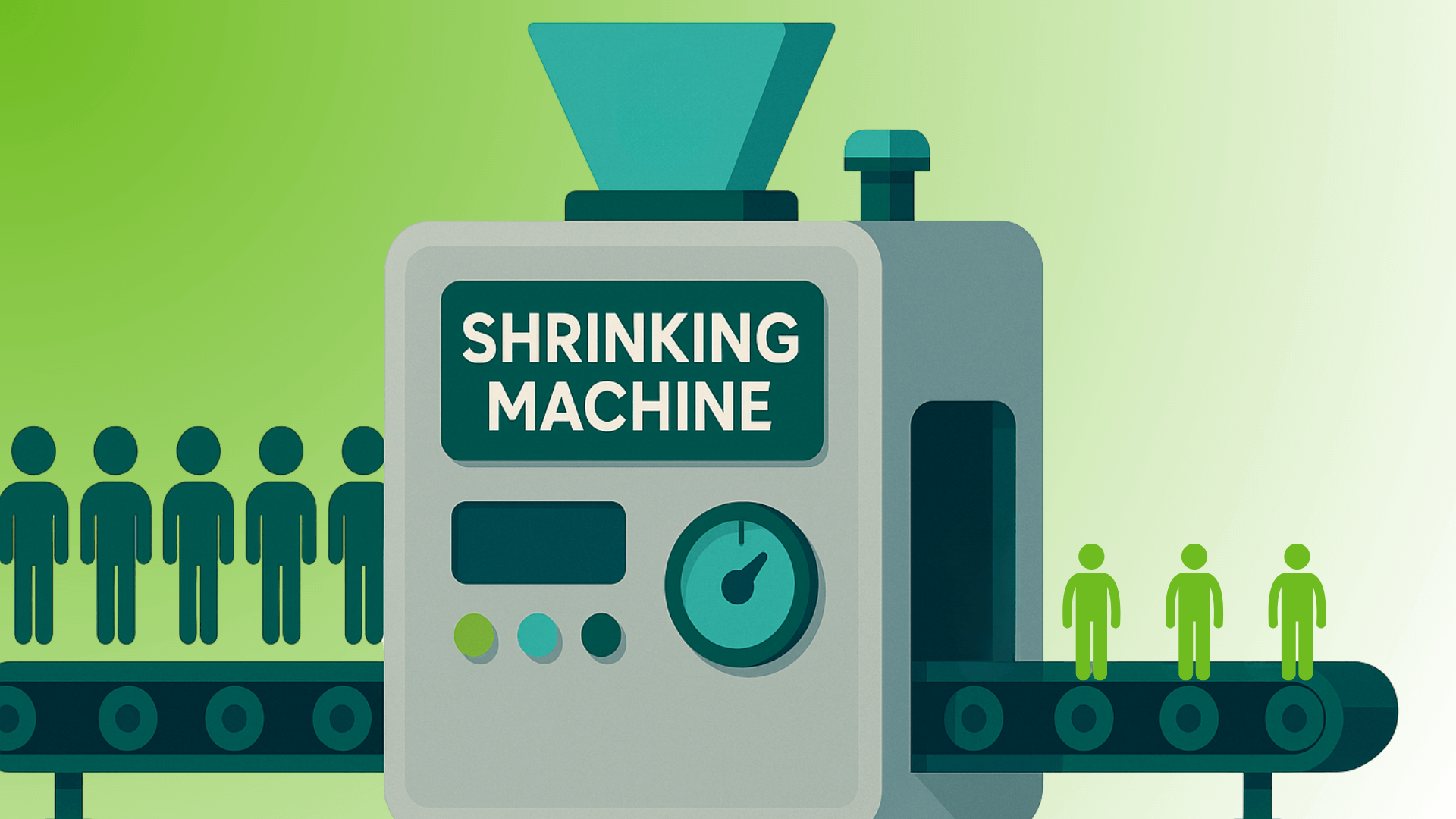
How to Start Shrinking Smart
If you’re on a giant team right now, you don’t need to panic – or wait for a reorg. You can start small (pun intended).
Take one project and map it out: every step, every person, every approval, every tool. Then ask yourself:
“What’s a subset of this work that a small group – say, five people – could deliver on their own?”
Start there. Let that small team run the project end-to-end. Watch how much faster they move. Notice how much less coordination they need. Then replicate it.
And to avoid slipping into new silos, use a team of teams model. Send one representative from each small team to a daily stand-up with the others. That keeps alignment high without dragging everyone back into the same bloated meetings that caused the problem in the first place.
This approach gives you the best of both worlds: speed from the small teams and visibility from their connections.
Two Pizzas, Infinite Potential
So yes, losing people or resources can sting. But if it pushes us toward smaller, smarter, and more focused teams, it might just be the best thing that ever happened to our marketing organizations.
Small teams move fast. They innovate faster. And when they work in Agile ways, they don’t just keep up with the market – they stay ahead of it. Maybe they even create it.
So if you find yourself on a small team right now, take heart. You’re not under-resourced – you’re unleashed.
And if you’re leading a big, lumbering team, it’s time to start slicing. You might find that two pizzas are all you ever needed.
Before you move on, make sure to get your copy of the OKR Cheatsheet.

Topics discussed

Improve your Marketing Ops every week
Subscribe to our blog to get insights sent directly to your inbox.