



Agile marketing has a shared services problem!
Agile marketing promises speed, adaptability, and focus on customer value. But if you’ve tried to scale it inside a complex organization—especially one with specialized or regulated shared services—you already know where things start to crack.
Execution teams move faster. Strategy teams prioritize more effectively. And then everything slows down at the same predictable bottlenecks:
- Specialized reviewers or SMEs overloaded with last-minute requests
- Studio teams juggling conflicting priorities
- Data teams pulled in ten directions without clear line of sight to strategy
None of these groups are “the problem.” The real issue is how shared services are designed—or more accurately, how they’re not designed—to work within an Agile marketing system.
Most organizations still treat shared services as external dependencies instead of integral parts of value delivery. That mismatch creates friction, delays, and frustration on all sides.
This article outlines a Shared Service Blueprint for Agile marketing—one that integrates shared services of all kinds directly into planning, execution, and learning loops without destroying team autonomy or overwhelming specialists.

Why Traditional Shared Services Break Agile Marketing
Before we get into solutions, it’s worth naming what goes wrong in most setups.
In traditional marketing operating models, shared services are typically centralized in the name of efficiency rather than flow. The goal is often to maximize utilization of specialized resources, even if that means work queues grow longer and feedback cycles stretch out.
They’re also usually engaged late in the process, once work is considered “ready for review.” By that point, key decisions have already been made, context has been lost, and any feedback tends to trigger rework rather than refinement.
Finally, shared services are frequently measured on utilization or throughput metrics that have little connection to actual business outcomes. The result is a system that appears efficient on paper but performs poorly when conditions change.
That model assumes predictability. Agile marketing assumes change.
When Agile execution teams operate on short planning horizons but shared services plan quarterly (or worse, reactively), you get:
- Surprise demand spikes
- Fire-drill reviews
- Over-processing and rework
- Burnout across teams
Agile doesn’t fail here—the operating model does.
To fix this, shared services need a clear role, explicit interaction points, and visibility into upcoming work—not just tickets tossed over the wall.
The Foundation: An Agile Marketing Organizational Map
Before you can improve how shared services work in Agile marketing, you have to be explicit about how the organization itself is designed to deliver value.
Most breakdowns between execution teams and shared services aren’t caused by poor collaboration or lack of goodwill—they’re caused by unclear ownership. When it’s not obvious who is responsible for setting priorities, who translates strategy into action, and who provides enabling capabilities, shared services end up either overloaded or underutilized.
That’s why this blueprint starts with an organizational map. Not as an org chart, but as a way to clarify how different groups contribute to value delivery and how shared services fit into the system as a whole.
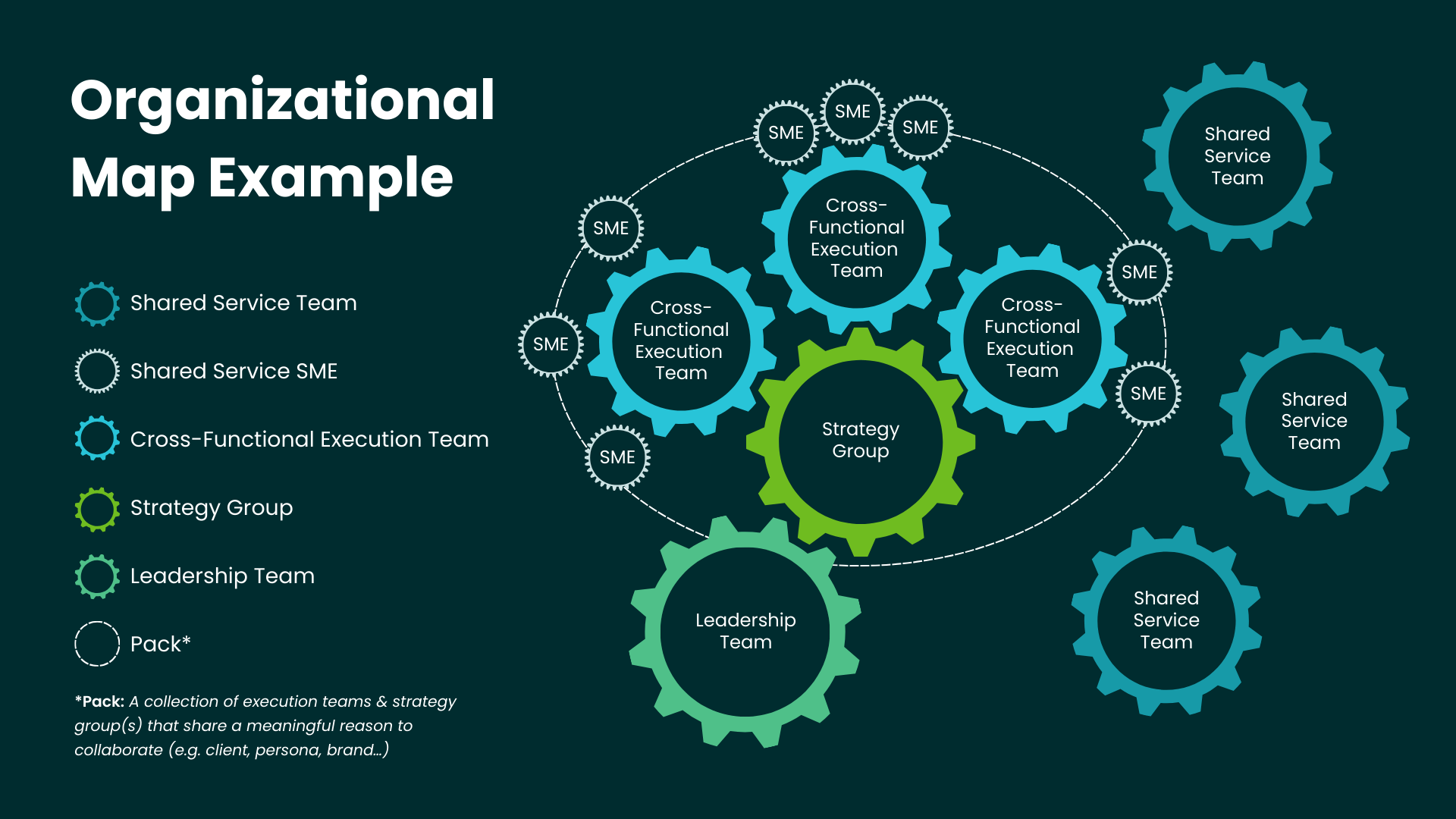
At the heart of this model is a simple but powerful distinction: who owns the “what” and who owns the “how.”
Four Core Groupings
Execution Teams
Stable, cross-functional teams that own delivery for a defined audience, brand, or client. They decide how work gets done.
Strategy Groups
Own prioritization and outcomes. They translate enterprise strategy into actionable objectives and set the what for execution teams.
Shared Services Teams
Provide specialized capabilities used by multiple teams (e.g., medical, studio, data). Their goal is to optimize flow across the system.
Leadership Team
Owns enterprise strategy, resourcing, and risk. Removes systemic impediments and protects teams from thrash.
This structure makes one thing explicit: shared services are part of the system, not an external dependency.
Where Shared Services Plug In: The Critical Interaction Points
Shared services don’t need to be in every meeting—but they must be present at the right ones.
Quarterly Business Review (QBR)
Creates alignment around strategy, priorities, risks, and capacity. Shared services gain early visibility into demand and feasibility.
Big Room Planning (BRP)
Aligns teams around the quarterly plan and dependencies. Shared services help shape realistic plans instead of inheriting impossible ones.
Planning & Refinement
Enables early feedback on claims, data needs, and design complexity—reducing rework later.
Review & Reflect
Allows shared services to see work in context, give timely feedback, and identify systemic improvements.
Office Hours
Creates a low-friction path for expert input, shifting shared services from gatekeepers to enablers.
Before you keep reading, The Ropes gives you 100+ hours of FREE Agile marketing courses, exclusive resources, and certification & coaching giveaways — completely free.

Visualizing Flow: From Strategy to Execution
Once the organizational roles are clear, the next challenge is making work visible as it moves through the system.
Up to this point, we’ve focused on who is involved—execution teams, strategy groups, shared services, and leadership—and why clear ownership matters. But clarity of roles alone isn’t enough. Shared services still struggle when they can’t see what’s coming, how priorities are changing, or where demand is likely to spike.
This is where visualizing flow becomes essential.
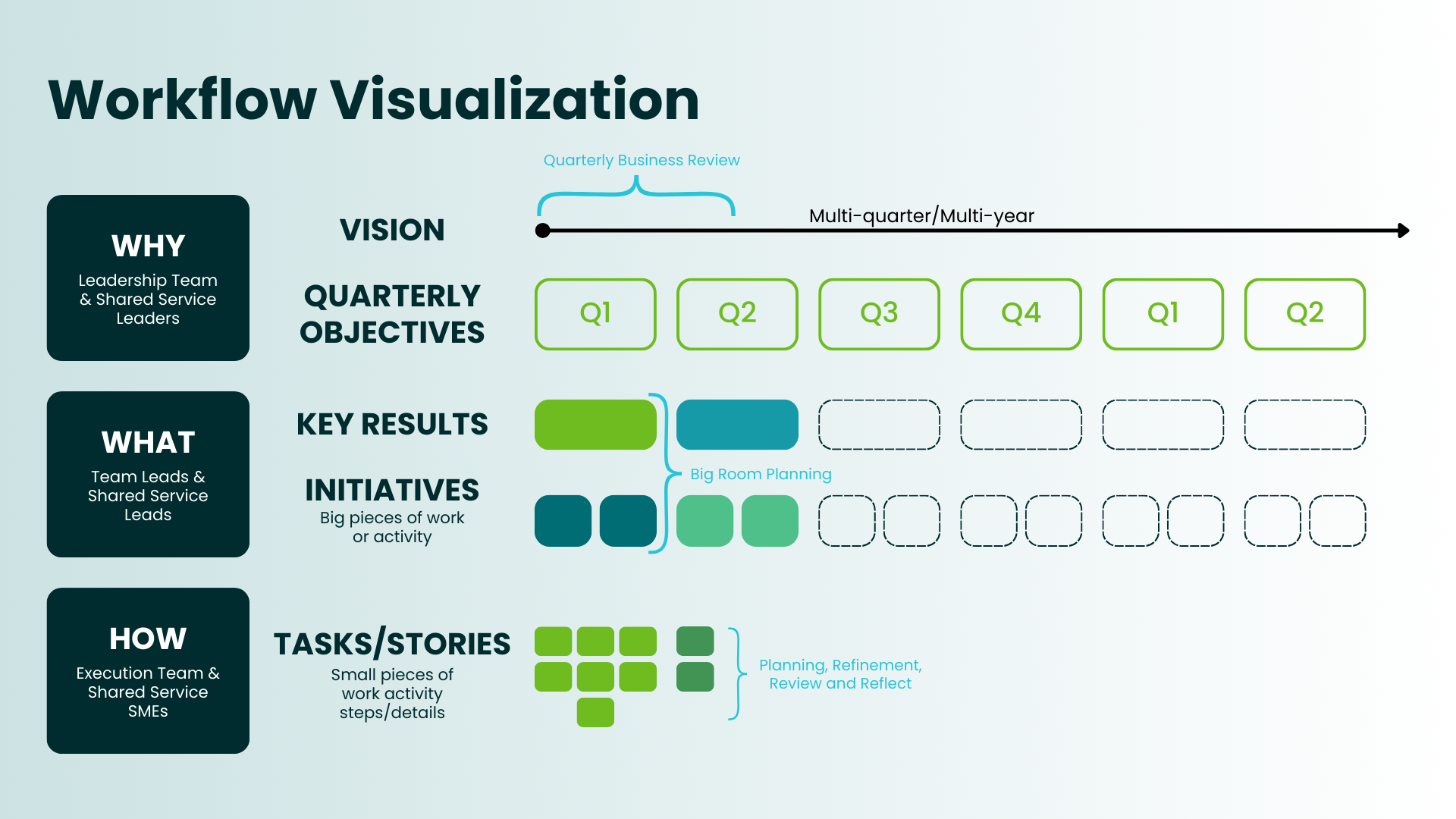
A shared, end-to-end view of work—from strategic intent through execution—creates the connective tissue between the organizational map and day-to-day delivery. It allows shared services to move from reactive intake to proactive planning, and it gives execution teams a clearer understanding of how their work ladders up to outcomes.
Three Levels of Work
Why
Vision and quarterly objectives, owned by leadership and strategy groups
What
Initiatives and key results, owned by team leads and shared service leads
How
Tasks and stories, owned by execution teams and shared service SMEs
This visibility is what turns the organizational model into a working system. When strategy, priorities, and execution are connected through a shared view of flow, shared services can plan capacity based on reality—not hope—and teams across the organization can make better tradeoffs together.
In other words, visualizing flow is how the roles and interaction points described earlier come to life in practice.
A Closer Look: A Regulated Shared Service Example (Medical Review)
While this blueprint is designed to work across any shared service—creative, data, analytics, compliance, or operations—it’s especially valuable in regulated environments.
Medical review is a useful example because it combines high expertise, significant risk, and unavoidable dependencies. In many organizations, it becomes the constraint that exposes weaknesses in the broader operating model.
When medical review is treated as a final approval step, everything slows down. When it’s integrated into the Agile system as a shared service with clear roles, planning visibility, and early interaction points, both speed and quality improve.
In this context, the same principles apply:
- Clear ownership of demand and prioritization
- Early involvement during planning and refinement
- Explicit capacity management
- A shift from gatekeeping to enablement
The takeaway isn’t that medical review is special—it’s that any high-skill, high-risk shared service benefits from intentional Agile design.
What This Model Enables
When organizations redesign shared services using this blueprint, the benefits show up quickly—and not just in delivery metrics.
First, teams experience far fewer surprises. Because shared services have earlier visibility into strategic priorities and upcoming work, demand no longer arrives all at once or at the last minute. This allows specialists to plan their time realistically and reduces the constant sense of urgency that drives burnout.
Cycle times also improve as rework decreases. Early involvement from shared services means feedback is incorporated while work is still forming, not after it’s been “finalized.” That shift alone can eliminate entire rounds of revision and approval, speeding delivery without sacrificing quality.
Quality itself improves because expertise is applied where it matters most. Instead of acting as late-stage gatekeepers, shared services become partners in shaping better work from the start. Risks are surfaced earlier, decisions are better informed, and teams gain confidence in what they’re delivering.
Perhaps most importantly, this model creates stronger strategic alignment across marketing. When everyone can see how work connects—from enterprise objectives down to execution—tradeoffs become clearer, conversations improve, and teams start optimizing for outcomes instead of local efficiency.

Getting Started: Practical Next Steps
Adopting this approach doesn’t require a sweeping reorganization, but it does require intention.
-
Start by formalizing scaled planning so upcoming campaigns, initiatives, and priorities are visible beyond individual teams. This shared visibility is what allows shared services to anticipate demand instead of reacting to it.
-
Next, bring shared services into the planning moments that matter most—particularly Quarterly Business Reviews and Big Room Planning. Their presence in these forums isn’t about adding overhead; it’s about ensuring commitments are realistic and risks are addressed early.
-
It’s also critical to identify clear Shared Service Team Leads. These roles provide a single point of coordination between execution teams and specialized functions, reducing confusion and helping balance demand across the system.
-
Finally, clarify responsibilities between Product Owners, Project Managers, and shared service leads. When prioritization, capacity planning, and decision-making authority are explicit, teams spend far less time negotiating work and far more time delivering value.
Progress comes from intentional design, not heroic effort.
Shared Services in Agile Marketing FAQ
What are shared services in Agile marketing?
Shared services are specialized teams or functions—such as creative operations, data and analytics, compliance, platform teams, or other centers of expertise—that support multiple Agile marketing teams. Instead of owning delivery for a single audience or backlog, they enable value delivery across the system.
Why do shared services often become bottlenecks in Agile marketing?
Shared services become bottlenecks when they’re designed outside the Agile system. Late engagement, unclear prioritization, limited visibility into upcoming work, and utilization-based metrics all contribute to overload and rework. The issue is rarely the people—it’s the operating model.
Do shared services need to be embedded on every Agile team?
No. Embedding specialists everywhere is usually inefficient and unsustainable. What matters more is clear interaction points, early involvement in planning, visible demand, and explicit ownership. Shared services can remain centralized while still operating in an Agile way.
How do shared services prioritize work across multiple teams?
Effective prioritization happens through shared planning forums like Quarterly Business Reviews and Big Room Planning. These create a system-level view of priorities, allowing shared services to balance demand, make tradeoffs explicit, and align their capacity with strategic goals.
Can this model work outside of regulated or enterprise environments?
Yes. While regulated environments make shared service challenges more visible, the same principles apply to creative, data, operations, and platform teams in organizations of any size. Any function supporting multiple teams benefits from clearer ownership, visibility, and flow.
What’s the first sign your shared services need to be redesigned?
If work consistently arrives late, priorities change without warning, teams rely on escalation to get things done, or shared services feel perpetually overwhelmed, those are signals of a system design problem—not a performance problem.
When shared services struggle in Agile marketing, the instinct is often to add more process, more approvals, or more tools. But as this blueprint shows, the real leverage comes from understanding where your system is misaligned and why work isn’t flowing the way it should.
If you’re not sure where those gaps are in your own organization, that’s the best place to start.
The Marketing Agility Scorecard by AgileSherpas is designed to help you quickly uncover the agility gaps slowing your team down—and point you toward practical ways to fix them. It gives you a clear, systems-level view of how strategy, execution, and shared services are actually working together today.
Take the Marketing Agility Assessment and see where your biggest opportunities for improvement are!
Designing better systems starts with seeing the one you’re operating in now.
Don't stop here. The Ropes unlocks 100+ hours of free Agile marketing courses, resources, and more — one free registration away.
Improve your Marketing Ops every week
Subscribe to our blog to get insights sent directly to your inbox.