




Nine years. That's how long we've been running this report. And I've never written an introduction to the data that felt this urgent.
Not because the findings are dramatic – though some of them are. But because the gap between what marketers who use Agile are experiencing and what everyone else is going through has gotten so wide that it's hard to look at these numbers and not feel a little shaken.
So no big intro this year. Let's get into it.
The Moment We're In (And Why Most Marketers Are Not Handling It Well)
Before we can talk about what the data shows, we have to talk about the environment in which the data was collected. Because context matters, and right now the context is: marketers are being asked to do more with less, prove strategic value they've never been asked to prove before, integrate an AI wave that isn't slowing down, and do all of this while their budgets are shrinking and their headcount is flat or declining.
Asked what would be a high priority for their teams in 2026, marketers told us:
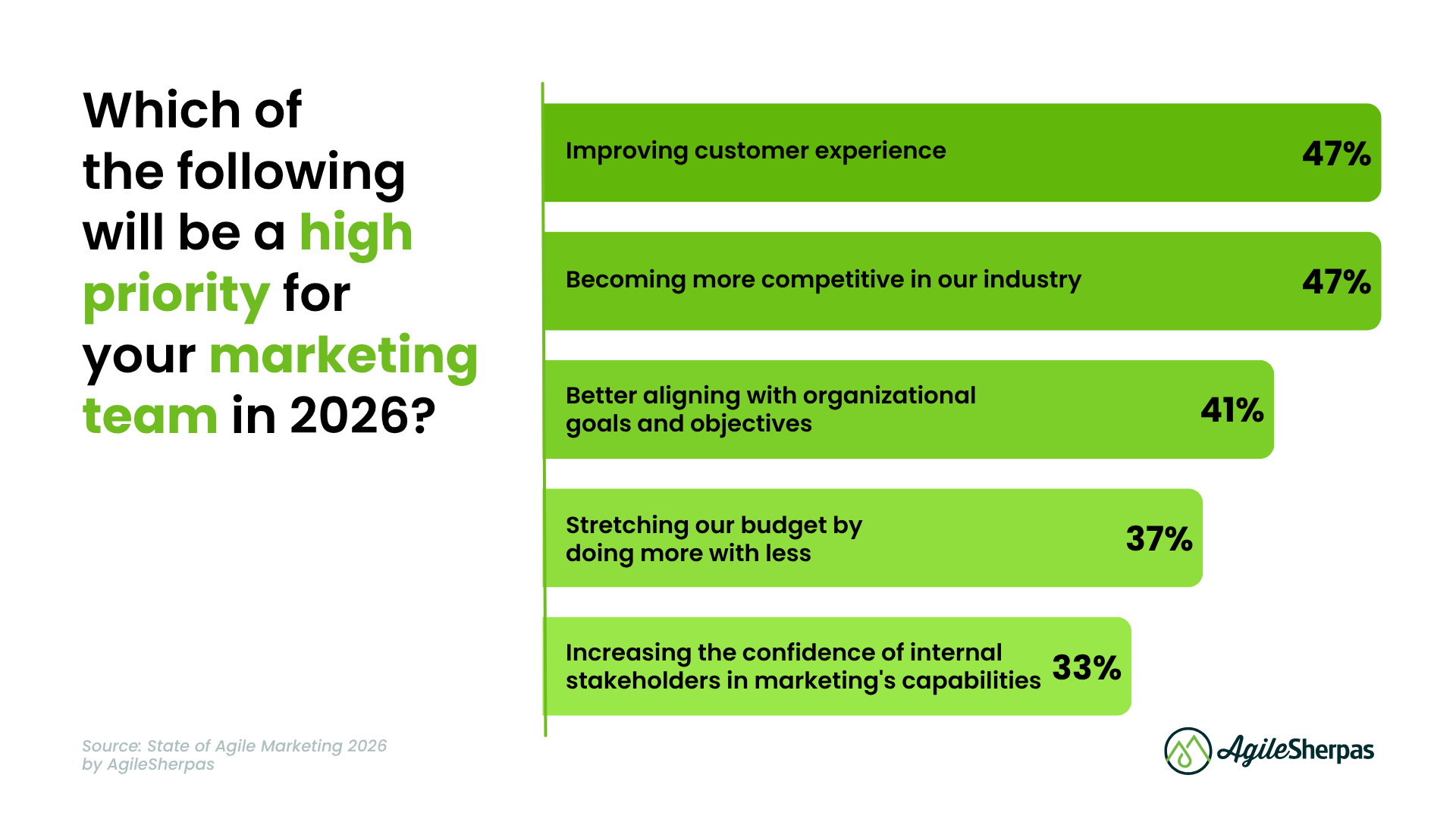
That's five different high-priority mandates simultaneously. That's not a to-do list; that's an impossible brief.
And that's before we even get to AI.
Here's the uncomfortable truth buried in that list: the third and fifth items – better aligning with organizational goals and increasing stakeholder confidence – are fundamentally about marketing's credibility and influence within the business.
Marketers aren't just struggling to get work done. They're struggling to be seen as strategic partners. That's a deeper problem than any tactical fix will solve.
If you look at this through the lens of our Agile Marketing Operating System, you can see exactly where the fracture lines are.
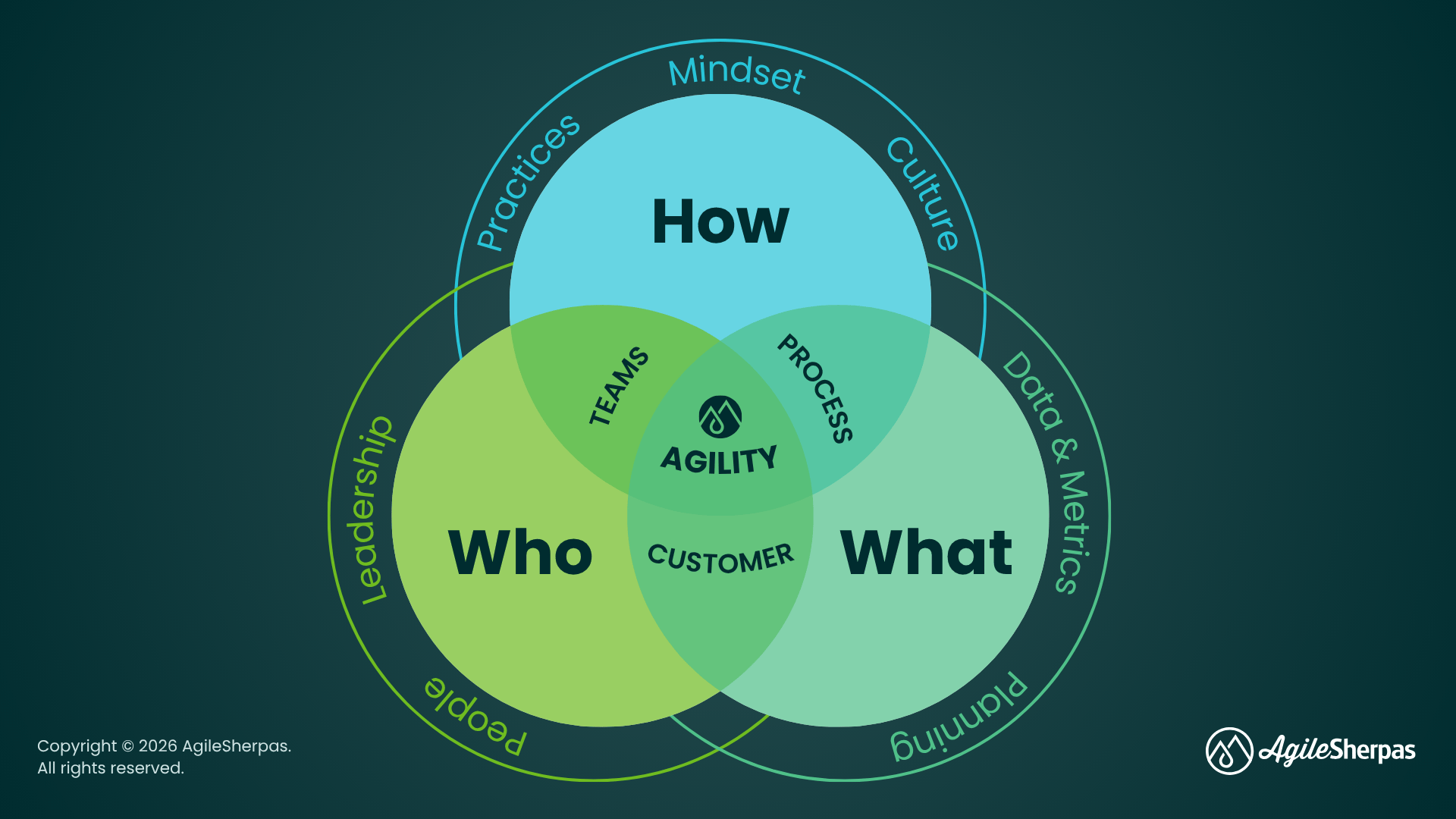
The What – strategy, planning, priorities, goals – is under pressure from every direction. The Who – leadership alignment, organizational trust, the relationship between marketing and the rest of the business – is fractured. And the How – day-to-day execution, processes, culture – is where most teams are stuck in reactive mode, unable to escape it.
The good news: 25% of marketers have a working answer to all three. The less good news: that leaves 75% without one.

The Adoption Picture: Honest, Not Optimistic
Twenty-five percent of respondents say they're currently using Agile marketing. Another 25% are past users. Twenty-seven percent have never used it. And 23% – nearly one in four marketers – don't know what it is.
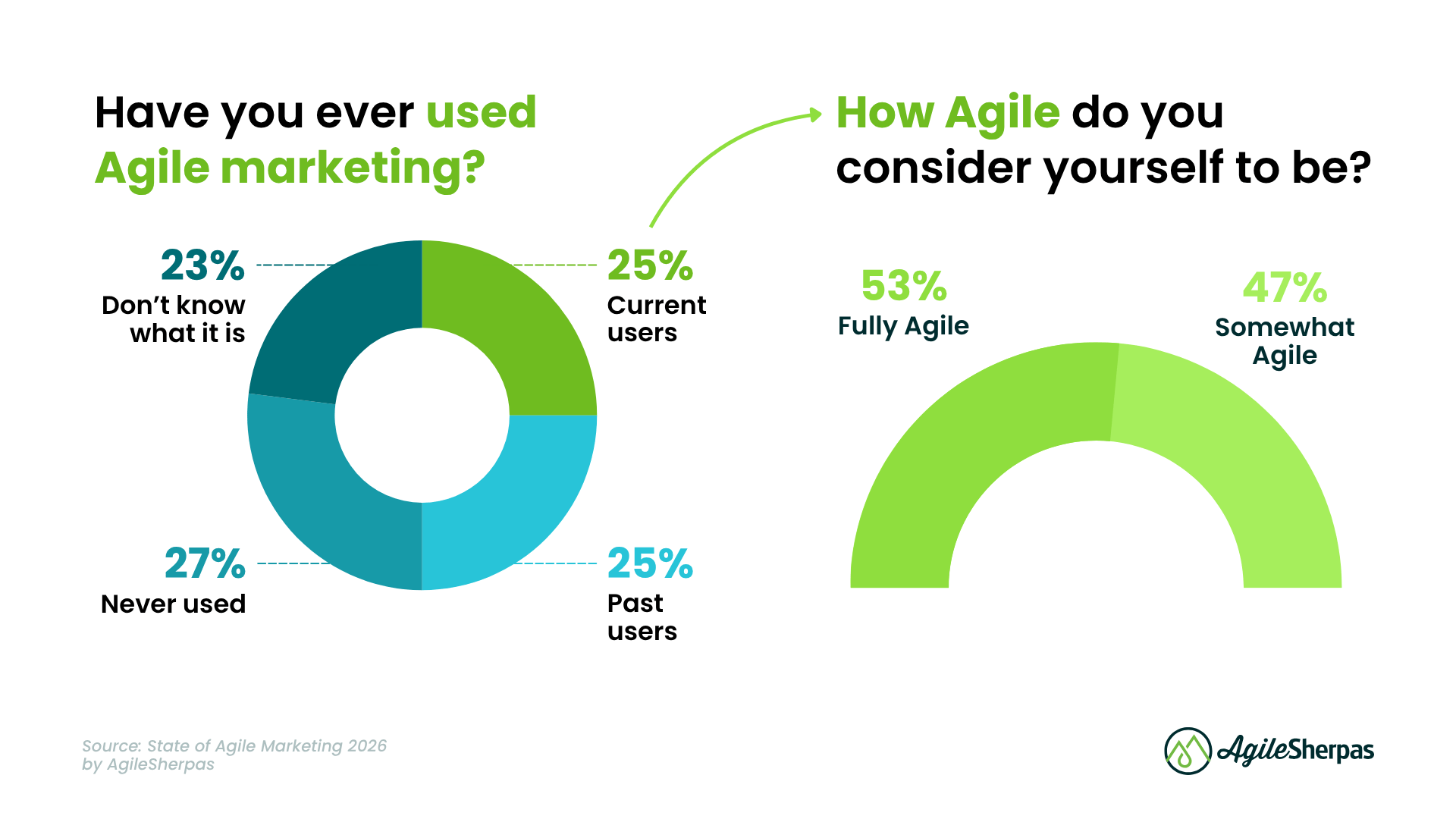
I'll sit with that last number for a second. After nine years of running this report, after all the content and certifications and conferences and communities built around Agile marketing, nearly a quarter of the marketers we surveyed have never heard of it.
That's not a marketing problem for AgileSherpas (though I will certainly take it as a personal challenge).
That's a signal about the enormous untapped potential sitting in the industry – and an honest reminder that adoption is not a given. It has to be earned, explained, and proved every single year.
What makes 2026 distinct, though, isn't the overall adoption number. It's the compounding effect happening inside adoption.
Among current Agile users, 76% are working in organizations where more than half the marketing teams are also Agile.
We've consistently found that the benefits of Agile don't just add up as more teams adopt it – they multiply. And the data confirms that trend is continuing.
But – and this is important – 47% of current Agile users describe themselves as only "somewhat Agile."
Half the Agile marketing population is working with an incomplete system.
They've picked up some practices. They're running sprints or using a Kanban board. But they haven't built the full operating model. That partial adoption has real consequences, and we can see them throughout this year's data.
The Operating System Lens: What, Who, and How
One of the reasons I find this year's report so interesting is that we built the Agile Marketing Operating System to help marketers think about agility as a complete system – not a collection of tools and tactics. When I look at the 2026 data through that lens, the story becomes much clearer.
What (Strategy, Planning, Data, Prioritization)
The strategy and planning data this year is some of the strongest we've ever collected, and also some of the most frustrating, because it shows exactly what's possible and exactly how many teams are leaving it on the table.
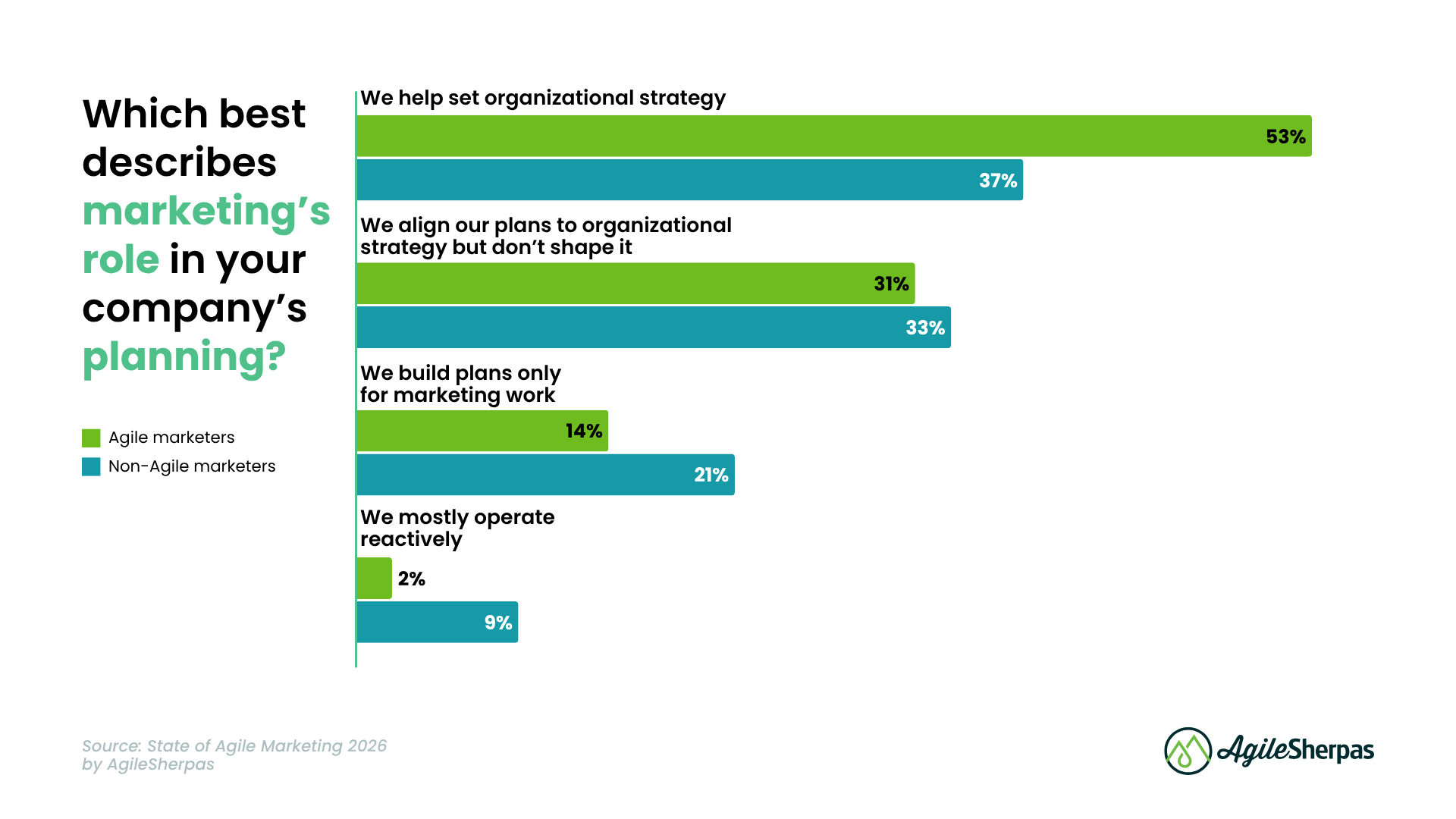
Fifty-three percent of Agile marketers say their team helps set organizational strategy – not just align to it, but actively shape it. Only 37% of non-Agile marketers say the same.
Meanwhile, 9% of non-Agile marketers say they mostly operate reactively. Being reactive isn't a strategy. It's a symptom of not having one.
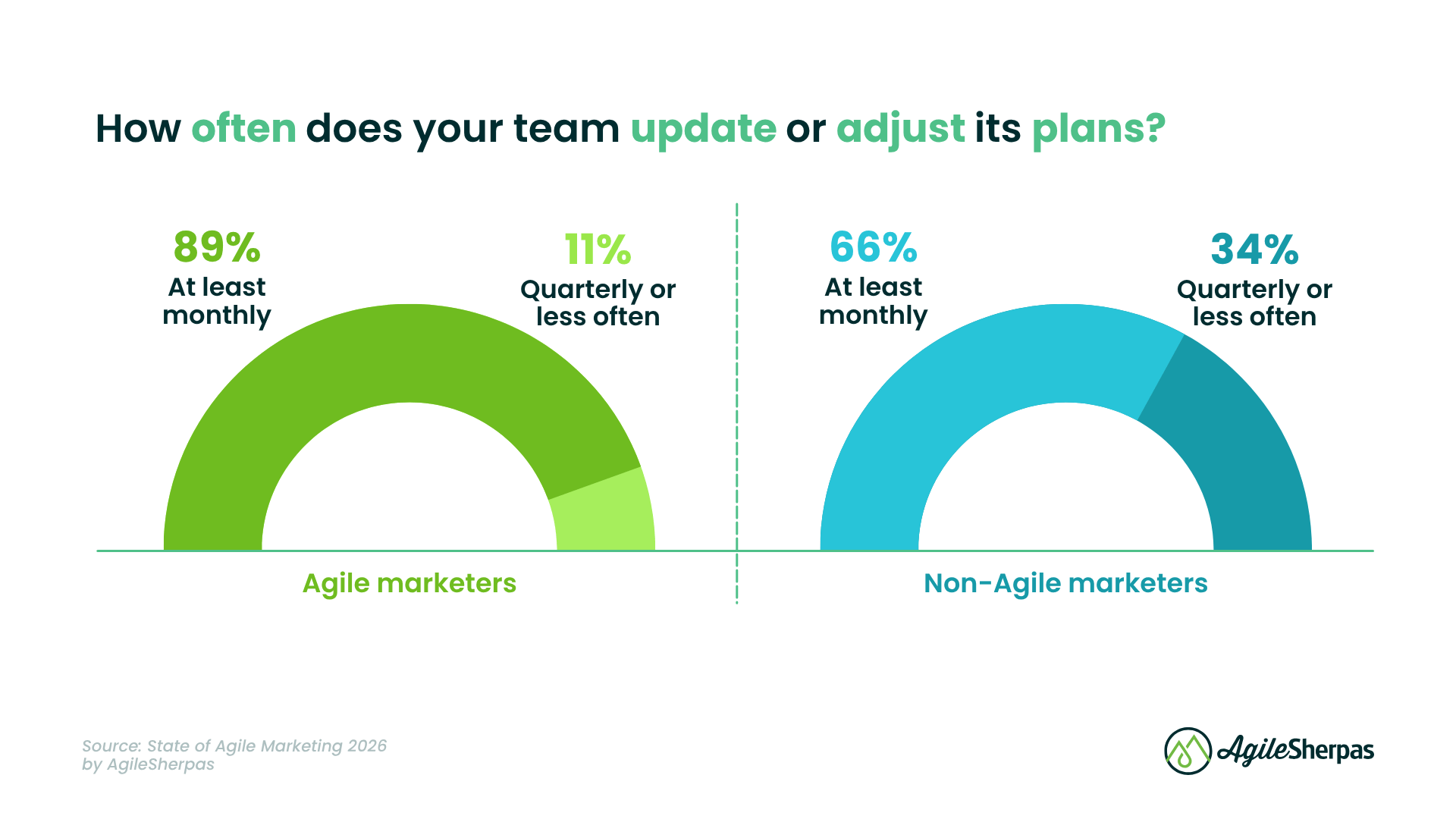
The planning frequency data is equally telling. Eighty-nine percent of Agile marketers update or adjust their plans at least monthly. Only 66% of non-Agile marketers do.
That 23-point gap is the difference between teams that can respond to change and teams that are always a quarter behind it.
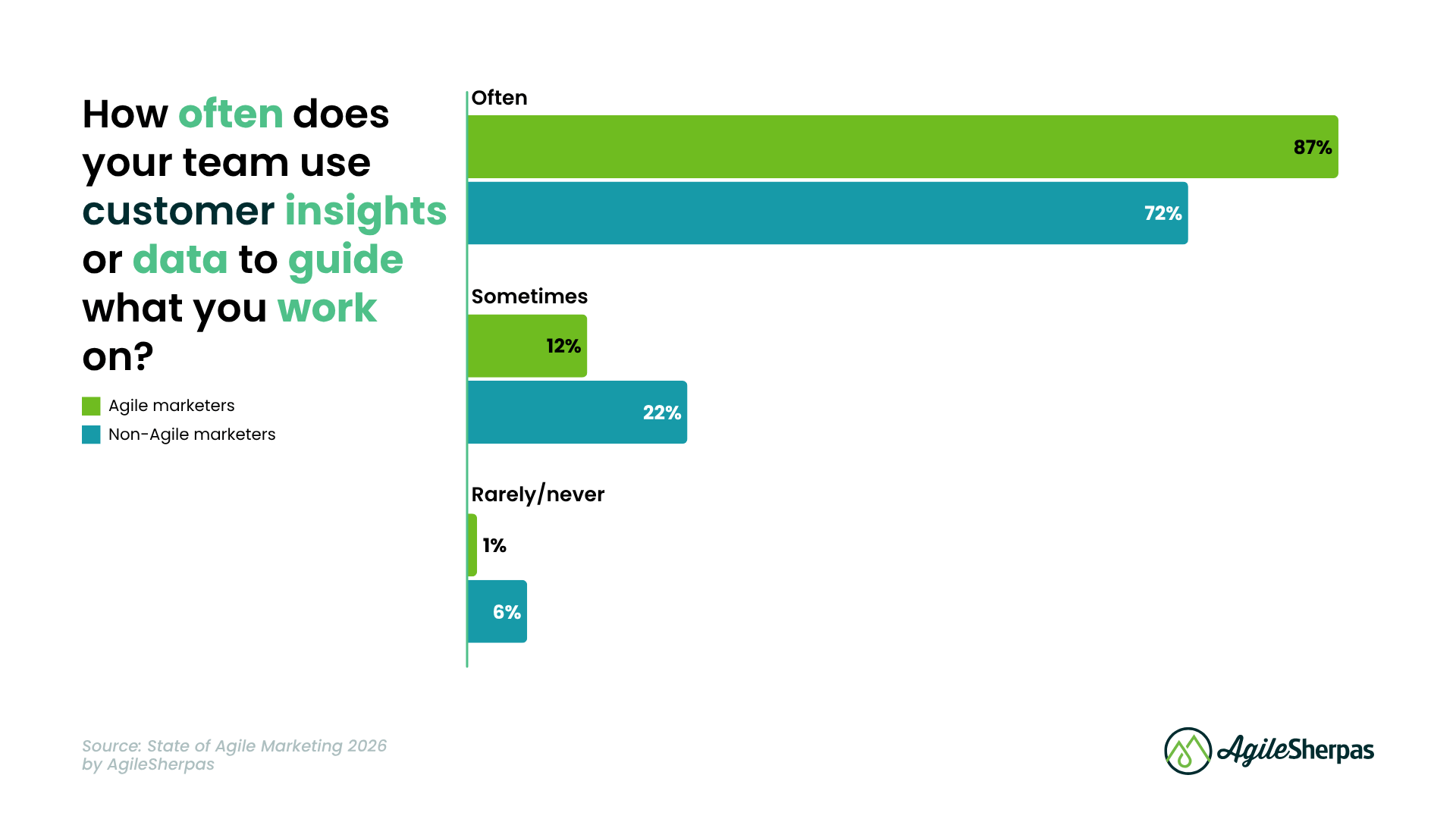
What's driving that more frequent adaptation? Customer data. Eighty-seven percent of Agile marketers say they often use customer insights or data to guide what they work on, versus 72% of non-Agile teams. That's not just a process difference. That's the difference between marketing that actually learns from its market and marketing that is perpetually guessing.
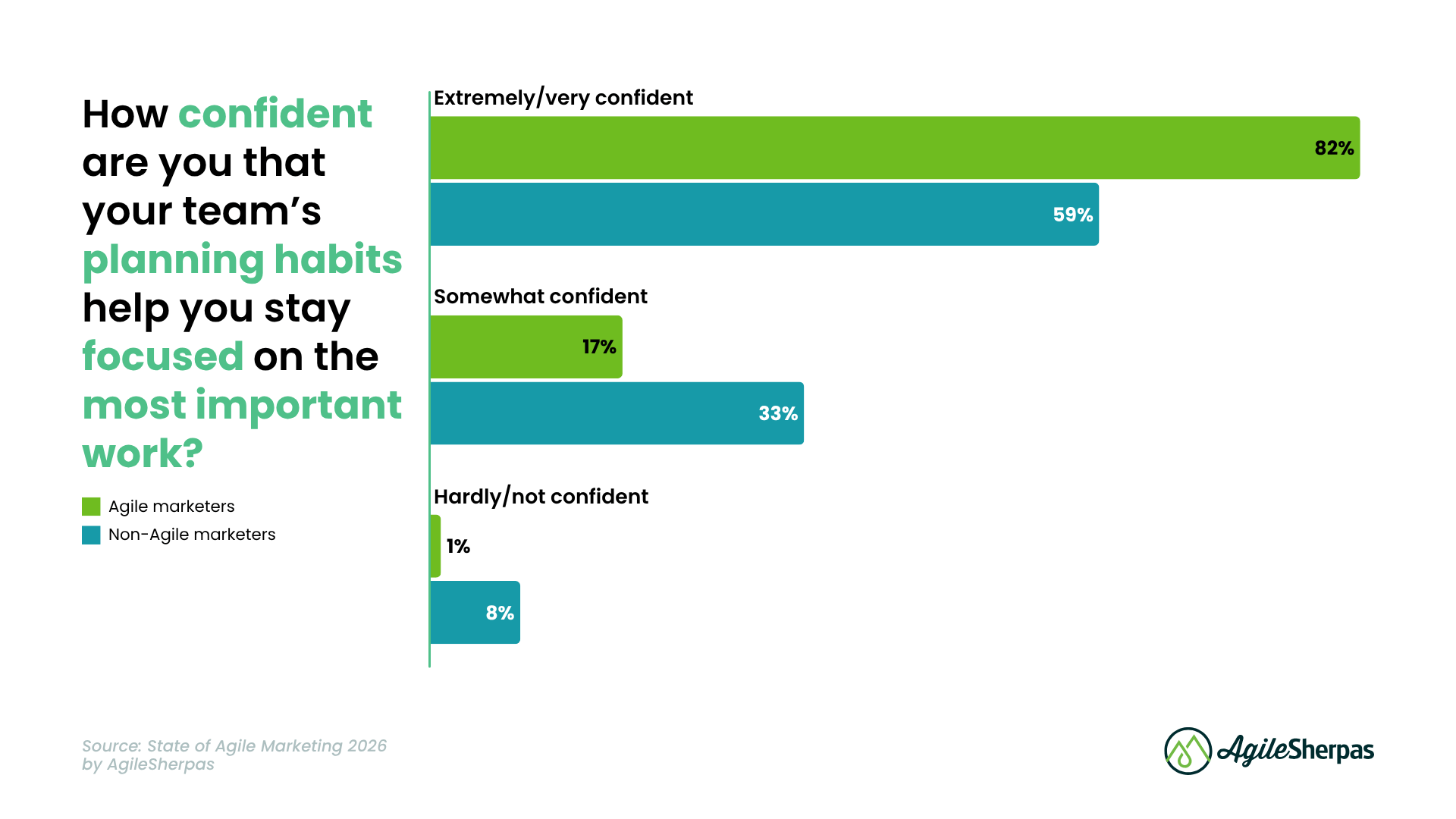
And here's the confidence data I want to highlight: 82% of Agile marketers are extremely or very confident that their planning habits help them focus on the most important work. Among non-Agile marketers? 59%.
It's important to appreciate what that gap actually means. It's not just a confidence score. It's a measure of whether people feel like their work time is being spent on things that matter.
If four in ten of your marketers feel like they're not focused on what matters most, you have a prioritization crisis. And a morale crisis. Often simultaneously. So that’s fun.
Before you keep reading, The Ropes gives you 100+ hours of FREE Agile marketing courses, exclusive resources, and certification & coaching giveaways — completely free.

Who (People, Leadership, Teams, Customers)
The collaboration findings this year are stark. Ninety-two percent of all marketers report collaboration challenges. Nearly universal. But the nature of those challenges differs dramatically based on whether or not your team is Agile.
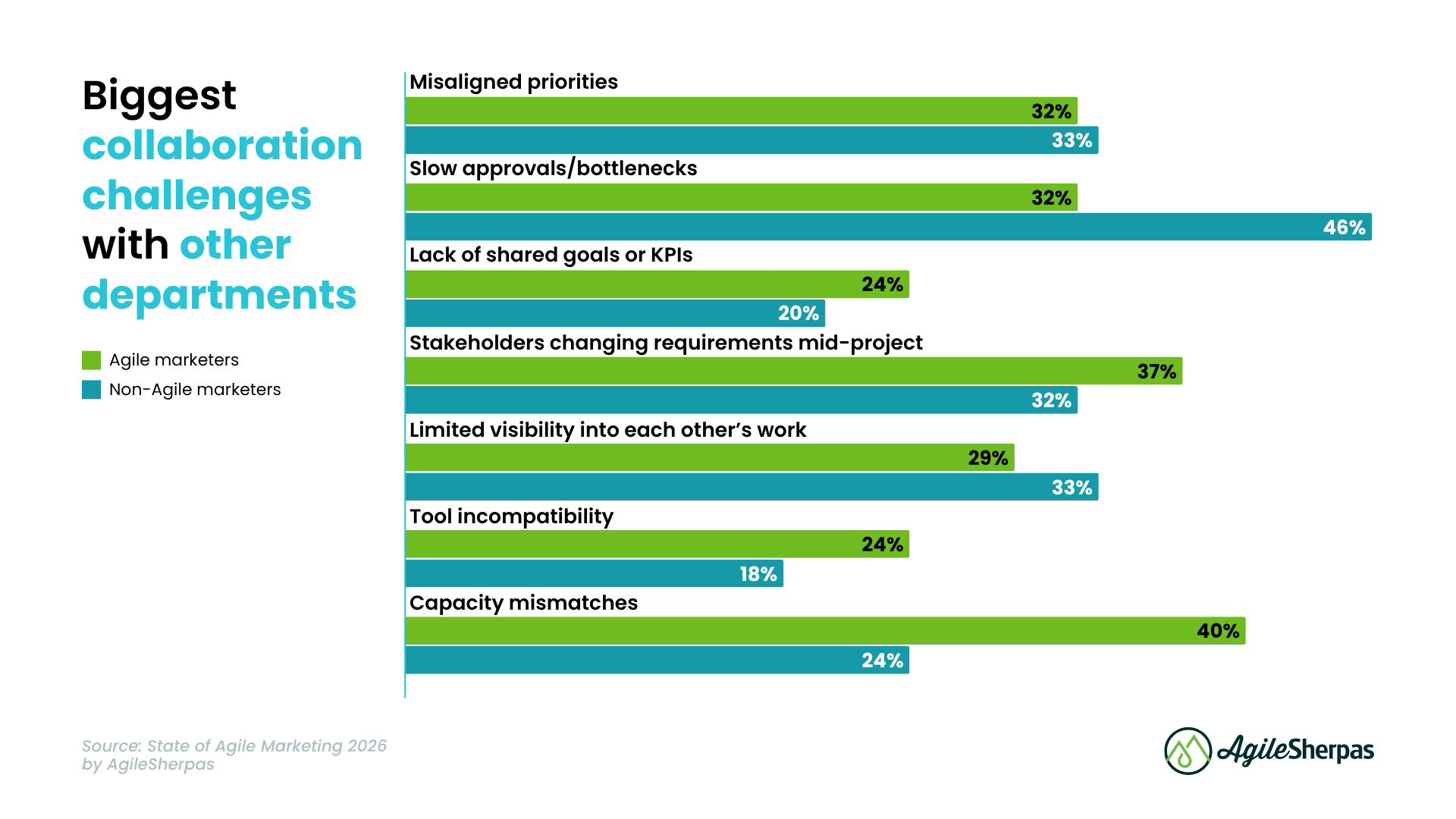
Non-Agile marketers are being held back primarily by slow approvals and bottlenecks – 46% cite this as a top challenge. That is a structural, process problem. It means the How and the What aren't working together, and the whole Who – stakeholders, leadership, other departments – can't move with any speed or confidence.
Agile marketers have largely solved the process problem: their biggest cross-departmental challenge is capacity mismatches – 40% cite this. Which means their team is moving fast and iteratively, but the departments they depend on (legal, product, sales, IT) aren't structured the same way. They've upgraded their operating model; they're now hitting the ceiling of the organizations around them.
That's actually a sign of progress, even if it doesn't feel like one. You can't get to the capacity mismatch problem without first solving the bottleneck problem.
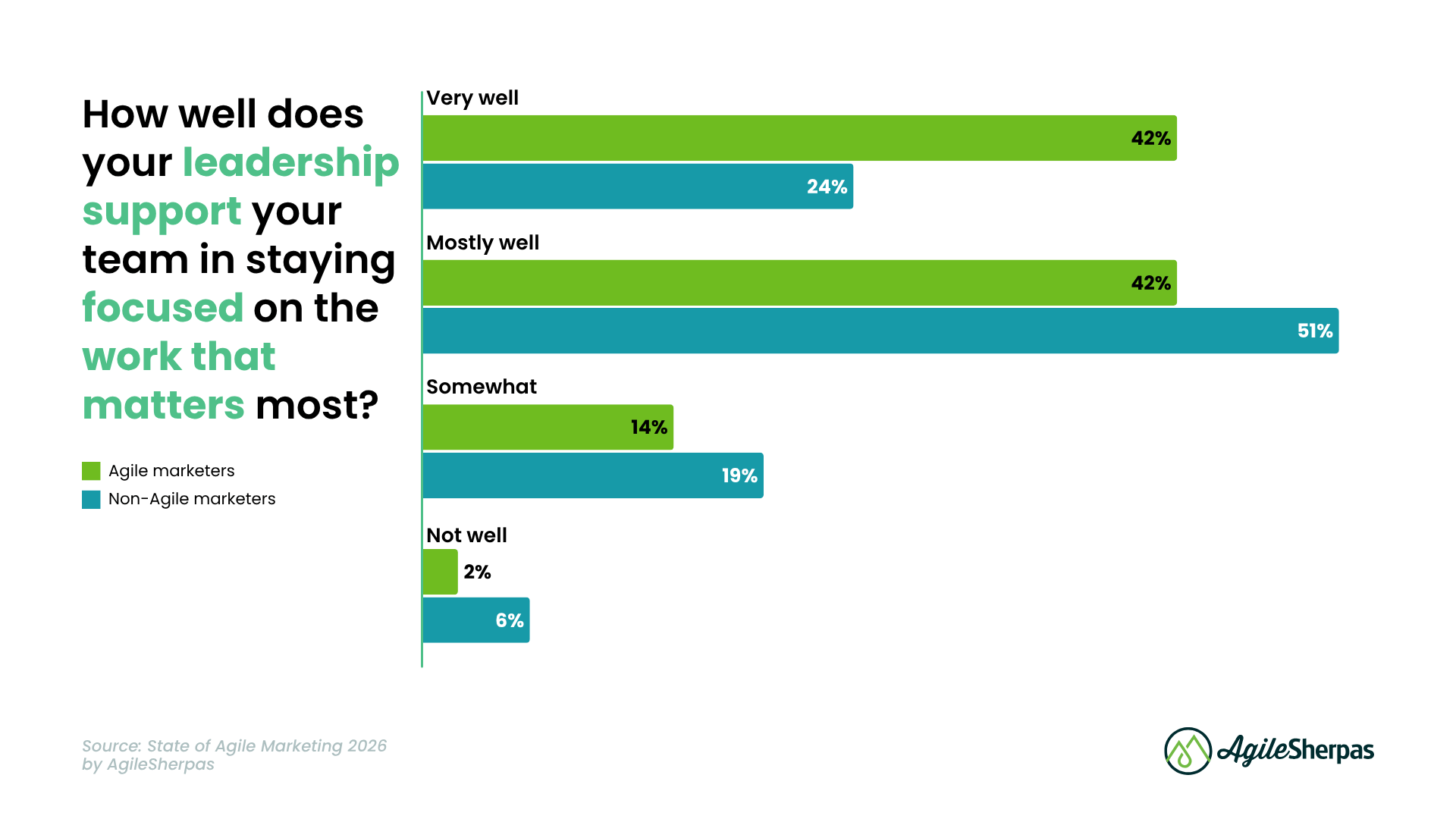
The leadership support data deserves its own paragraph. When asked how well leadership supports their team in staying focused on the work that matters most, 93% of Agile marketers say "very well" or "mostly well,” versus 65% of non-Agile marketers.
That is a massive gap.
And when you cross-reference it with the barriers to agility (lack of leadership support, unclear priorities, frequent interruptions – all in the top five for most teams), you start to see a feedback loop: teams without leadership alignment struggle to stay Agile, which means they don't get the outcomes, which makes it harder to make the case for sustained investment, which means leadership never fully commits.
How do you break that cycle? You start by helping leaders understand what they're actually buying when they invest in Agile.
Not a framework. Not a set of rituals. An operating system that gives them better visibility, better responsiveness, and a team that can actually be trusted to execute on strategy.
How (Practices, Process, Mindset, Culture)
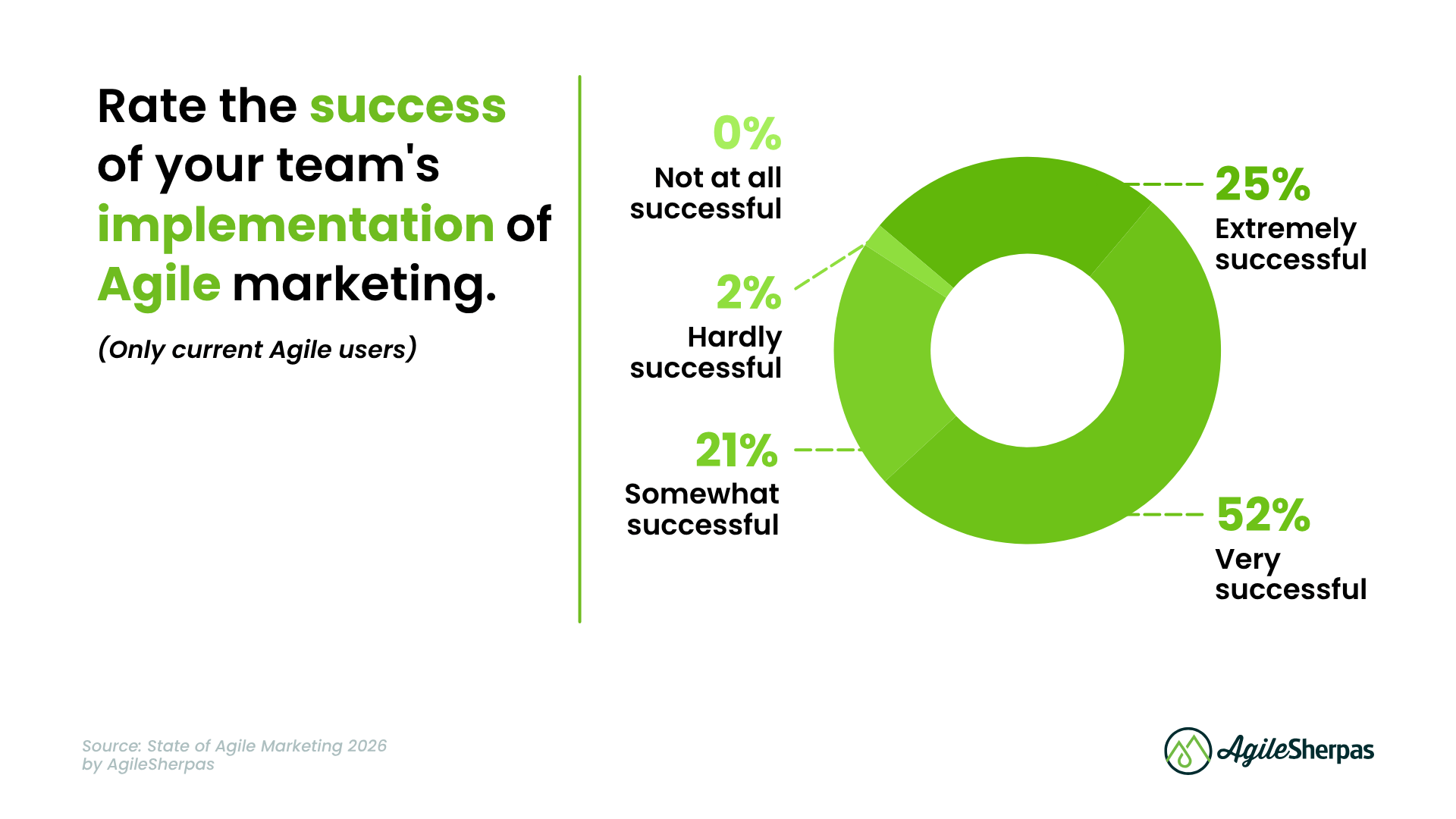
Ninety-eight percent of current Agile marketers rate their implementation as successful. That's the fourth year in a row we've seen this number in the high nineties – and I still think it catches people off guard when they first see it. We're conditioned to expect that transformation initiatives mostly fail. Here is a data point that says something different.
But there's a nuance worth unpacking. The most successful Agile marketers aren't just doing more Agile practices than their less successful counterparts – they're doing specific ones.
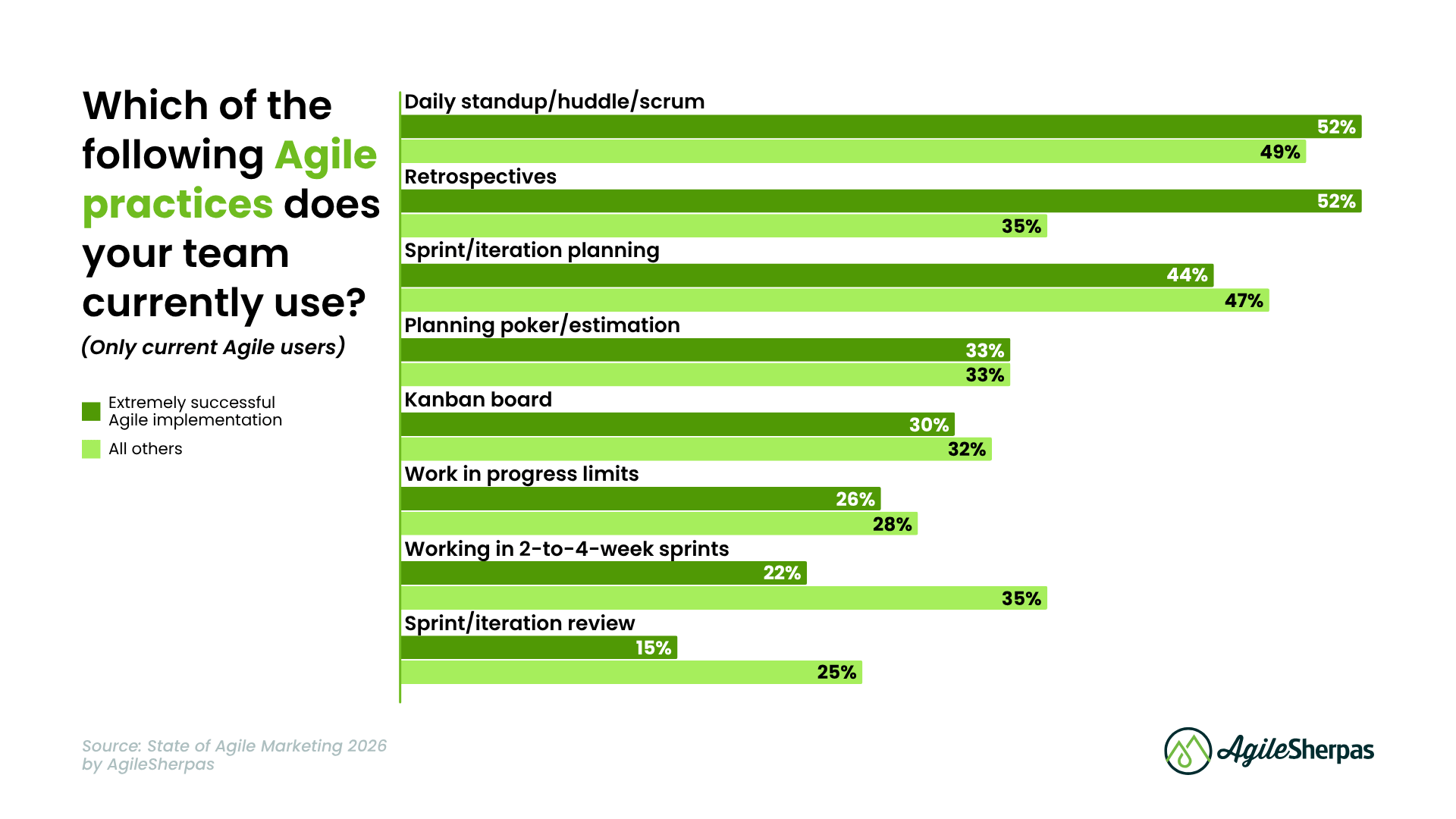
Retrospectives stand out. Fifty-two percent of extremely successful Agile marketers use retros, versus 35% of others. Retrospectives are the practice most likely to be skipped when teams get busy (because they feel like a luxury when you're behind) and most likely to be the thing that actually makes you less behind over time. The data has been consistent on this for years. And yet teams keep skipping them.
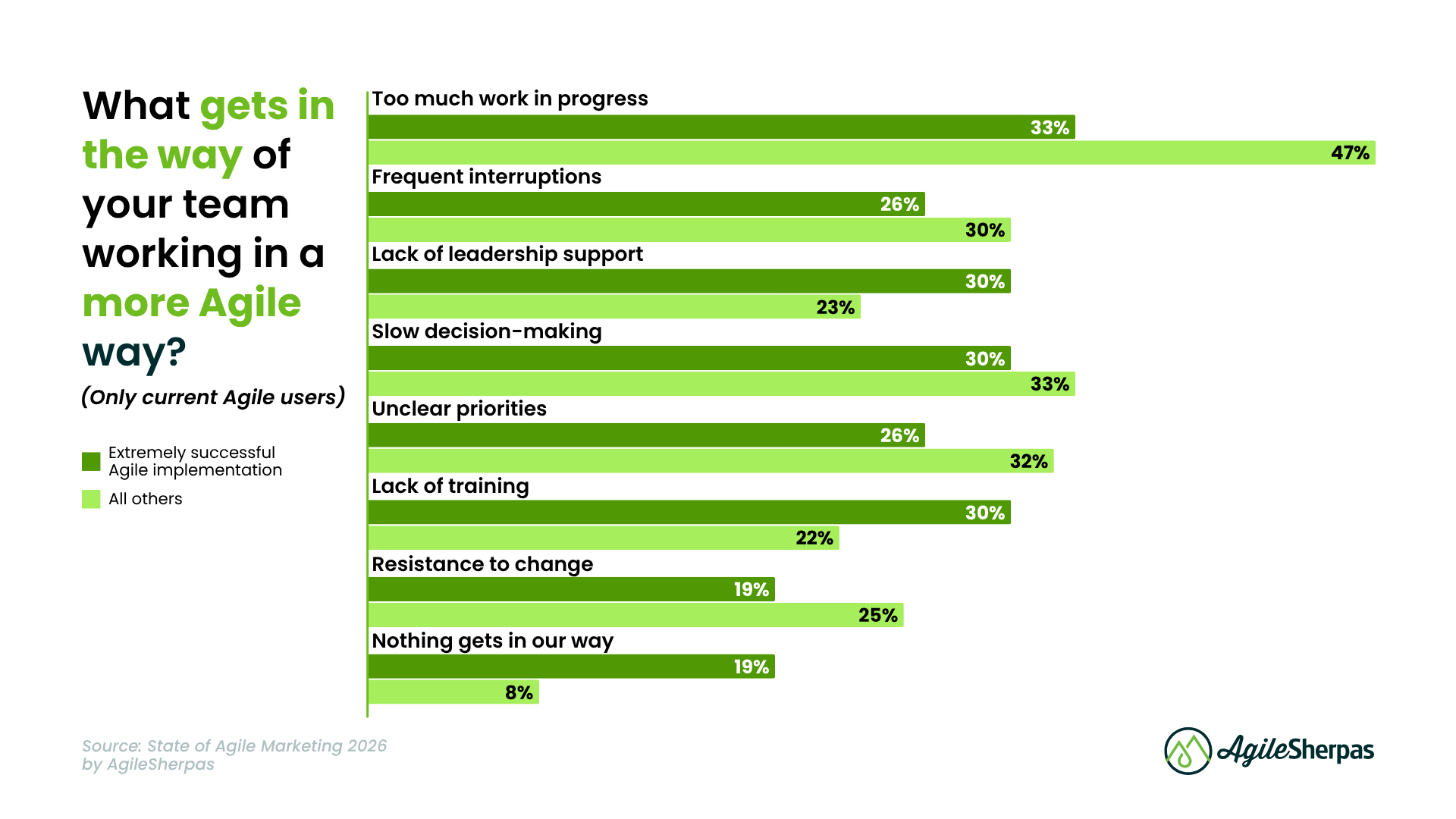
Work in Progress limits remain the biggest operational barrier for Agile marketers – the number one thing getting in the way. We've been writing about WIP since our very first report; it hasn't gone away.
If anything, in an environment of shrinking teams with expanding mandates, WIP is a bigger problem in 2026 than it's ever been. Every "yes" to a new initiative without a corresponding "no" or "not yet" somewhere else is a WIP problem in disguise.
The operational well-being data is worth pausing on, because it tends to get lost in the sea of productivity metrics.
Eighty-seven percent of Agile marketers say Agile improved their productivity. Seventy-seven percent say it helped them feel less stressed. Those two numbers appearing together – more productive and less stressed – is not what we're conditioned to expect from transformation initiatives. Usually you trade one for the other. Agile, when implemented well, doesn't make that trade. It rejects the premise.

The AI Story: A Diverging Road
Let me be direct about what the AI data in this year's report is telling us, because I think it's the most important trend in the 2026 findings.
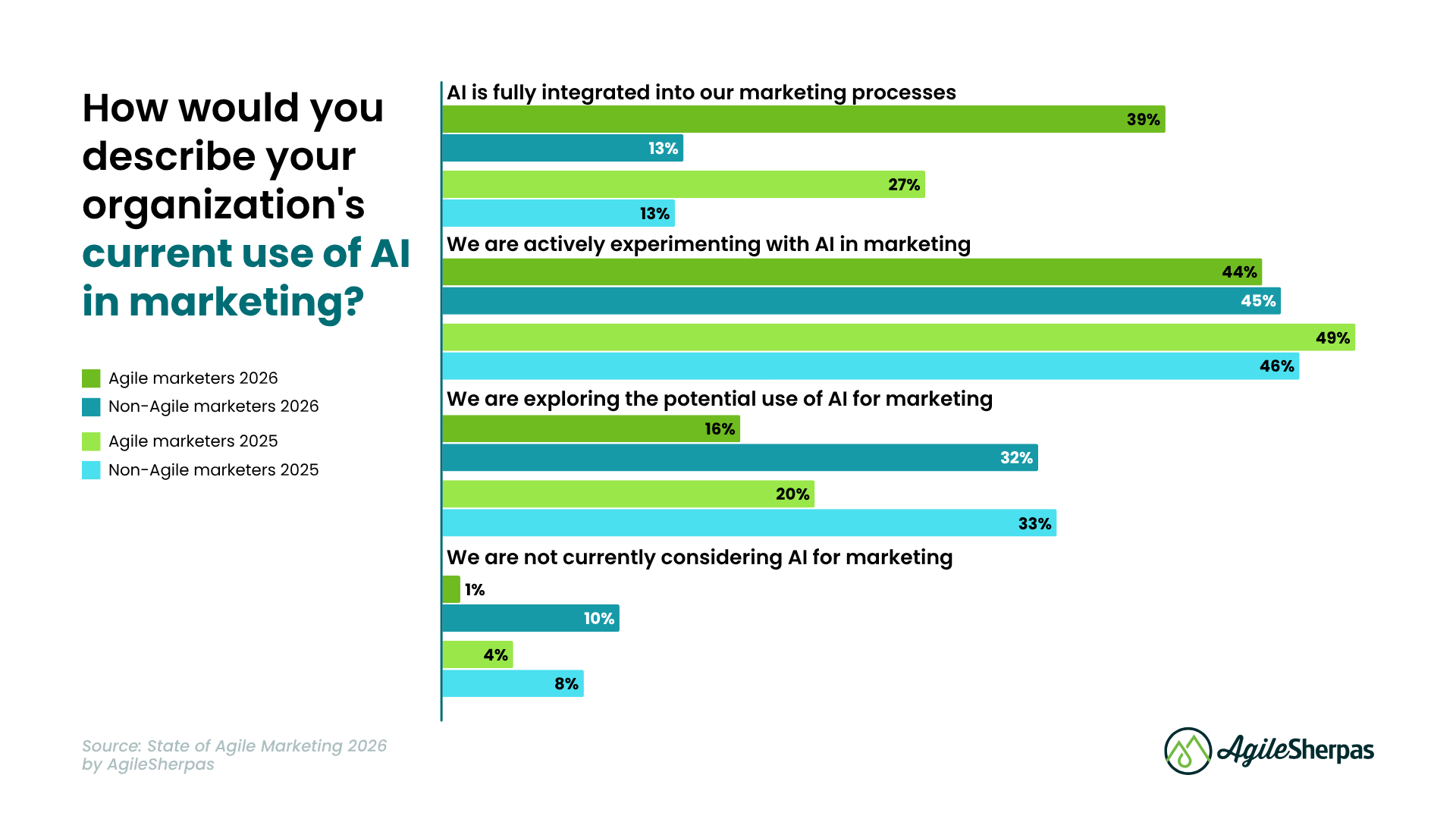
Agile marketers are three times more likely than non-Agile marketers to have AI fully integrated into their marketing processes: 39% versus 13%.
And that gap has grown since 2025, when it was 27% versus 13%.
Non-Agile teams have been essentially flat on full AI integration for two consecutive years, while Agile teams have jumped 12 percentage points.
Why? The easy answer is that Agile teams are more comfortable with change. But the more accurate answer is structural.
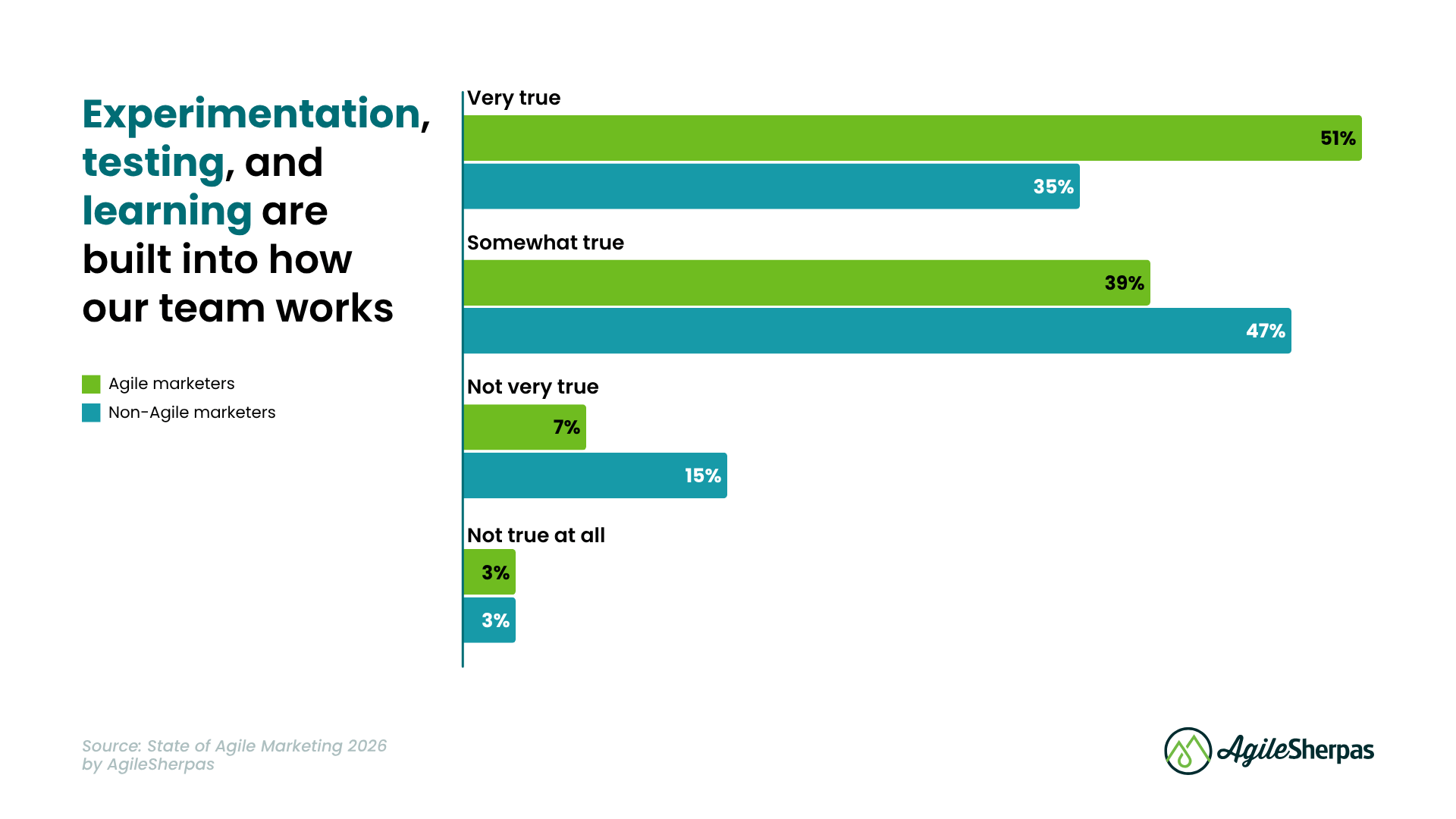
Ninety percent of Agile marketers say experimentation, testing, and learning are key parts of their work process. Only 74% of non-Agile marketers say the same.
That test-and-learn infrastructure is what allows you to experiment with AI safely, learn what works, iterate, and embed it. Without that infrastructure, AI adoption looks like risk rather than opportunity – and the data shows that's exactly how non-Agile teams experience it.
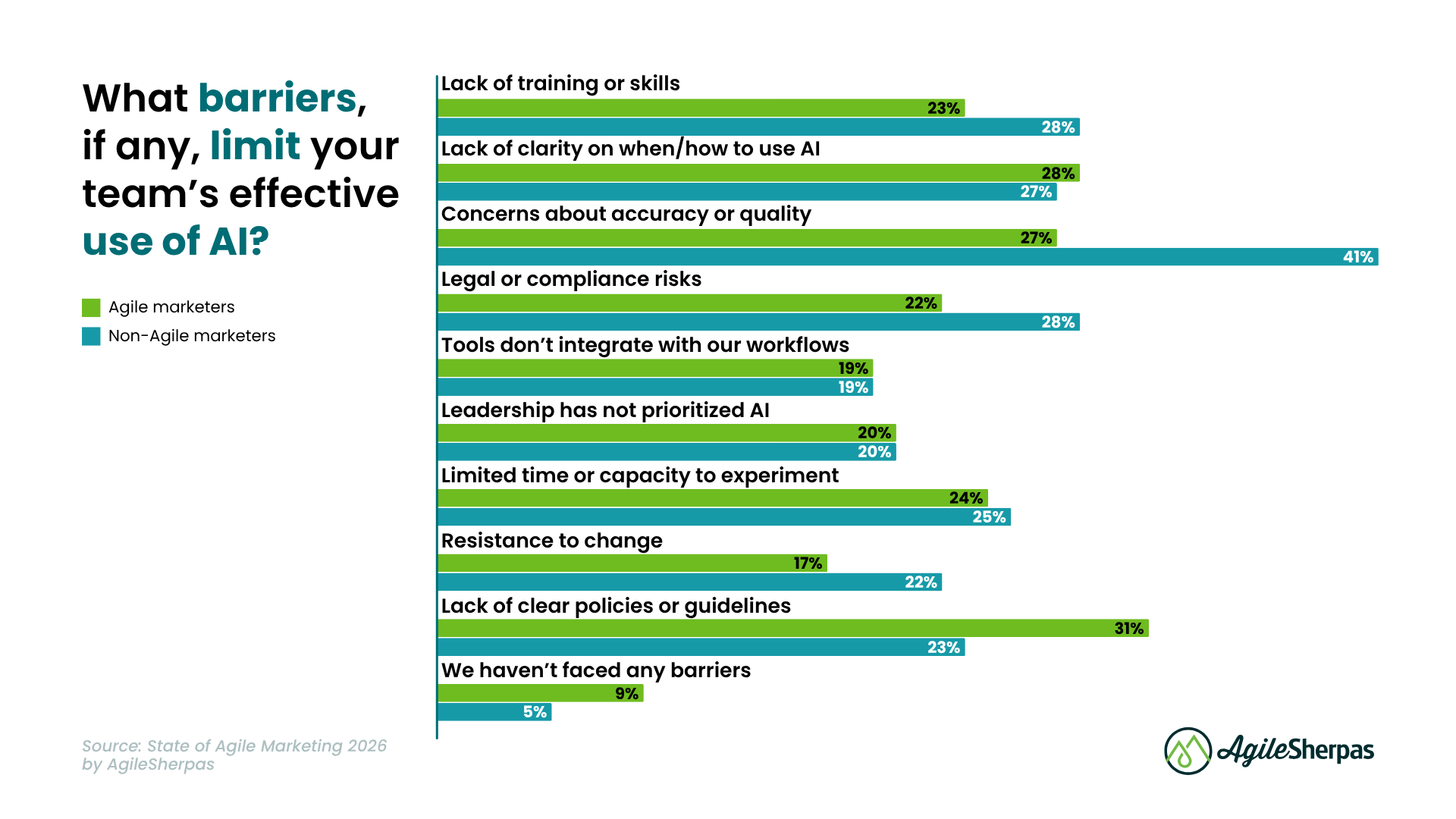
The barrier data is where this divergence becomes almost philosophical. Non-Agile marketers' top AI barrier is concerns about accuracy or quality – a trust problem.
They're still deciding whether to believe AI works at all. Agile marketers' top barrier is lack of clear policies or guidelines. They've already moved past "does this work?" into "how do we govern this responsibly?"
That is not a small difference. That is a fundamentally different relationship with the technology, and it will compound.
The teams that are already navigating governance questions in 2026 will be significantly further along in 2027 and 2028; the teams still stuck on trust will be playing catch-up for years.
I've said before that the AI adoption cycle is running the same playbook as the Agile adoption cycle, just on fast-forward.
The skeptics who waited too long to adopt Agile found themselves behind competitors who moved earlier. The same thing is happening with AI right now, except the window is narrower and the penalty for waiting is larger.
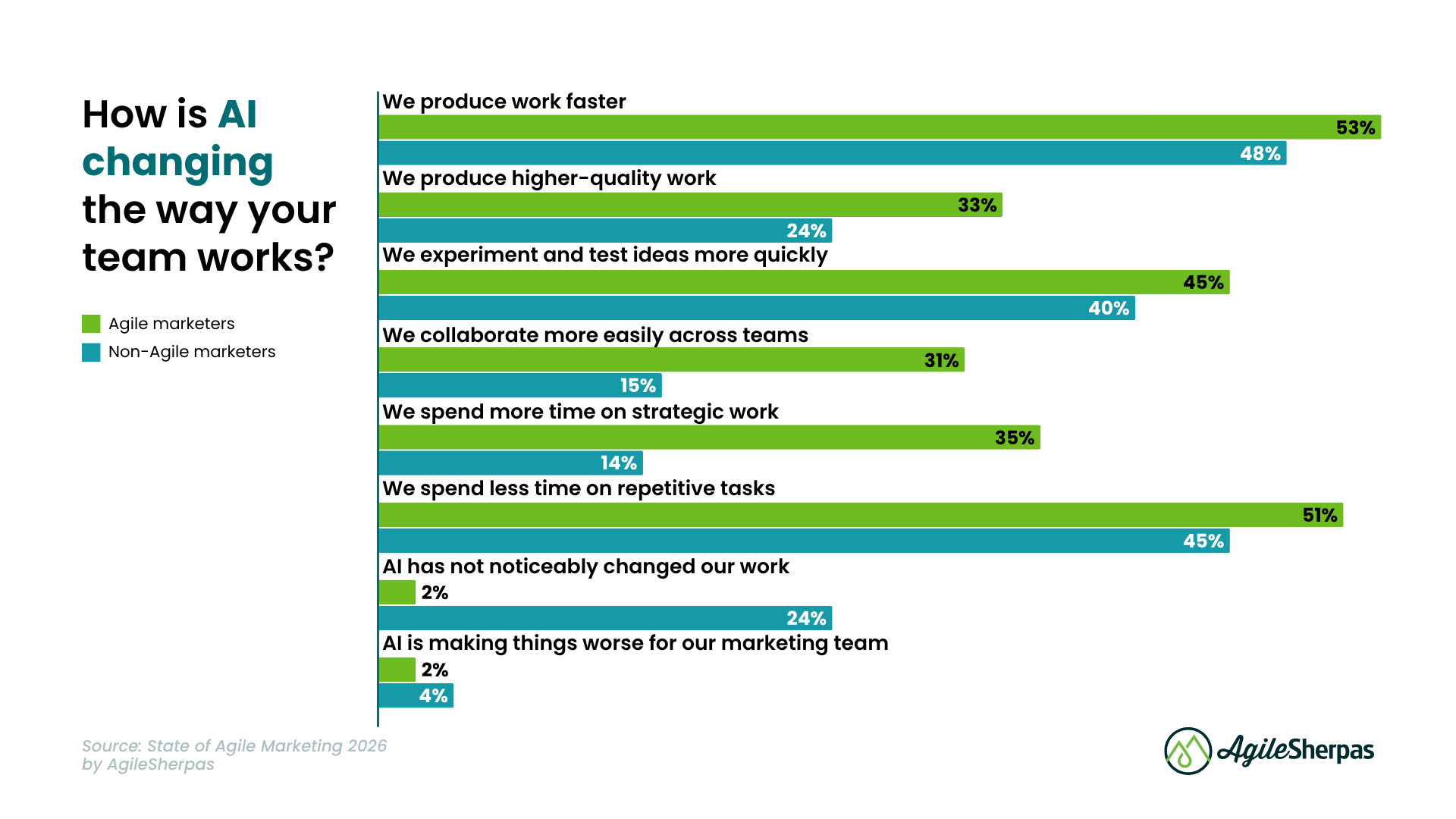
The outcomes data confirms the gap is already showing up in results: Agile marketers who use AI are more likely to report spending more time on strategic work (35% vs. 14%) and to say AI has made them better at cross-team collaboration (31% vs. 15%).
Those aren't efficiency gains. Those are strategic and relational gains, the kind that show up in influence, in promotions, in budget allocations. You want those, right?
The Strategic Value Problem (And Who's Actually Solving It)
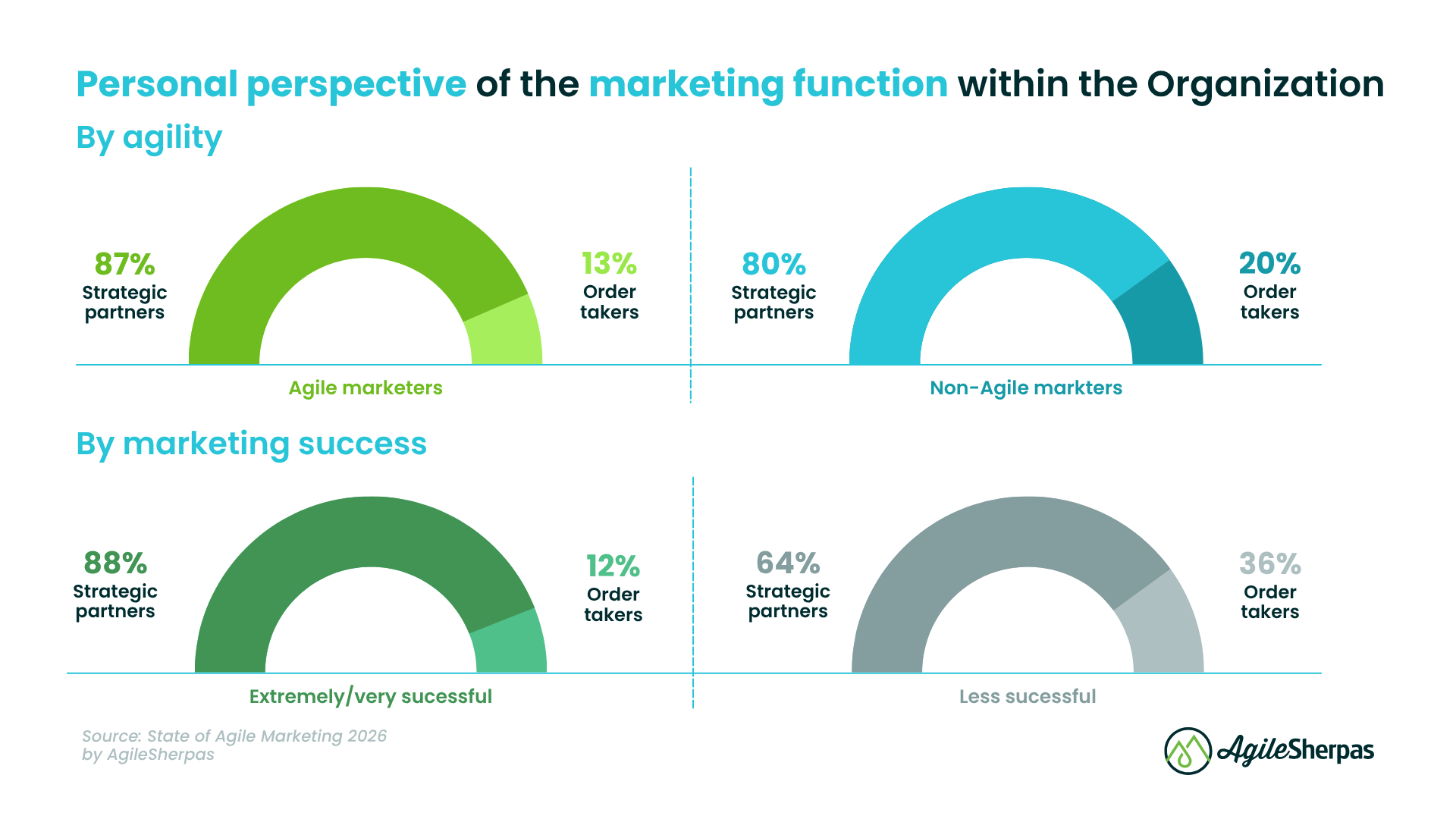
One of the through lines in this year's data is about marketing's identity problem. Eighty-two percent of marketers overall believe they create strategic value within their organization rather than just taking orders.
That sounds good. But when you dig in, a different picture emerges.
Among Agile marketers, 87% see themselves as strategic partners. Among non-Agile marketers, 80% do.
Now look at the success split: 88% of extremely or very successful Agile marketers see themselves as strategic partners, versus only 64% of less successful ones.
There is a 24-point gap between thriving Agile marketers and struggling ones on whether they believe they create strategic value.
That's not just a perception gap. It's a self-concept gap.
Teams that don't believe they're strategic partners will behave like order-takers – which makes them order-takers – which proves to the organization that they're not strategic partners.
It's a loop, and Agile marketing is one of the most effective tools we've found for breaking it.
Here's why:
- Agile marketers are more likely to actually help set organizational strategy (53% vs. 37%).
- They're more likely to say their daily work clearly connects to strategic goals (73% vs. 59%).
- They're more likely to have protected time to think strategically (54% regularly, vs. 29% of non-Agile teams).
- They're 80% viewed as extremely or very reliable by other departments, compared to 66% of non-Agile teams.
Reliability is underrated as a strategic asset. It's not glamorous. But a marketing team that other departments trust to show up, communicate well, and deliver what they say they're going to deliver is a marketing team that gets invited into the strategic conversations.
The Agile Operating System doesn't just make marketing more efficient; it makes marketing more trustworthy. And in organizations where marketing is fighting for influence, trustworthiness is the whole game.

What The Multi-Year Arc Tells Us
Nine years of data gives you permission to say something about trajectory rather than just snapshot. Here's what I see when I look at the arc.
The question of whether Agile marketing works has been answered. Not tentatively – definitively.
We have not found a single respondent with a negative experience with Agile marketing in three consecutive years of data. Zero.
The 95% "positive experience" number this year continues a multi-year streak of near-unanimous endorsement from the people actually using it.
The question of who Agile is for has also been answered.
Earlier in our history, there was a reasonable argument that Agile was better suited for tech-adjacent or digital-first marketing teams. The 2026 data – drawn from 430 marketers across 24 countries, spanning every industry category, team size, and company revenue range – closes that argument entirely. This is not niche.
The question that remains open – and that is, frankly, more interesting now – is why adoption isn't accelerating faster given all of the above.
Twenty-five percent current adoption after nine years of compelling data, zero negative experiences, and consistently strong outcomes is... not the growth curve you'd expect.
Part of the answer is the "implementation is hard" reality that the data also reflects: lack of leadership support, unclear priorities, too much WIP, not enough training. The barriers are real.
But I think there's something else underneath it: a persistent belief that Agile is a framework you bolt onto an existing marketing function rather than a fundamental redesign of how that function operates.
You can't patch an old operating system with new practices.
The teams that see 98% success rates, that have 19% who say "nothing gets in our way," that are three times more likely to have AI fully integrated – those teams didn't install a few sprints on top of their existing chaos.
They rebuilt the system.
Where We Go From Here
If I'm talking to a marketing leader reading this who is in the 75% – non-Agile, partially Agile, or somewhere in between – here is what I want you to take from this year's data.
The environment you're working in right now is not going to get simpler.
The list of high priorities will not shrink.
The AI wave is not going to slow down while you figure out whether to trust it.
And the teams that are already navigating governance questions in 2026 while your team is still deciding whether to try a sprint – those teams are getting further ahead every quarter. Hell, they’re getting further ahead every two weeks.
The Agile Marketing Operating System gives you a way to think about this that isn't overwhelming. You don't have to fix everything at once.
But you do have to know which part of the system you're actually fixing.
Is your What broken – the planning, the prioritization, the connection to strategy?
Is your Who broken – the leadership alignment, the team structure, the trust with other departments?
Is your How broken – the practices, the culture, the habit of learning from what you've done?
Usually it's more than one. Usually the breakdowns are connected. That's the point of a system – the parts interact, and when one is broken, the others compensate until they can't anymore.
The teams that are thriving in this data didn't get there by adding Agile on top of existing dysfunction. They got there by using Agile to diagnose and rebuild. The data says it's worth it. Every number in this report says it's worth it.
The only question is whether you're willing to do it the hard way (because there is no other way) and build something that will actually hold.
Don't stop here. The Ropes unlocks 100+ hours of free Agile marketing courses, resources, and more — one free registration away.
The 9th Annual State of Agile Marketing Report is based on a survey of 430 marketers worldwide, fielded from December 2025 through February 2026. Download the full report at www.agilesherpas.com/state-of-agile-marketing-report
Topics discussed

Improve your Marketing Ops every week
Subscribe to our blog to get insights sent directly to your inbox.